I always bring a backup, but I don't think it fits into either of the two categories given. It's not necessarily "matching", and it's not "complimentary".
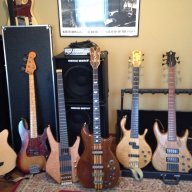
I bring a bass that will work for me to play the music in case my primary craps out. But it's not matching in the sense that it's not an identical bass. Usually (lately) I am playing a 6 string fretted. I usually bring another 6 string fretted, but usually one is a J and one is a P. Sometimes, the backup is a 5 string Sterling H. The point is, it's not "matching".
And bringing a "complimentary" bass, as your examples indicate, would suggest that I'm bringing 2 basses, so I can switch depending on the song. That's not the case. If my gig calls for fretted, then I would not bring a fretless as a backup. If I did bring a fretless, it would be to use it on specific songs. I don't bring a second bass for the purpose of switching back and forth based on the song (usually, anyway).
So, I voted for Yes, matching. But, my real answer would be "Yes, the backup is any old bass that will work for the music in case the primary dies." So, it might be matching or it might not.
It is too easy to step on a cord and break an output jack. Or have an accident and break off a headstock. Or whatever. There's a million ways even a passive bass *could* croak in a way that is not easily fixable at a gig. So, if I'm getting paid to play, I come prepared for at least one bass-killing accident/failure.
When I'm gigging a tube amp (which is 99% of the time), I bring a backup amp, too. A small, light, Class D with more power than any of my tube amps have. Same reason.
I'm not a pro. I don't make my living playing music. I am a semi-pro. I do get paid (roughly, beer money) to play. Even though it's "semi" pro, I choose to do the job as I would expect any professional to. I.e. be prepared for foreseeable problems.