• TalkBass has been independent since 1998. Add your voice.
    Create a free account to reply to discussions, view embedded media, and browse with fewer display ads.
    Join freeLog in
    Want zero display ads or expanded classifieds tools? Compare plans.

Do you care about the Space Program?

Space exploration is expensive, no doubt.... however, it is only a fraction of the cost of military spending. I'd gladly see a 50% reduction in military spending with those funds going into space exploration, alternative energy, famine relief, education, and a whole lot of other things....
 
Space exploration is expensive, no doubt.... however, it is only a fraction of the cost of military spending. I'd gladly see a 50% reduction in military spending with those funds going into space exploration, alternative energy, famine relief, education, and a whole lot of other things....

I find it funny how political ideology is creeping into this conversation.:rolleyes:

Just kidding...kind of hard to talk about where you'd rather see the money go without it sounding political isn't it?
 
I find it funny how political ideology is creeping into this conversation.:rolleyes:

Just kidding...kind of hard to talk about where you'd rather see the money go without it sounding political isn't it?

A common criticism of space exploration is based on the expense. But if we're going to be making such a criticism, why not look at where all of the money goes and consider reallocating that spending if it seems expedient?
 
On a related point, I have heard that they are going back to regular one piece rockets with nose cone payloads. They are better for aerodynamics, and safer than the shuttle setup. There is too much going on with the shuttle and too many surfaces that are very easily damaged. A regular cylindrical rocket is less risky as far as that goes.

I agree that they need to start thinking infrastructure to make space usable and able to produce things, rather than putting a bunch of space junk out there. The worst thing we can do is put a ton of raw materials into space to just get lost.
 
Yes, from what I've read the recyclable aspect of the Shuttle program has turned out to be much less economical than originally projected. Also, NASA lost a lot of paying customers after losing two shuttles. Those customers have since moved to other more reliable methods to put their payloads into orbit. From what I understand, the new rockets are derived from the old Saturns, but with the option of using solid boosters for additional thrust.
 
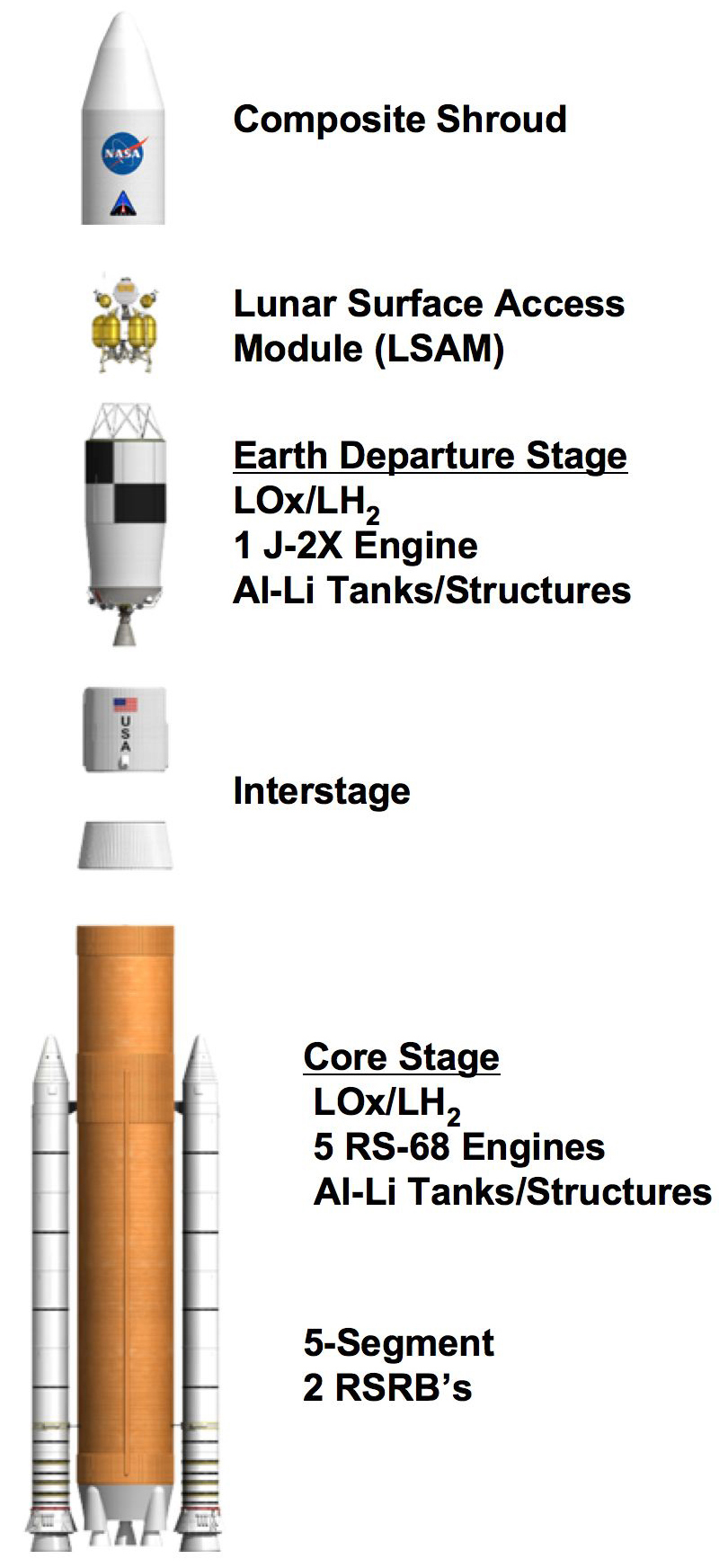
Drawing of the proposed Ares V heavy launch vehicle which uses some shuttle and some Saturn technology:

Ares_V_Exploded_View.jpg
 
NASA is abandoning the winged vehicle design, like the Space Shuttle, as it is too costly and too inherently risky.

The Space Shuttle is the way it is because of a conscious effort to produce an "all purpose vehicle". This has turned out to be less than successful in NASA's estimation and many regard this move as the equivalent of putting all of our eggs in one basket.


NASA's New vehicles will be more specialized.

Orion crew vehicle:
[Invalid or Expired Link Removed]

Ares launch vehicles:
[Invalid or Expired Link Removed]
 
One crucial point about rocket technology:

Solid rocket boosters generate a lot of thrust (as much as 3 million lbf per engine) but are inherently dangerous with a catastrophic failure rate as high as 1% per use.

Complex rocket engines don't have as much thrust (less than 300,000 lbf per engine), and even with many moving parts have a lower failure rate, and then only shut down rather than take themselves out along with the rest of the vehicle and crew.

Solid rockets are necessary when lifting heavy payloads into orbit but for safety's sake it may be prudent to limit their use with manned crews and small payloads.


[Invalid or Expired Link Removed])

http://en.wikipedia.org/wiki/Space_Shuttle_Solid_Rocket_Booster
 
You should stop pumping money into space and instead start focusing on the planet you live on. :scowl:

The irony is that that very IDEA is a direct result of the space program. The whole "save the planet" movement only exists in its current form because of the way NASA captured images showed the planet in a wider context. Would anyone be talking about "the planet" if we'd never seen a photo of it as single object? If you talked about "the planet" pre-space exploration you'd have either got a "huh?" or "which planet?". Earth only became recognisable as a planet once we could stand outside it.

NASA is the biggest win the green movement ever got. Global warming/Ozone layer holes were only really identified through satelitte imaging.

Personally I think the whole thing has lost it's drive. I'm too young to remember the moon landings. As a kid I remember the shuttle being delayed, and finally launching mid 70's. What's happened since then? Pretty much nothing. I think Bush promised that in 20 years America would have the technology to get as far as the moon (and after that Mars), but that must have been the dementure talking - he's obviously forgotten that we already know how to do that.
 
IMO, we need to consider not only life on Earth, but also the long-term prospect of spreading life beyond Earth. The only way to do that is to invest in active research and development, which requires an active space program. Another way to look at it is that space exploration is a requirement for the future survival of terrestrial life.

+1 - Absolutely ... I couldn't have said it better.

Some day we will develop new energy sources to move outward ... I wish I could be there to see it :hmm:
 
You should stop pumping money into space and instead start focusing on the planet you live on. :scowl:

I agree......... Perhaps Norway will pick up the slack regarding exploration.:hmm:


Exploration is in our DNA. It made us wonder what was over that hill. It made us build boats and ships and cast off to see what was out there. Space is the next thing....

An earlier post reflected on the many practical things the space program has brought to the world. I think more than that is the gift of wonder. For my generation (Apollo) NASA represented what the best and brightest could do when they weren't making bigger and better ways to blow things up.

It's hard to explain to anyone that wasn't around what is was like to see men walk on the moon. And to do it using technology that is just laughable by modern standards.

NASA still tries to be an agent for research and inspiration today. Sadly, they have to do it on a budget that is less than the Army spends for green paint.

If you really think that a space program is a waste ask yourself why every major industrialized nation has one (or shares one). It's how a people push themselves forward.
 
I agree......... Perhaps Norway will pick up the slack regarding exploration.:hmm:


Exploration is in our DNA. It made us wonder what was over that hill. It made us build boats and ships and cast off to see what was out there. Space is the next thing....

An earlier post reflected on the many practical things the space program has brought to the world. I think more than that is the gift of wonder. For my generation (Apollo) NASA represented what the best and brightest could do when they weren't making bigger and better ways to blow things up.

It's hard to explain to anyone that wasn't around what is was like to see men walk on the moon. And to do it using technology that is just laughable by modern standards.

NASA still tries to be an agent for research and inspiration today. Sadly, they have to do it on a budget that is less than the Army spends for green paint.

If you really think that a space program is a waste ask yourself why every major industrialized nation has one (or shares one). It's how a people push themselves forward.

A-freakin'-men.

Societies in the past that have turned inward have eventually collapsed or become a shell of their former selves (Roman Empire, British Empire - no disrespect to our British friends intended!).

Human nature drives us to see the new, do that which has not been done, to be there, that place which we put the first human footprint. Not all humans, but enough that it MATTERS to keep moving forward. Doing otherwise is stagnation.

There are a million and one reasons to continue to support manned missions and unmanned missions in space, not the least of which is that for us to ensure our continued existence on this little ball of rock, mud, and water, we need to be certain to know very well what else is whizzing about in the same general vicinity of the universe, and be able and prepared to deal with it. In other words, take Deep Impact seriously - the threat of an asteroid or comet strike, and the resultant destruction, up to and including the elimination of all life on this planet, is very real, it has happened, and it isn't a matter of will it happen again, it is a matter of WHEN will it happen again. Anything less than a robust manned and unmanned space program is the species equivalent of an ostrich sticking its head in the sand and hoping the lion doesn't see it.

What good is diverting the puny amount of funding given to NASA to "other causes", when failing to use that funding to continue to be aware of what is going on around us, both on the planet (remember, without remote-sensing satellites, we wouldn't have anywhere near the information about the condition of our environment!) as well as that which will eventually threaten it from outside could end all life on the planet? To do this, to end space exploration, is to doom our race to its end, in my opinion.
 
A-freakin'-men.

Societies in the past that have turned inward have eventually collapsed or become a shell of their former selves (Roman Empire, British Empire - no disrespect to our British friends intended!).

Human nature drives us to see the new, do that which has not been done, to be there, that place which we put the first human footprint. Not all humans, but enough that it MATTERS to keep moving forward. Doing otherwise is stagnation.

There are a million and one reasons to continue to support manned missions and unmanned missions in space, not the least of which is that for us to ensure our continued existence on this little ball of rock, mud, and water, we need to be certain to know very well what else is whizzing about in the same general vicinity of the universe, and be able and prepared to deal with it. In other words, take Deep Impact seriously - the threat of an asteroid or comet strike, and the resultant destruction, up to and including the elimination of all life on this planet, is very real, it has happened, and it isn't a matter of will it happen again, it is a matter of WHEN will it happen again. Anything less than a robust manned and unmanned space program is the species equivalent of an ostrich sticking its head in the sand and hoping the lion doesn't see it.

What good is diverting the puny amount of funding given to NASA to "other causes", when failing to use that funding to continue to be aware of what is going on around us, both on the planet (remember, without remote-sensing satellites, we wouldn't have anywhere near the information about the condition of our environment!) as well as that which will eventually threaten it from outside could end all life on the planet? To do this, to end space exploration, is to doom our race to its end, in my opinion.

You think picking on Norway was mean???;)
 
Bass players are a nerdy group. For instance they know the difference between solid and engine thrust in foot pounds! That's weird.

Medical monitoring, hand held battery powered tools, and materials research are just some of the things that have rolled into our lives from the NASA boys and girls. Not to say that they haven't wasted bucks with pure metals where alloys would have worked, or zero gravity pens (instead of using a crayon or pencil).

While I struggle with justifying the bucks on space when we could use work on bridges and highways, I think we could afford both.
 
zero gravity pens (instead of using a crayon or pencil).

This is often quoted as NASA doing the clever thing instead of the smart thing. HOWEVER... what would be the consequences of you snapping the point of your pencil in zero G? Tip drifts off... where did it go? Not to worry - sure graphite is conductive, but it's not like there's any essential equipment around here.

Crayon might work, but only if they build their rockets out of old egg boxes and washing up liquid bottles ;-)