• TalkBass has been independent since 1998. Add your voice.
    Create a free account to reply to discussions, view embedded media, and browse with fewer display ads.
    Join freeLog in
    Want zero display ads or expanded classifieds tools? Compare plans.

Do you play Bass through a solid state or valve?

Ooooh--nice. I LOVE 12"s---bet it sounds chunky with that amp!

Yep! 12's Do have that really full pound sound. It took me a while to get back to where I started from in 1968. TUBES & 12's!

mtcesNM.png
 
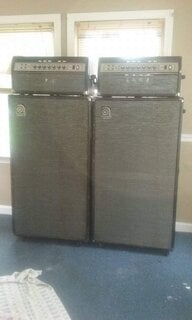
My avatar isn't as size representable as the actual setup. It's an Ampeg SVT-212AV, not the refrigerator.
QIg3Sct.gif
But, it does pound a great rock sound.

KYWQNPm.png
I'm going to ask a ridiculously nooby question here, but I've never owned a tube amp and have never asked these kind of questions because I feel a bit embarrassed to do so as everyone else expects you to know these things unless you're a total beginner...

The top part is the amp, comprised of a preamp and a speaker, the bottom part is a cabinet speaker, which is not NEEDED as just the top part will do the job, but you connect a cabinet to the main amp to get more volume and a possible change of tone, am I right? Further more, you can use different brands and types of cabinet with your amo head in order to get different tones?


That's what I understand from using amp modelling pedals anyways...


Also, as far as I've understood, you often mic up an amp with different types of microphone and in a different part of the amp or cabinet to pick up different variations of the tone, depending on the placement, mic etc...?

 
  • Like
Reactions: gsgbass
I'm going to ask a ridiculously nooby question here, but I've never owned a tube amp and have never asked these kind of questions because I feel a bit embarrassed to do so as everyone else expects you to know these things unless you're a total beginner...

The top part is the amp, comprised of a preamp and a speaker, the bottom part is a cabinet speaker, which is not NEEDED as just the top part will do the job, but you connect a cabinet to the main amp to get more volume and a possible change of tone, am I right? Further more, you can use different brands and types of cabinet with your amo head in order to get different tones?


That's what I understand from using amp modelling pedals anyways...


Also, as far as I've understood, you often mic up an amp with different types of microphone and in a different part of the amp or cabinet to pick up different variations of the tone, depending on the placement, mic etc...?
On my Fender head, it's just the power part of the amp. The Ampeg cab is the speaker, part of the amp. My setup has to have the cab for sound. The head is only the powerhouse. You can use different combinations of heads, and cabs, as long as they are compatible for, wattage, and impedance. Different size speakers do give a different sound. I don't use pedals, so may need some more answers from some others.
 
  • Like
Reactions: FuzzFacetious
I'm going to ask a ridiculously nooby question here, but I've never owned a tube amp and have never asked these kind of questions because I feel a bit embarrassed to do so as everyone else expects you to know these things unless you're a total beginner...

The top part is the amp, comprised of a preamp and a speaker, the bottom part is a cabinet speaker, which is not NEEDED as just the top part will do the job, but you connect a cabinet to the main amp to get more volume and a possible change of tone, am I right? Further more, you can use different brands and types of cabinet with your amo head in order to get different tones?

That's what I understand from using amp modelling pedals anyways...
Nope, top part is the amp, or head, which has the preamp and power amp. Bottom part is the cab with the speakers. Now with guitar amps, it's not too rare to see tube combos with it all built in together, but it is with bass amps. Bass combos are almost always solid state.

Also, as far as I've understood, you often mic up an amp with different types of microphone and in a different part of the amp or cabinet to pick up different variations of the tone, depending on the placement, mic etc...?
True.
 
  • Like
Reactions: FuzzFacetious
(I'm going to ask a ridiculously nooby question here, but I've never owned a tube amp and have never asked these kind of questions because I feel a bit embarrassed to do so as everyone else expects you to know these things unless you're a total beginner...)
The question is never ridiculous if you don't know the answer, and many players just use the stuff and don't much care how it works, but more how it sounds.
Within the posts in this topic quite a few technologies are being discussed. So here's some basics:
It's all about gain, your "electric" instrument (bass or guitar) has pickups which are transducers. The convert the string vibration into a small (representative) electrical signal. From passive PUs (another topic) the output is generally millivolts. Active PUs (require power 9volt battery, phantom powered) have a pre-preamp in them to boost (add gain) the signal to a level useful to the next stage, the preamp (thus active PUs often have a higher output than passive). The preamp boosts (adds gain) the millivolt signal to volts (around 1 volt (sometime called nominal voltage)). To add this gain, you can use vacuum tubes or solid state (particular transistors). Some of the discussion here is about this gain stage i.e. do you prefer tubes or solid state preamps. The preamp is where the majority of the "amp" tone is made, and includes tone controls (eq) and other useful circuits e.g. compressor. The next stage is the poweramp, it's job is to take the 1(ish) volt signal from the preamp and boost it (add gain) and convert it (into AC voltage/current (measured in watts)) so it's suitable for the speaker(s) which are also transducers (convert the AC signal into sound (compressions and rarefactions (sound waves) in the air)). Poweramps can use tubes (power tubes) or SS (output transistors) to do this. Again much of this discussion.
The amp you asked about, a Fender Super Bassman (Super means better ? LoL), is what is commonly referred to as a "head". It has a preamp and poweramp combined into the same chassis (bolted inside a wooden box). Importantly they share a common power supply (which means they influence each other more than if they didn't share it).
The majority of this discussion has been about "analogue" audio equipment (tube and SS), digital circuits are made from SS components including gazillions of transistors (in ICs, CPUs etc), but these transistors are on/off switches, not audio gain devices. Again another topic to itself.

So hybrid as discussed here means a combination of tube and SS. E.g. Tube preamp, SS poweramp or SS preamp and Tube poweramp, they don't have to be in the same box (although sometimes are). So you can use a X preamp with a Y poweramp into Z speakers. Also there are many choices for X and Y and Z which can all be combined to taste. As previously posted there some electrical and physics constraints, if you have a 500w poweramp and plug it into a 100w speaker cab, you can blow the speaker up (burn its voice coil). Also poweramps are designed to run into curtain "loads" (resistance (loosely impedance but is more complicated)). each speaker has a nominal impedance (generally 4, 8 or 16ohms). You need to match both the overall speaker impedance (ohms) and the overall power handling capability (watts) to the poweramp.

There's also many references to class D (mostly in the poweramp context). The various "classes" (A, B, D etc and combinations) refer to the way the gain is applied to the signal to increase it within the circuit. Look them up on wikipedia for detail. Simplistically class A the +ve and -ve side of the signal (think complicated sign wave) are not separated, very accurate but a bugger to get lots of watts from, so mostly used in preamps. Class B (sometimes called push/pull) the signal is split into +ve and -ve, each is amplified (gained) then recombined into the speaker. The majority of guitar and bass poweramps are class B. Class D is not analogue (Class-D amplifier - Wikipedia, the free encyclopedia) but, from comments here, sound good and are very lite and efficient.


(Also, as far as I've understood, you often mic up an amp with different types of microphone and in a different part of the amp or cabinet to pick up different variations of the tone, depending on the placement, mic etc...?)
And you'd also probably take a direct feed from the instrument and the preamp (if you can).

Anyway, sorry to ramble on, hope it helps you understanding and if I got any of it wrong I'm sure others will chime in..
 
Yes.


Downsized by Fender 100T/4x10 combo but loved it! Still have a Genz Streamliner 900 hybrid and recently bought a Glockenklang Blue Soul. Just different kinds of wonderful! Cabs now are Accugroove - 2x Tri112 and a Tri-115.

Dan
 
Exactly. There's something to be said for "set it and forget it" rigs, for me that's a P-bass into SVT + 8x10s.

Portability and context of the situation are big factors as well. Like you said, studio work versus gigging is a big difference in needs. Not to mention, if you have roadies then who cares how heavy your rig is? It's not like you have to carry it around. If you're schlepping 2 SVTs and 4 8x10s cabinets around for a $75 gig, chances are that is going to get real old real fast.


But to answer the OP's question, I am not averse to tube rigs, I've owned several, but right now my GK stuff is doing the trick for me. I'm particularly liking the Avatar neo cabs with them, it's a real good combination to my ears. Sounds big and thumpy with my flats-loaded P bass, aggressive and grindy with my punk P-bass or Ibanezes. One thing I prefer about the SS rigs is how they react when the volume is turned up. You can get a decent sound, then turn up the master volume to get more of that same tone. A lot of times my tube amps would change sound once I started to crank up the master or gain to get more volume...that got annoying trying to re-EQ a lot.
Well I prefer an Old Ampeg SVT but since I've aged slightly I use a solid state SWR with wheels.
 

Attachments

  • image.jpeg
    image.jpeg
    448.9 KB · Views: 57

Latest posts