
Enjoy the benefits of a premium membership!
Upgrade Account
-
TalkBass has been independent since 1998. Add your voice.
Create a free account to reply to discussions, view embedded media, and browse with fewer display ads.
Join free Log in
Want zero display ads or expanded classifieds tools? Compare plans.
You are using an out of date browser. It may not display this or other websites correctly.
You should upgrade or use an alternative browser.
You should upgrade or use an alternative browser.
Do you practice plugged in?
- Thread starter adudenamedruby
- Start date
More options
Who Replied?

Point taken: If you intend to pluck/pick hard on stage, then practicing unplugged will be fine -- you ought to practice the way you intend to play. Personally, though, I'm a believer in the idea that plucking/picking more softly enables you to play with more speed, accuracy and nuance, and so the goal should be to do that despite the "group, energy, excitement, etc." that you feel on stage, you should try to maintain a gentler touch. From that perspective, it's better to practice with an amp -- turned way up to force you to play softly -- than to play unplugged. Of course, YMMV.
Ideally technique would be separate from the volume of the amp. The rationale is when we play in an ensemble, we are often asked to turn up or turn down without regard to what we want. I.E. you rarely can hear as well as you want. At least this is true for me since I am naturally a bit of a control freak and perfectionist.
I have a fairly light technique, but it's not the lightest. I find that a certain balance of resistance and force leads to optimum speed. It can be very difficult to maintain the necessary balance if I am focused on how well I hear. This is something I have struggled with immensely since I am fascinated by sound. It got a lot easier once I stopped chasing "good tone" and started just playing.


I think I didn't express myself well. I don't necessarily intend to play hard on stage, but that's what happens when you let the energy flow. First, no, you should not always try to maintain a gentler touch, it's not appropriate for certain styles of music. Some styles are all about energy, not gentleness. Second, if you have a great level of control with your instrument, you can play soft or hard equally well. In fact, I think that you should.Point taken: If you intend to pluck/pick hard on stage, then practicing unplugged will be fine -- you ought to practice the way you intend to play. Personally, though, I'm a believer in the idea that plucking/picking more softly enables you to play with more speed, accuracy and nuance, and so the goal should be to do that despite the "group, energy, excitement, etc." that you feel on stage, you should try to maintain a gentler touch. From that perspective, it's better to practice with an amp -- turned way up to force you to play softly -- than to play unplugged. Of course, YMMV.
I also tend to believe that some people don't like to play unplugged because it uncovers their sloppy technique and other flaws they don't want to hear.

Important to distinguish practice and practice:Unless you play unplugged, you should practice plugged in.
1) Practice, as in learning songs. You should play as you'd perform.
2) Practice, as in developing technique. You should practice however best facilitates developing what you're working on.
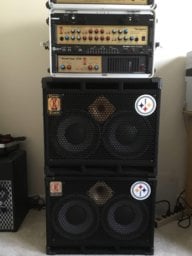
I'm curious how others practice the majority of the time.
Personally, I plug into Rumble 40 about 90% of the time. I practice from 6pm to 9/10pm on weekdays. I live in an apartment, so I don't want to go past 10. If I do go past it, I have one of those mobile VOX preamps that I'll plug in. I rarely practice without being plugged in.... though I feel like it's easier to just pick up your bass and play without worrying about that.
I have a couple of Eden combos that are great. Of course at 320 watts each, needless to say, I don’t crank them/
As a regular gigger with Guild then Dearmond Ashborys I practice unplugged. It is way quieter than an EB unplugged. Resting the headstock on the clavicle causes huge resonance through my body. I began to know every aspect of the Ashbory body and the subtle fundamentals and overtones on every bit of each string. Then when it comes to live playing there’s no undiscovered country. The bass is mine and one with me so my musical thoughts get transferred immediately.
I think those of us who do this with our EBs hear the tone of our basses as the starting or end point we amplify. Even through effects we know what our bass’s sound is.
From unplugged practice I’ve learned to almost immediately judge whether a new bass I’m auditioning is right for me. The feel through my hands and body are a sure impression of the new bass’s resonance and rigidity. So in the store I know before I plug in. I’ve been wrong once because after a long distance purchase a string swap made huge a transformation. Yes that bass sounded meh plugged in before the swap.
I think those of us who do this with our EBs hear the tone of our basses as the starting or end point we amplify. Even through effects we know what our bass’s sound is.
From unplugged practice I’ve learned to almost immediately judge whether a new bass I’m auditioning is right for me. The feel through my hands and body are a sure impression of the new bass’s resonance and rigidity. So in the store I know before I plug in. I’ve been wrong once because after a long distance purchase a string swap made huge a transformation. Yes that bass sounded meh plugged in before the swap.

A DAW / Interface was not posted, but since the end result is headphones, I chose "headphone amp."
I have a family to consider and it just works best this way. Not to mention I play along to a lot of music as my primary method of practice and learning and it's just easier to control the mix this way.
Using this method, I watched two foot games... Got 6 hours of practicing and noodling in.
I have a family to consider and it just works best this way. Not to mention I play along to a lot of music as my primary method of practice and learning and it's just easier to control the mix this way.
Using this method, I watched two foot games... Got 6 hours of practicing and noodling in.
(snipped) I also tend to believe that some people don't like to play unplugged because it uncovers their sloppy technique and other flaws they don't want to hear.
I am the other way around, I tried unplugged but it's hard to hear all the unwanted noises I may make, like string noise, "harmonic" noise that I made, fret noise, buzzes.
The same reason I don't like using headphones plugged into my amp directly, I can't hear those noises. When I practice with headphones, they're always plugged into Palmer pocket amp, cause with that pocket amp, I can hear any noise I may make.

Groove Master
Commercial User
- Apr 22, 2011
- 1,808
- 1,291
- Disclosures
- Author of Groove 101, Slap 101 and Technique 101
Almost all the time these days in my UAD card with a plugins chain  and a virtual drums software (XLN, RMX)
and a virtual drums software (XLN, RMX)I think an electric instrument has two parts: the instrument itself and the amp. So using both is necessary to learn how to play the whole instrument/system.
On the other hand, learning to manipulate the unplugged instrument helps develop more tonal control when plugging in. So I think there is some advantage to some amount of unplugged practice.
I think the particular bass and strings also affect how satisfying it is to play unplugged. My bass happens to be very resonant, and in combination with my go-to strings, the tone of my unplugged bass is about the same as it is plugged in (assuming no whacky EQ adjustments).
The big caveat with playing unplugged is to not let it affect one's touch. I play with a light touch and let the amp do the heavy lifting, so I try to maintain that same touch if I play unplugged.
I'm actually kind of curious about these Noggin Rockers (sort of a stethoscope for electric instruments) as a halfway point between being unplugged and being amplified: Invalid Link Removed
On the other hand, learning to manipulate the unplugged instrument helps develop more tonal control when plugging in. So I think there is some advantage to some amount of unplugged practice.
I think the particular bass and strings also affect how satisfying it is to play unplugged. My bass happens to be very resonant, and in combination with my go-to strings, the tone of my unplugged bass is about the same as it is plugged in (assuming no whacky EQ adjustments).
The big caveat with playing unplugged is to not let it affect one's touch. I play with a light touch and let the amp do the heavy lifting, so I try to maintain that same touch if I play unplugged.
I'm actually kind of curious about these Noggin Rockers (sort of a stethoscope for electric instruments) as a halfway point between being unplugged and being amplified: Invalid Link Removed
I practice mostly early morning from around 5am, so its definitely headphones on for me, which I run through a Spectradrive. Then when I am looking at using an effect from my BH550 head I just run the Spectradarive into the amp head and the headphones from the amp head. Would love to practice more through the speakers but don't think I can afford another divorce!!
I like to practice amplified and do so 90% of the time. Part of what I'm working on is lightening my touch, letting the amp do the work. Until I get this down into my DNA plugging in is almost an imperative. The only time I don't plug in is late at night when I just have to noodle on my bass to unwind and don't want to disturb the neighbors.

Bass > mixer > headphones. Most of my time is practcing songs over mp3's on my iPod. I don't even have a working amp at home right now. Practcing how you play is a nice idea, but really, no matter what I do by myself, it's not like playing with my bands.
unless I’m practicing in exactly the same space with exactly the same conditions, it’s going to sound different. It’s not going to be the same room for me, not the same volume, etc so I don’t feel the need to practice with the exact same setup.
I usually play through a little headphone practice amp, although in the living room I have an old bass and I will sone times grab it and noodle a bit unplugged while watching TV.

Gary Willis is an excellent case in point - he's the living embodiment of what is possible with a light touch. Unbelievable even.I think I didn't express myself well. I don't necessarily intend to play hard on stage, but that's what happens when you let the energy flow. First, no, you should not always try to maintain a gentler touch, it's not appropriate for certain styles of music. Some styles are all about energy, not gentleness. Second, if you have a great level of control with your instrument, you can play soft or hard equally well. In fact, I think that you should.
So my take is: you can play energetic and "rough" even with a soft touch - but you need to have perfect control over your technique. Which aligns with your point, I think.
(One thing that works for me is to switch between free stroke and rest stroke depending on how "rough" I want to sound)

I have practiced unplugged for years. I developed reoccurring tendonitis in my arm, and finally wentto the doctor. He's also a bass player, and said to plug in. He explained that unplugged I am changing how I pluck, finger style, and it was causing the issue. I have been plugging in for a year now, and have not had any issues since.
So for me, it's now plugged in.
So for me, it's now plugged in.
Yes, I see what you mean and I agree with you in a way. What I meant was that a light touch produces a certain sound, you cannot go against it. if you want other types of sound, it may be necessary to accentuate your attacks in order to get something more aggressive sounding. Simply increasing the volume does not sound the same at all.Gary Willis is an excellent case in point - he's the living embodiment of what is possible with a light touch. Unbelievable even.
So my take is: you can play energetic and "rough" even with a soft touch - but you need to have perfect control over your technique. Which aligns with your point, I think.
(One thing that works for me is to switch between free stroke and rest stroke depending on how "rough" I want to sound)
May I ask you why you didn't stop when it started to hurt? What I understand is that you had a problem with your technique.I have practiced unplugged for years. I developed reoccurring tendonitis in my arm, and finally wentto the doctor. He's also a bass player, and said to plug in. He explained that unplugged I am changing how I pluck, finger style, and it was causing the issue. I have been plugging in for a year now, and have not had any issues since.
So for me, it's now plugged in.
I didn't think playing was the cause. I thought it was something I was doing at work. Didn't realize playing was exasperating the issue.
My problem is i pluck much harder and at a different angle then when I'm plugged so I can it better (my hearing is severely damaged). When I can hear myself, I use a much lighter touch.
My problem is i pluck much harder and at a different angle then when I'm plugged so I can it better (my hearing is severely damaged). When I can hear myself, I use a much lighter touch.
Ah, I understand. I think you did well, in this case.I didn't think playing was the cause. I thought it was something I was doing at work. Didn't realize playing was exasperating the issue.
My problem is i pluck much harder and at a different angle then when I'm plugged so I can it better (my hearing is severely damaged). When I can hear myself, I use a much lighter touch.
Often, from experience here, the cause can be as far up as in the neck. “The knee bone is connected to the chicken boneI didn't think playing was the cause. I thought it was something I was doing at work. Didn't realize playing was exasperating the issue.
My problem is i pluck much harder and at a different angle then when I'm plugged so I can it better (my hearing is severely damaged). When I can hear myself, I use a much lighter touch.
.” This is why localized surgeries reveal themselves to be ineffective. The pain returns. Solution, chiropractic or good manipulative PT.


