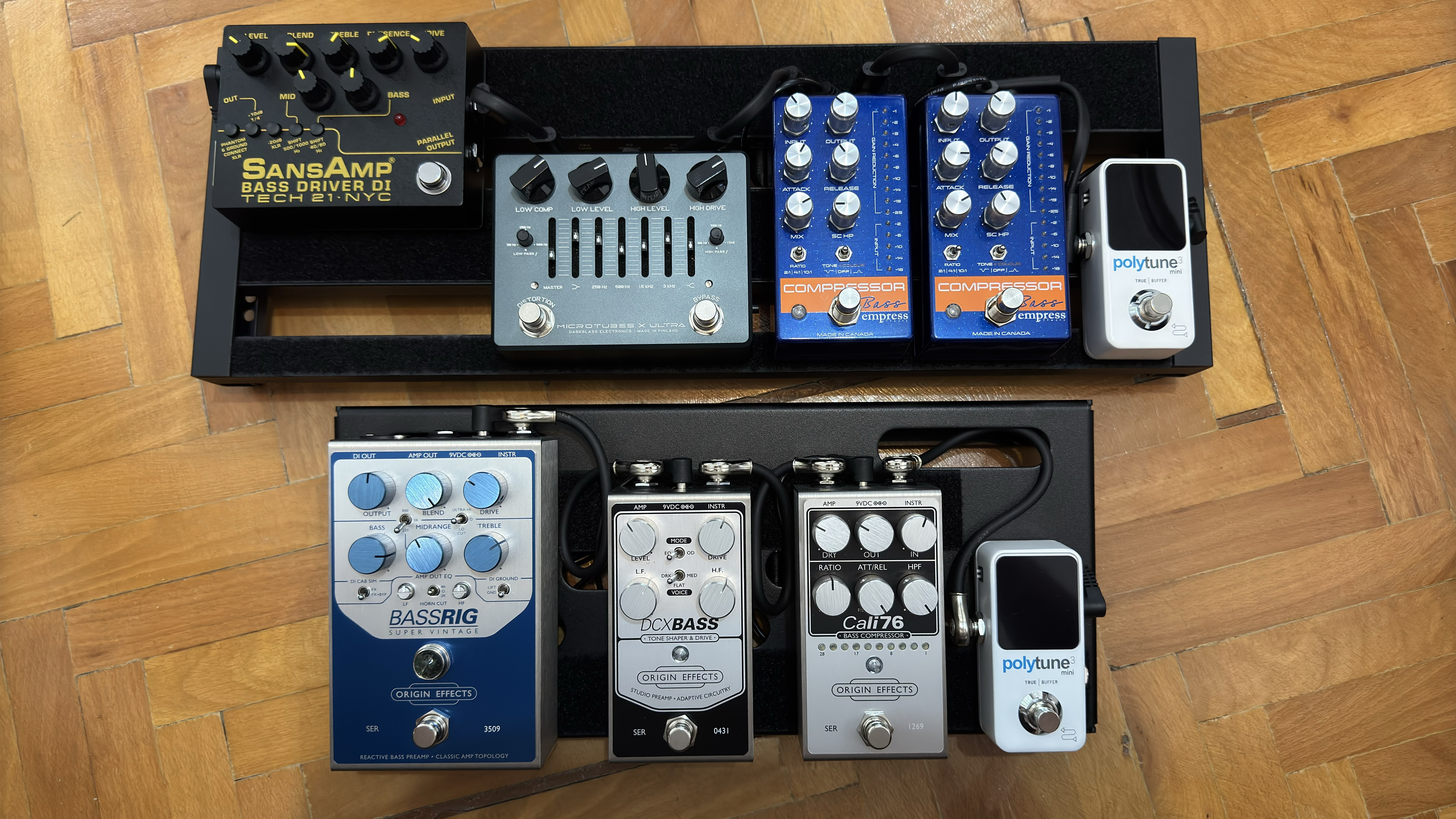
How many of y’all run double DI’s? For example a Darkglass preamp + a REDDI or some other tube DI. Or two different SansAmps in parallel. Post your double DI rigs here, I’m curious! Or perhaps you use a Geddy Lee preamp, which counts I guess. I want to see parallel processing signal chains.

Enjoy the benefits of a premium membership!
Upgrade Account
-
TalkBass has been independent since 1998. Add your voice.
Create a free account to reply to discussions, view embedded media, and browse with fewer display ads.
Join free Log in
Want zero display ads or expanded classifieds tools? Compare plans.
You are using an out of date browser. It may not display this or other websites correctly.
You should upgrade or use an alternative browser.
You should upgrade or use an alternative browser.
Do you run two DI’s in parallel?
- Thread starter Azari
- Start date
More options
Who Replied?

I do that when I record. When playing live I like to send the sound guy one mono signal, but because I use a Sansamp I mix my clean signal with the amp simulation anyway. I'm a sound person myself, but I don't trust sound persons regarding the balance. Most of them won't be happy when you send them two signals anyway.
It seems like it’s fairly common to run a mic’d cab + a DI. Why is two DI’s somehow worse?I do that when I record. When playing live I like to send the sound guy one mono signal, but because I use a Sansamp I mix my clean signal with the amp simulation anyway. I'm a sound person myself, but I don't trust sound persons regarding the balance. Most of them won't be happy when you send them two signals anyway.
I am considering grabbing a Radial Mix 2:1 DI box to combine my two XLR’s into one just in case a sound guy refuses to use 2 inputs.
Running two signals to FOH does make sense though… The way I do it is I use one channel with scooped mids and more bass, and another channel with more mids and less bass. This helps the soundguy tailor the sound to the room and other players better, theoretically…. I haven’t tried this setup at a gig yet though because my guitarist and drummer are both on maternity hiatus.

Last edited:
It's not worse but less convenient IME, and I just want to do the mix myself.It seems like it’s fairly common to run a mic’d cab + a DI. Why is two DI’s somehow worse?
I am considering grabbing a Radial Mix 2:1 DI box to combine my two XLR’s into one just in case a sound guy refuses to use 2 inputs.
I basically do that anyways by blending my direct signal with the amp simulation (which sounds like a miked bass cab) on the Sansamp.
When you send the sound person two signals, you never know how they are going to be mixed. One might get muted completely..
Last edited:


I have a time or two, but at someone else's request, not mine. A soundguy or a producer/recording engineer. I always attribute to those guys thinking too hard, but hey, it makes them happy and causes no problems to me..... 
Live, I just took whatever tube DI I brought at the time from the monitor desk to my ears and didn't take whatever they were doing with the other DI.
Recording, I seem to always like the end product, not really aware of how they processed the bass in the mix.
Live, I just took whatever tube DI I brought at the time from the monitor desk to my ears and didn't take whatever they were doing with the other DI.
Recording, I seem to always like the end product, not really aware of how they processed the bass in the mix.

The way I do it is I use one channel with scooped mids and more bass, and another channel with more mids and less bass.
I wouldn't find that helpful at all. Most audio techs prefer to take a DI off your bass. That way they start with a neutral signal and don't have to reverse engineer whatever EQ you dial into your rig to get your mojo on stage.
I could see the benefit of running one DI for clean and one DI for OD, or other effects. IMHO totally legit! However, this should primarily be done with audio techs you work with regularly. This sort of approach takes teamwork, experimentation, and time to develop.
I am considering grabbing a Radial Mix 2:1 DI box to combine my two XLR’s into one just in case a sound guy refuses to use 2 inputs.
How do you expect to blend the signals for optimum tone out in the house? There is a good chance the EQ blend that work bests for you on stage will not be optimum for the house mix. Again, I think this idea has some utility if you are talking about blending effects back with a dry signal, but not so much with blending two EQ curves.
My advice, work with really good audio techs who understands your artistic vision. Then, get out of their way so they can do their job.
Granted, my second bass channel with less bass and more mids also has more distortion on it, so it is kind of a clean/dirty situation.
In any case I can still get a satisfactory tone from just one of my preamps if necessary.
In any case I can still get a satisfactory tone from just one of my preamps if necessary.

We have a dual-channel setup at my church with the SansAmp BDDI v.2 and the Radial J48.
I also run my VT Bass DI and Q\Strip as two channels at home.
I also run my VT Bass DI and Q\Strip as two channels at home.

- Aug 21, 2003
- 11,607
- 18,655
- Disclosures
- A-Designs Mike Lull GK Tsunami Cables GHS Strings RMI Basswitch Nordstrand Pickups Darkglass
My experience has been best results are achieved, and sound crew made happiest, if a single, unaffected full range signal is sent to FOH. Do what you must to make yourself happy on stage (within limits), but let the professional out front do their job. After all, they can hear what's out front while those on stage can't.
D
Depending on the equipment/pedals in each signal chain it could result in severe phase issues. For example if you use the Origin "Bassrig" pedals which blend absolutely HORRIBLY with a parallel clean DI.
With DI + mic'ed amp (as in REAL amp) you can at least move the mic if needed.
So no, I would never run two parallell DI's unless it was a thoroughly tested setup, and even then I would only consider doing it with a FOH engineer I know and trust 100%.
For recording... still no. I often use amp+DI, but recording two parallel DI boxes doesn't make sense to me, for the reasons explained above. If I wanted something like that I would rather do the parallel processing "in the box" with plugins, where I would have more control over potential phase issues. It doesn't take much phase shift to COMPLETELY change how the bass "sits" in the mix.
With DI + mic'ed amp (as in REAL amp) you can at least move the mic if needed.
So no, I would never run two parallell DI's unless it was a thoroughly tested setup, and even then I would only consider doing it with a FOH engineer I know and trust 100%.
For recording... still no. I often use amp+DI, but recording two parallel DI boxes doesn't make sense to me, for the reasons explained above. If I wanted something like that I would rather do the parallel processing "in the box" with plugins, where I would have more control over potential phase issues. It doesn't take much phase shift to COMPLETELY change how the bass "sits" in the mix.
I’ve been using two SansAmps, inspired by Geddy Lee’s signature model SansAmp 2112 which has dual XLR outputs for the same purpose. A cleaner one with more bass and a dirtier one with less bass. Though it has many possible settings… In my experience Tech 21 preamps play very nicely together & I’ve never had phasing issues with these. They emphasize quite different frequencies of course. Your mileage may vary when it comes to mixing & matching other gear in parallel though. Tech 21’s SansAmp RBI manual even has presets for parallel bi-amping intended for when you have two of the units… So I figured if it’s good enough for Geddy it’s good enough for me. BUT he has his own sound guy I’m sure he pays very wellDepending on the equipment/pedals in each signal chain it could result in severe phase issues. For example if you use the Origin "Bassrig" pedals which blend absolutely HORRIBLY with a parallel clean DI.
With DI + mic'ed amp (as in REAL amp) you can at least move the mic if needed.
So no, I would never run two parallell DI's unless it was a thoroughly tested setup, and even then I would only consider doing it with a FOH engineer I know and trust 100%.
For recording... still no. I often use amp+DI, but recording two parallel DI boxes doesn't make sense to me, for the reasons explained above. If I wanted something like that I would rather do the parallel processing "in the box" with plugins, where I would have more control over potential phase issues. It doesn't take much phase shift to COMPLETELY change how the bass "sits" in the mix.

I can get a much more detailed and powerful sound using two SansAmps together. The best pedalboard for metal
 lol
lol
Last edited:
D
Only for recording I have the DI on the Darkglass expose, live I use the SansAmp and the Darkglass only as a distorsion.
How often do you run both a mic’s and DI simultaneously? In my experience it’s an accepted method, and talked about on TalkBass a lot, but in the real world not very common.It seems like it’s fairly common to run a mic’d cab + a DI.
If I were to use two channels for bass that needed to be blended for FOH, I would want a dedicated sound guy to experiment and dial it in with. I have a feeling many house-hired sound guys will just mute one of the two bass channels in FOH, if they let you plug in two channels at all. Don’t get me wrong, I can see a benefit of running two channels, whether it’s two DI’s or a mic’s cab + DI, but if your sound guy doesn’t know what you’re after or you don’t know how they’re actually mixing it out front it could cause way more problems than benefits. I have different sound guys at every gig, so there’s no way I’m using two bass channels. I’m focusing on one channel that sounds killler. (Even with a killler sound plugged into the board, my FOH sound is still at the behest of each sound guy’s ears)


Was gonna ask the same thing. I can think of one (1) gig in the last 10+ years where the sound tech insisted in taking a DI line, and putting a mic on my cab. And that's across multiple countries/continents! It literally almost never happens IME, whether it's a pub gig, wedding/corporate function, or a soft seater/theatre (the kinds of gigs I get most frequently).How often do you run both a mic’s and DI simultaneously? In my experience it’s an accepted method, and talked about on TalkBass a lot, but in the real world not very common.
@Azari Where are you seeing so many live shows where the bass has a mic'd cab with a DI line to boot? And I'm not really counting the big time/properly famous bands, because that level of touring and production is well beyond the "norm" for the working pros out there.
I occasionally record with dual signals usually first going into Countryman Type 85, Behringer DI100 or RNDI active DIs for a dry signal then parallel out through various effects and preamps as needed thru a passive DI like a JDI. Live I strive to make my signal as "simple" and ready to go to FOH, backline or the powered speaker I generally use these days. I don't recall the last time I had a truly competent sound tech that I trusted to mix a dry and wet signal, most have their hands full trying to mix drums and vox satisfactorily much less adding a complex bass signal. YMMV
There two issues to worry about.In my experience Tech 21 preamps play very nicely together & I’ve never had phasing issues with these.
1. Some pedals invert polarity. Also the polarity may flipt between bypassed and active. This can happen with analog and digital pedals. It can also happen with amps that have switching features. For example, I believe engaging the driver circuit on my Ampeg SVT 8-Pro inverts the signal.
2. Digital pedals have another problem. Digital processing takes time, which causes the output to be delayed.
Neither of these typically cause audible problems if you only use the processed signal. Both can cause problems if you use parallel processing. Out of polarity signals cancel instead of summing. Combining signals with different amounts of delay results in comb filtering/phasing.
Latest posts
-
 The Bartolini BH2: Why Does It Sound So Dark? My EHB1265MS Experiments
- Latest: Riff Ranger
-

-

-

