with diamonds?Sean also plays a fretless StingRay so there’s clearly more to the story ie: he uses all the Pino instruments, and therefore is actually Pino in disguise.

TalkBass has been independent since 1998. Add your voice.
Create a free account to reply to discussions, view embedded media, and browse with fewer display ads.
Join free Log in
Want zero display ads or expanded classifieds tools? Compare plans.
with diamonds?Sean also plays a fretless StingRay so there’s clearly more to the story ie: he uses all the Pino instruments, and therefore is actually Pino in disguise.

What if you use EMG active pickups?I'm not sure I get the hi fi assumption of active basses.
I think too many pre amps are capable of sounding very clunky and use extreme permutations that are pretty useless.
And hi fi it ain't.
If the bass sounds good and you've got your thing down, start with a passive sound and use the active option for a slight enhancement.
If a bass doesn't work passively, its either you or the bass or both. That my take.


Phish, Dead and Panic. AKA improvisational hippie jam band music.


I’d bet you he’d rather have a ModulusA good friend is in such a band and their bass player is using a Yamaha
I think too many pre amps are capable of sounding very clunky and use extreme permutations that are pretty useless.


Mirrors of Embarrassment is my all time favorite album. its borderline obsessive actually. every other year i put the disc on and then in stays in rotation for at least 6 months before i change it.Or ARU or Jazz is dead

My favorite is this amp.The same could be said of the preamps on bass amps. Too many knobs is the devil’s plaything. Boost 800 Hz about 15dB and it’s instant clunk
View attachment 5265516
Luckily most of today’s class D amps have fewer controls because there’s no room for more
There’s also many active basses using EMG pickups and a bog standard passive tone control (LPF).

My favorite is this amp.
View attachment 5265858
 This is an old pic so my settings are different now - it's my rehearsal-space amp powering a Carvin 18" ported cab. I usually prefer simpler controls but once set to the room - I don't touch it. It never strikes me as being 'modern' sounding (I use the MIX setting combining/blending both sides), but I'm not going for a modern sound/tone.
I wouldn't say it was ignorance or any lack of ability or imagination on producers/engineers parts. I mean, think about it---when a P or J is pretty much a plug-n-play path to a solid bass sound in almost any genre, why wrestle with duck farts when the clock is ticking?[QUOTE "There's that story of Sean Hurley moving to L.A. with a five-string active Lakland to become a session player just to realize it's a P-bass world out there."]
Part of the reason that the P-bass was preferred by studio engineers is that, at least in the old days (late '60's/early '70's), EVERY engineer in L.A. knew what settings to use on the board to properly place the bass tone of a P-bass in the mix...some of them not only pled ignorance about how to handle active basses but even had problems setting levels on non-Fender passive basses (they frequently had trouble controlling the tendency of Gibson EB-0's and EB-3's to sound like mud or duck farts at even modest gain levels !).

My favorite is this amp.
View attachment 5265858
I hear you!
View attachment 5265897
I usually play my Hofner Ignition Club bass with nylon tapes I modified to have VVT controls straight to my amp. But, if absolutely necessary, I can add either my Boss GEB-7 or GE-7B Bass EQ, my SABDDI, or my Bartolini NTMB preamp I mounted in a box to the signal chain if I want more eq than available at my amp.
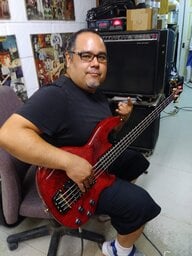
I wouldn't say it was ignorance or any lack of ability or imagination on producers/engineers parts. I mean, think about it---when a P or J is pretty much a plug-n-play path to a solid bass sound in almost any genre, why wrestle with duck farts when the clock is ticking?

I was talking specifically about the era Canejo Bajo was referencing, and the difference between recording a P or J of the day, vs something like an EB or similar as he discusses.Nathan East has probably been the most recorded of late, obviously he does all genres, and he uses his Yamahas for well over 35 years now.
But as some pointed out, why does it have to be plug and play for the bassist, when they'll spend hours getting a drum kit sound? Really, we're not that difficult.