• TalkBass has been independent since 1998. Add your voice.
    Create a free account to reply to discussions, view embedded media, and browse with fewer display ads.
    Join freeLog in
    Want zero display ads or expanded classifieds tools? Compare plans.

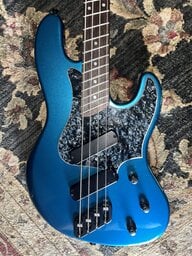
Does a top wood effect resonance?

Hey TB~. This has been bugging me lately..
Does a top wood, (regardless of the type), on an electric bass, change the resonance of the instrument, for better, or worse?
My suspicion is that it might if you're playing it unplugged, and it could be noticeable, but when playing through an amp,
probably not...IDK?
...and even that could vary depending on if it's a neck-through, or BO. Any thoughts?
Curiously~
 
Sure would like to see some actual data from blind or double blind tests instead of repeated assertions of things that seem to defy physics...

Did you read the thread I linked to? I think I explained it pretty clearly. And it's based on my own 30+ years of designing, building and testing electric basses. Plus my long career as a mechanical engineer. How does anything I've said defy physics?

I do my testing by playing basses through a normal amp and listening to them. Trying basses side-by-side which have controlled differences in design/construction. And having Pro Bassist friends of mine try them out too, and give me their reactions of if and how the sound is different. That's how we Luthiers do our testing and develop our instruments. We're not rigging the tests or falsely influencing the results. We want real answers to help us make our instruments better.
 
@Paul New, you've simply restated my point. No need for the " but ". Thanks for agreeing with me!
Don’t mention it. I did offer a way, very unscientific of course, to test for yourself.

And it’s a small point, but when the strings are moving and causing the body to vibrate also, then the pickups are moving too. Who knows if that causes cancellation, magnification, or most likely both and many vector combinations?
 
Last edited:
Try listening to your basses played unplugged, note their aural characteristics, and then plug them in and see if you think any of that unique acoustic quality carries over when amplified. I think it does, but as I said, this is about as unscientific as it gets.
Yes!
I do this quite a bit, and it seems to me that I could "feel" a difference in my basses, and the way they resonate in my hands..
..as well as an audible difference when amplified, so it's probably not just your imagination..
Surely this could fall under the category of "applied sciences"..? :thumbsup:
 
If I'm correctly understanding Bruce, I'd agree you may not hear a certain wood, but you certainly hear stiffness adding definition. This mirrors my experience.

Personally I think the biggest contributing to top wood resonance is density, just like neck stringers.
Think stiffness and the ability to transfer energy through the wood, More dense more able to resonate.

And really top woods should only be considered for aesthetic reasons.
An aspect that I had not considered..🤔
The effect of stiffness, and density of the wood, on the whole instrument...
Les Pauls are an interesting example~
 
Don’t mention it. I did offer a way, very unscientific of course, to test for yourself.

And it’s a small point, but when the strings are moving and causing the body to vibrate also, then the pickups are moving too. Who knows if that causes cancellation, magnification, or most likely both and many vector combinations?
As a thought experiment, try placing a piezo sensor at various locations on your pickups and see what you get. And then try muting your strings, cranking up your gain, and singing near a pickup, tapping on it. etc. It's not necessarily that small of a point in some cases, IME, but as usual it just depends.
 
Did you read the thread I linked to? I think I explained it pretty clearly. And it's based on my own 30+ years of designing, building and testing electric basses. Plus my long career as a mechanical engineer. How does anything I've said defy physics?

I do my testing by playing basses through a normal amp and listening to them. Trying basses side-by-side which have controlled differences in design/construction. And having Pro Bassist friends of mine try them out too, and give me their reactions of if and how the sound is different. That's how we Luthiers do our testing and develop our instruments. We're not rigging the tests or falsely influencing the results. We want real answers to help us make our instruments better.
Yes, but I think your post was probably one of the only ones not being referred to in his comment. The rest of this thread is pretty blurred with speculative opinion. :smug:
 
When an explanation purports to be scientific but uses these terms: Warmth, Coldness, Mushy, Muddy, Clarity, Fuzziness… I’m sorry but it is not objective science. Unless we can assign measurable values to those terms, it’s always going to be subjective and speculative.

I’m not saying that a thoughtful builder with tons of experience can’t build an instrument that sounds beautiful and exactly like he wanted it to sound, but that is art, not science.
 
  • Like
Reactions: Max Bogosity
When an explanation purports to be scientific but uses these terms: Warmth, Coldness, Mushy, Muddy, Clarity, Fuzziness… I’m sorry but it is not objective science. Unless we can assign measurable values to those terms, it’s always going to be subjective and speculative.

I’m not saying that a thoughtful builder with tons of experience can’t build an instrument that sounds beautiful and exactly like he wanted it to sound, but that is art, not science.

Those terms have all been defined as shapes of the waveform as seen on a spectrum analyzer. Someone has probably assigned numbers ranges in a paper somewhere. It is objective science, if you want to go there. With a splash of art. We Luthiers use those terms to communicate with our customers, the musicians, because that's how they describe the sounds.
 
Last edited:
  • Like
Reactions: Paul New