• TalkBass has been independent since 1998. Add your voice.
    Create a free account to reply to discussions, view embedded media, and browse with fewer display ads.
    Join freeLog in
    Want zero display ads or expanded classifieds tools? Compare plans.

Does anyone else play thumb-over?

Questions: "Is "good enough" good enough?" How many thumb over players would be better technically if they were instead thumb behind the neck players? How many of them are aware of their deficiency and wish they could change?

Until recently I am a self taught bass player. I'm thankful that I learned to play thumb behind the neck, but I picked up other bad habits because I didn't know any better. I wish I had learned proper technique from the start. Now, at 68, I am taking Scott's Bass Lessons' 26 week accelerated course to correct any bad technique. It's never too late to at least try new things, but you have to be committed because changing old habits is hard work. Having said that, there's nothing wrong with the status quo if you're happy with your playing.
 
You are a very naughty boy and your fretting hand should slapped by a ruler from a nun of the Order or Our Lady of the Low End.

Seriously, occasionally I'll thumb wrap on easy parts just to give the usual position a rest. Lately I'm playing Maiden's "Rhime of the Ancient Mariner" on a 5-string (I know, Harris is going to come after me with a ruler) and when I get to that slow chord section I thumb wrap to mute the B string.
 
I often hear how "wrong" it is to wrap the thumb around the neck. Try this. Turn on AXS TV sometime and watch a tribute concert..... one of those concerts where tons of legends show up and do a concert in honor of another artis. Dang near every guiyar players and half the bass players on stage are wrapping their thumbs and KILLING it up there.

So, while I don't do it, I certainly can't say it's "wrong".
 
It was drilled into me NOT to do it early on, so it felt weird to do it ever since. I’ve been told my left hand technique is good, but there are plenty of vastly better players than me who hang a thumb over. Somebody mentioned Squire, though in his case, he had huge hands, might have been more comfortable. My “good” technique may be helping with my mild onset of arthritis, hard to tell. If it works, do it!
 
  • Like
Reactions: pbass2
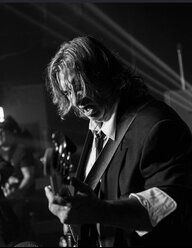
You mean like Darryl Jones is doing in the photo below? It's the standard rock bass technique; no worries. :)

479258592-jpg.754897

Biiiiig +1 :thumbsup:

Ronnie Lane also played that way.

And Chris Squire would use that technique from time to time as well.

So I say, play however ya want! :)
 
  • Like
Reactions: FRoss6788
Thumb on the neck behind the fore/middle finger is a double bass technique, not a guitar technique, lean more towards the 'guitar' part in the name of "bass guitar" and not the 'bass' part as far as technique is concerned.

If it works for you use it, so long as you wrists are straight and your angles are good you will be fine.
It may be restrictive.... so if it is adjust your thumb to a position where it is not.

Hand positions change, so thumb positions will change...its common sense and good ergonomics to do so.
 
  • Like
Reactions: FRoss6788
I do both. Anything I can do reach wise with thumb behind I can do with the thumb over. But I got pretty good mitts. And lots of time my thumb mutes the E. Lucky that way I guess. Right AND left hand muting.
 
I don't do it. I was told, when I started playing, that it's a typical rock pose.
Have you ever seen a flamenco or classical guitarist play like that?
Or a cellist or violin player?
Why? Because it's not practical or ergonomic.
I was also told that it will also hinder you finding a proper intonation and glissando on fretless. So I never picked it up, just followed the advice of the guys with over a decade of music school.
 
  • Like
Reactions: Watchootognbout
I do it all the time. After various injuries and nagging muscle/joint issues, the way I play on at any given time is highly dependent on whatever feels the most comfortable and pain-free at that time. A lot of what I do probably looks goofy, but it keeps me playing, and I have no issues executing my parts. However, I did put in my time learning to play with "recommended" technique and can certainly do it when needed.
 
Questions: "Is "good enough" good enough?"

I think this is a deeper and more complicated question that it might seem at first glance.

Obviously the intention behind the question is to ask whether someone should settle for "good enough" when they could always strive for "better."

However, I also think that someone could validly approach this question from a different perspective, along the lines of: If a player's fretting-hand technique is already "good enough" to cleanly execute the music they want to play, might there be better things to spend their likely limited time on then entirely breaking down and "fixing" their technique?

Speaking for myself, I know that there are always more ways in which I can improve my physical technique, but I'm in a place where I find it much more valuable to spend my time on writing songs/parts, improving my theory, and rehearsing parts from my band's set, and typically only dedicate serious attention to improving technique when I come across a part that I have difficulty executing or otherwise find that my technique is holding me back in some specific way.
 
It was drilled into me NOT to do it early on, so it felt weird to do it ever since. I’ve been told my left hand technique is good, but there are plenty of vastly better players than me who hang a thumb over. Somebody mentioned Squire, though in his case, he had huge hands, might have been more comfortable. My “good” technique may be helping with my mild onset of arthritis, hard to tell. If it works, do it!
I was surprised to learn how much Squire used it for playing chords and whatnot. I learned bass by playing along with Yes albums in the 70's, pre-Youtube, so I never knew he was doing that (which is probably good, because I most definitely do not have big hands, and I would have certainly attempted to mimic my idol!).
 
Last edited:
For guitar, you have to for true five finger chords.

on a standard tuned 6-string not really. you may argue that taking several strings with one finger makes not really true chords, but it's a part of standard technique.

however, if your guitar is a 7-string gypsy/russian one with DGBDGBD tuning, the answer is yes.
in fact, Cm there looks like 5545545, that would take 7 fingers to fret it, but in fact usually they use one finger for middle D and G strings on the 5-th fret and use thumb for the bass on lower 2 strings, so that's 5 fingers again.