• TalkBass has been independent since 1998. Add your voice.
    Create a free account to reply to discussions, view embedded media, and browse with fewer display ads.
    Join freeLog in
    Want zero display ads or expanded classifieds tools? Compare plans.

Does different tone cap affect when fully open?

Hello bass-friends,

since I want to be able to roll off a bit more of the highs on my '76 Aria Pro II Pbass (with Fender Original Pickup installed, 250 tone pot), I want to change the .67 cap to a .100. Now I always assumed that this would not make any difference when the tone is fully open, but maybe I'm wrong. I don't want to loose any of the highs, just be able take more out.

So is this correct?

Thank you all.
 
  • Like
Reactions: bdplaid
It does make a difference. The port full open still has the capacitor "visible" in the circuit.
Guys selling $30 tone caps love saying stuff like that at least. I carried out some test of my own so I don't need to put my faith in what others claim. It's not hard to ask a friend to help with a double-blind test, "throw the switch randomly but don't tell me it's position and write down my guesses". That should suffice for most of us that aren't electrical engineers or a marketing person for guitar parts reseller...
 
The above posts point to two sides of the same issue:
1) Everything makes a difference.
2) The real question is whether it makes an audible difference.
In my experience, I can't hear any difference between tone caps when the tone pot is dimed. I can hear a lot of difference when the tone pot is progressively rolled off. For example, my short scale travel bass and my Jaguar H mid scale bass both came with the .022 guitar tone capacitor instead of the conventional .047 bass tone capacitor. Since I play both guitar and bass, I could tell with one swipe of the tone knob. As soon as I could get them on my work bench, the control panel came off, the pots were changed from 500 to 250, the tone cap was changed from .022 to .047, and I got back nice, big, round, but still present, articulate, traditional bass tone. I even added a push-pull to the Jaguar to have the alternate of a .068 for a little more dub tone when indicated. YMMV.
 
  • Like
Reactions: Jefenator
Guys selling $30 tone caps love saying stuff like that at least. I carried out some test of my own so I don't need to put my faith in what others claim. It's not hard to ask a friend to help with a double-blind test, "throw the switch randomly but don't tell me it's position and write down my guesses". That should suffice for most of us that aren't electrical engineers or a marketing person for guitar parts reseller...

I was mostly commenting on the electric properties. Some people think that the capacitor is out of the circuit when the pot is full open, which is not true.

While I think I can hear differences between capacitor variants I do not think the expensive ones are better. And of course the difference is small. And $30 is not much money by the standards of gearslutting.

Disclaimer: I did the capacitor tests with guitar. I can easily imagine that I couldn't hear the difference with a bass.
 
Just to add: I tested this with good quality headphones with a clean preamp. With this setup, I can hear differences many claim don’t exist. I cannot hear differences in cap values with tone pot open.

It all matters far less in real-world playing conditions.

if you’re concerned about highs, no-load pots take the whole tone control out of the circuit. But then you will have more highs than a pot fully open.

actually, I suggest you simply buy the components (they’re cheap) and test it out using your equipment and ears.
 
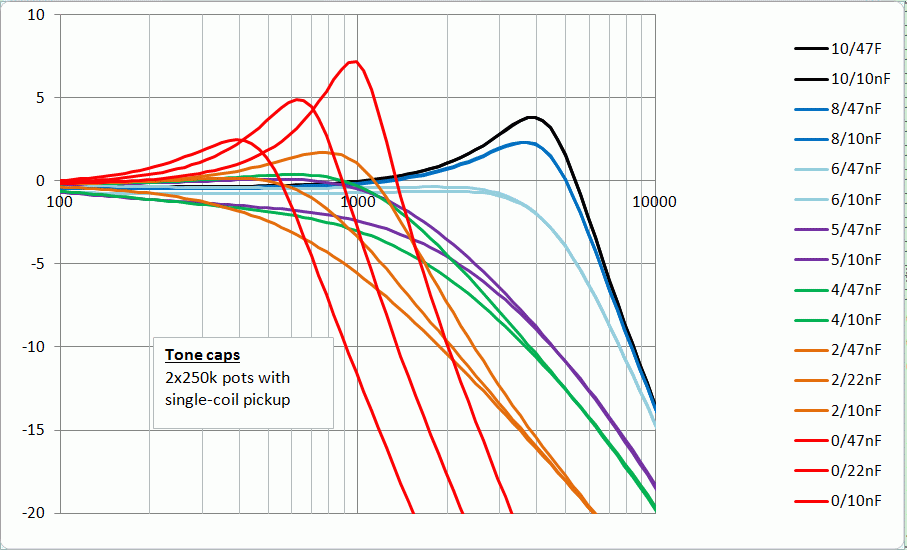
You won't be able to hear a difference, someone graphed it:

tonecaps250kSC_zps99d82e9e.gif


The effect of Tone Capacitors | GuitarNutz 2
 
  • Like
Reactions: markanini
You won't be able to hear a difference, someone graphed it:

tonecaps250kSC_zps99d82e9e.gif


The effect of Tone Capacitors | GuitarNutz 2

That assumes that the capacitor only has capacitance. In reality it at least also has inductance, and that is why different capacitors with same value printed on them can sound different.

A passive pickup is very sensitive to adding capacitance, resistance or inductance to it. It is part of the charm.
 
The reason different caps with the same value PRINTED on them sound different is because of the Tolerance. They're not actually the exact same value.
That won't matter at all when the knob is dimed, anyway.
 
  • Like
Reactions: mcnach
The reason different caps with the same value PRINTED on them sound different is because of the Tolerance. They're not actually the exact same value.
That won't matter at all when the knob is dimed, anyway.

No. On my (guitar) testing harness where I have 12 capacitors on a rotary dial I measured the exact value of the orange drop I have and then selected out of a 100 pack a ceramic disc capacitor or exact same value. A similar ceramic disk cap with slightly different value was already in there. The same-value capacitors sound different, and the two ceramic caps of different value more similar than the same-value one.

And I'm not the first one to run such tests.

As I said before, maybe I couldn't hear it on bass where less of the higher frequencies are present in the first place. But to see capacitors as a perfect monolith with no other properties is - in my experience - misguided.
 
It's rather odd that these claims of "I can hear it" are never accompanied by empirical evidence to support it.
The other values to worry about are drift, some caps will vary in value from just a temperature change, & some vary over time more quickly.
 
It's rather odd that these claims of "I can hear it" are never accompanied by empirical evidence to support it.
The other values to worry about are drift, some caps will vary in value from just a temperature change, & some vary over time more quickly.

What kind of evidence would you accept? I'm all for the Lemme school of guitar electronics and if you follow my posting history here and on TGP and SFUGF you will see that I usually do not subscribe to voodoo-eque sound differences. But in the specific case of different capacitors they are very easy to test for yourself and I ended up hearing differences.

Also compare to boutique amps that are made using very specific components including (usually expensive) capacitors. People pay big bucks for those because they think they hear a difference.
 
The graph above is a great example.
There's a similar one vis-à-vis pot values.

But the graph isn't measured from a real world pickup circuit, right? It is calculated from electrical values, assuming they are all perfect specimen. Not to mention it shows nothing more than the resonance peak cutoff frequency and amplitude. It's the Lemme school of guitar electronics. Obviously there is more to pickups that the resonance peak, even though the peak is of course very important.
 

Latest posts