
Enjoy the benefits of a premium membership!
Upgrade Account
-
TalkBass has been independent since 1998. Add your voice.
Create a free account to reply to discussions, view embedded media, and browse with fewer display ads.
Join free Log in
Want zero display ads or expanded classifieds tools? Compare plans.
You are using an out of date browser. It may not display this or other websites correctly.
You should upgrade or use an alternative browser.
You should upgrade or use an alternative browser.
Does 'Dirty Electricity' Exist?
- Thread starter Hurricane Jimmie
- Start date
More options
Who Replied?
Brownout conditions in the summer are very real. Here in the mid-Atlantic, DMV, when i was working on air conditioners, in particular, the Goodman capacitors on condenser fans were really susceptible. They would sell out. I don’t think “dirty power” is as accurate a description as insufficient power is. The Furman units don’t do anything to deal with this. If your AC voltage drops, the current picks up. In a residential situation, it shouldn’t be disastrous but it certainly isn’t good. When i was working in an industrial setting with three phase, we had a voltage reader that would drop to <410 volts and it presented problems. They had Dominion replace upgraded transformers but the only real solution would have been prohibitively expensive- a $2 million diesel generator. It was not cost effective. I cant see buying an inverter for gigs.


AFAIK, dirty power usually means noise or the shape of the sine wave is distorted. It definitely exists. May result in a noisy amp.
Another problem is the voltage may not be in the proper range. If the voltage drops too low the amp will be weak. If the amp has a protection circuit it may go into protect and stop working. IF the voltage is too high, I think there is significant risk of letting out the magic smoke.
Some amps have an auto-voltage select feature.
Another problem is the voltage may not be in the proper range. If the voltage drops too low the amp will be weak. If the amp has a protection circuit it may go into protect and stop working. IF the voltage is too high, I think there is significant risk of letting out the magic smoke.
Some amps have an auto-voltage select feature.

Power with spikes and high frequency noise riding the 60Hz or 50 Hz power outlet sine wave is an issue. It can be filtered. Modern amps tend to have that filtering built in. Bad power from a generator is something else.
Another problem to be concerned with in clubs is low voltage. When everything kicks in voltage can drop as was mentioned. One of these AC volt meters from amazon is good to use to test the voltage level before you plug your amp in. If it is lower than what your manual specifies, don’t use that outlet for your amp. Easily fits in a gig bag.
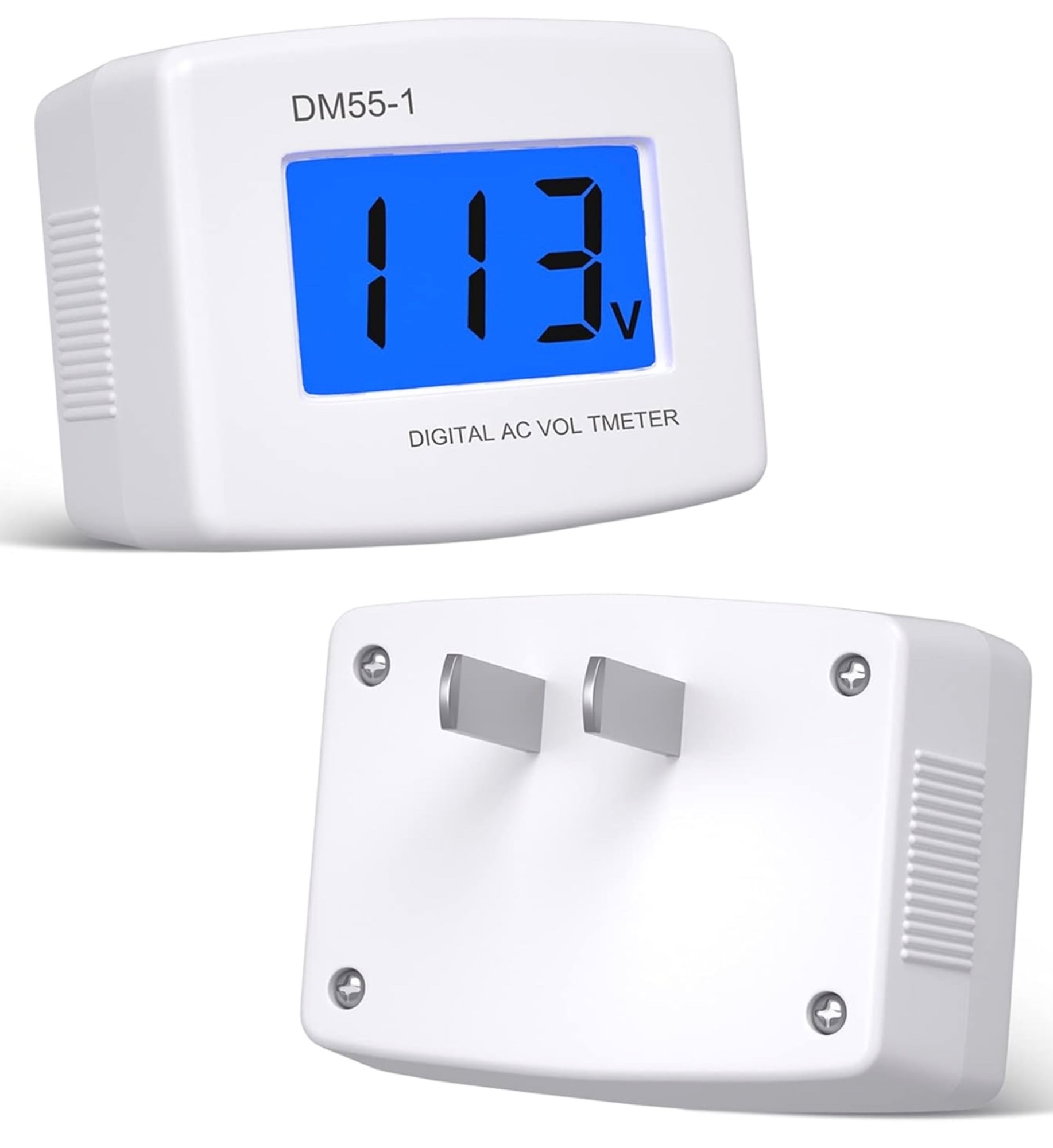
Another problem to be concerned with in clubs is low voltage. When everything kicks in voltage can drop as was mentioned. One of these AC volt meters from amazon is good to use to test the voltage level before you plug your amp in. If it is lower than what your manual specifies, don’t use that outlet for your amp. Easily fits in a gig bag.

Everything's dirty there.Definitely at some of the strip clubs I seen.

I have experienced this before, when running a whole band off of one 15A circuit.It could also be you are coming close to the max that the one outlet can supply as far as current is concerned, which may be dragging down the voltage slightly.

Played in a barn once with questionable power, whenever anyone touched a light or a switch my ToneHammer would immediately shut down. Learned later that Class D amps do not like low voltage and will go into protect mode. Got people to stop messing with any electrical stuff and the rest of the gig was a wild blast,
Hence the dirty electricityEverything's dirty there.
A bass amp blowing up wasn't the worse damage there.

- Feb 12, 2006
- 60,986
- 5
- 220,768
- Disclosures
- Development Engineer-Mesa Boogie, Development Engineer-Genzler (pedals), Product Support-Genz Benz
Most power issues are horribly misdiagnosed IME.
When you can’t identify the actual cause of the problem, it’s not very effective to apply a random solution.
In this case, a double-conversion pure sine wave UPS is generally the most effective because it bypasses the bulk of the power system and generates its own waveforms.
When you can’t identify the actual cause of the problem, it’s not very effective to apply a random solution.
In this case, a double-conversion pure sine wave UPS is generally the most effective because it bypasses the bulk of the power system and generates its own waveforms.

Two anecdotes from my experience that I think both qualify as "dirty power"...
A long time ago I was playing (in a bar above a pizza parlor) and my tube amp sounded like . Some intuition made me pull out my voltmeter, found 100V at the socket (expecting 120, this wasn't Japan). The floor of that room was also bouncing up and down when people danced. I don't think the place was built to rock'n'roll standards. Probably meant for dad to go have a couple beers while mom & the kids had pizza downstairs.
There's a local venue (very nice small winery tasting room) where I always have a nasty buzz. I mean, my bass amp always has a nasty buzz , I enjoy my glass of wine after the gig. Outlet is wired correctly according to my plug-in tester, but my meter measures about 2 V between neutral and ground. It's a very old building, who knows what else is on that leg of the power or how unbalanced the two legs are?
A long time ago I was playing (in a bar above a pizza parlor) and my tube amp sounded like
. Some intuition made me pull out my voltmeter, found 100V at the socket (expecting 120, this wasn't Japan). The floor of that room was also bouncing up and down when people danced. I don't think the place was built to rock'n'roll standards. Probably meant for dad to go have a couple beers while mom & the kids had pizza downstairs.There's a local venue (very nice small winery tasting room) where I always have a nasty buzz. I mean, my bass amp always has a nasty buzz
, I enjoy my glass of wine after the gig. Outlet is wired correctly according to my plug-in tester, but my meter measures about 2 V between neutral and ground. It's a very old building, who knows what else is on that leg of the power or how unbalanced the two legs are?
I’ve had this happen with digital power amps. I’m no electronics guru, but I’m told that it’s a low voltage issue. I’ve never had it happen with conventional (i.e., not digital) amp.
- Feb 12, 2006
- 60,986
- 5
- 220,768
- Disclosures
- Development Engineer-Mesa Boogie, Development Engineer-Genzler (pedals), Product Support-Genz Benz
With a load on the receptacle, you SHOULD measure a small voltage on a properly wired circuit because there will be a voltage drop on the neutral due to the current that will not be present on ground because there is no current. With no load, the voltages should be the same because they are ultimately bonded together at the service entrance point. Where there is NO voltage between the neutral and ground under load, this is the smoking gun to a bootlegged ground (ground tied to neutral at the receptacle or nearby) which is both dangerous and non-code conforming.There's a local venue (very nice small winery tasting room) where I always have a nasty buzz. I mean, my bass amp always has a nasty buzz
It COULD be a low voltage issue, but it could just as easily be several other power related things as well. Power issues (including low voltage) can cause problems with both digital (as in DSP) or conventional (analog) amps.I’ve had this happen with digital power amps. I’m no electronics guru, but I’m told that it’s a low voltage issue. I’ve never had it happen with conventional (i.e., not digital) amp.
If by "digital" you mean class D (which is not digital), they are just like any other amp in this regard, but most class D amps often contain additional protection circuitry to improve reliability. That said, I included under-voltage protection in some of my class AB amps back in the day so it's not necessarily related to class D or SMPS.
What would the minimum voltage be for safe operation? I realize this is a loaded question, too many variables for a simple answer, but is there a point where you would not feel safe plugging in an amp?
Most (all?) amplifiers have input voltage specifications stating the acceptable, designed for, range (a tolerance you’d hope larger than the statutory range!).What would the minimum voltage be for safe operation? I realize this is a loaded question, too many variables for a simple answer, but is there a point where you would not feel safe plugging in an amp?
Outside that range is a crap-shoot. Outside the device’s published specifications, even with different revisions of the same model of amplifier, the misbehaviour behaviour and threshold can be significantly different.
edwinhurwitz
Supporting Member
I played a venue about 25 years ago where the stage power was actually hooked up to separate services. As in the hot and cold of one outlet. When I plugged my Furman voltage regulator (not one of the power "conditioners", but 120 volts out for a range of voltages in) in, it promptly blew up. Luckily, our soundguy was a licensed electrician. He was able to get safe power to the stage and the venue hired him to rewire their services. And bought me a new Furman.What you're describing is not a power filter, but an "online" uninterruptible power supply, which converts AC to DC and then generates new clean AC power. These are expensive, but effective.
To the OP, the best thing you can do is carry a receptacle tester to make sure that things are not mis-wired. And if you notice issues on a properly-wired outlet, try to find out what else is living on the circuit that could be affecting your power.
Right... the 2V or so between neutral and ground was with nothing plugged into the pair of outlets. I'm pretty sure the building is older than I am (and I sure ain't a recent vintage), who knows who has done what to the wiring in there over the years?With a load on the receptacle, you SHOULD measure a small voltage on a properly wired circuit because there will be a voltage drop on the neutral due to the current that will not be present on ground because there is no current. With no load, the voltages should be the same because they are ultimately bonded together at the service entrance point.

Weird it went away.
I always bring one of these with me, it’s always in the gigbag. 15ft cord 6 outlet surge protector with RFI/EFI blocking. It definitely helps out with outlets that are tied to lighting, one spot I practice is horrendous and this calmed it down enough to be passable, got to pick my battles, old house but nice cool basement!
https://www.sweetwater.com/store/de...inQbN3ZT-XyAen6xsKz2jdccJXUq4JfRoCRLMQAvD_BwE
I always bring one of these with me, it’s always in the gigbag. 15ft cord 6 outlet surge protector with RFI/EFI blocking. It definitely helps out with outlets that are tied to lighting, one spot I practice is horrendous and this calmed it down enough to be passable, got to pick my battles, old house but nice cool basement!
https://www.sweetwater.com/store/de...inQbN3ZT-XyAen6xsKz2jdccJXUq4JfRoCRLMQAvD_BwE
- Feb 12, 2006
- 60,986
- 5
- 220,768
- Disclosures
- Development Engineer-Mesa Boogie, Development Engineer-Genzler (pedals), Product Support-Genz Benz
It depends on the amp, but for those that comply with international safety standards, +/- 10% of the nominal rated voltage is what’s tested for. That would be 132V for 120V markets and 264V for 240V markets.What would the minimum voltage be for safe operation? I realize this is a loaded question, too many variables for a simple answer, but is there a point where you would not feel safe plugging in an amp?
Most equipment is certified to operate at +/- 10% of nameplate voltage. So if it says (for example) "100-120VAC", you should be able to expect that it will operate at 90VAC. It all depends on what's printed on the nameplate.What would the minimum voltage be for safe operation? I realize this is a loaded question, too many variables for a simple answer, but is there a point where you would not feel safe plugging in an amp?
This is distinct from "dirty" mains voltage which is non-sine-wave voltage. That is very common when a circuit is shared with high power switching power supplies of dubious quality.
In theory an audio amplifier ought to have in its DC power supply sufficient isolation to allow it to tolerate "normal" amounts of noise in the mains power. But I don't know what the "normal" amount would be for audio equipment.
It's pretty easy to measure mains voltage, but it takes much more serious equipment to accurately measure noise in the mains supply. Some multimeters that claim to be "True RMS" will have a power factor measurement, and if you put a pure resistive load (electric heater) on and measure PF, that'll be an indication of how noisy the mains supply is. But not all meters that claim to be "True RMS" really are (I can't remember my sparky buddy's explanation for this).


