• TalkBass has been independent since 1998. Add your voice.
    Create a free account to reply to discussions, view embedded media, and browse with fewer display ads.
    Join freeLog in
    Want zero display ads or expanded classifieds tools? Compare plans.

Does more air movement provide a better low volume solo practice tone?

I have a question that probably sounds silly but I'd seriously like to know.

Would the addition of a 1x15 cab to my (2x10) R500c provide a better sound at low (solo practice) volumes?

More information for context:

My music room is relatively small (14' x 11'). Most of my practice is solo at relatively low volumes. I'm looking for the nicest sound at that low volume.

On my current bass journey my first bass amp was a Rumble LT25 (1x8) which, in my environment with my basses, wasn't very bass-y and felt lacking. So I replaced it with a "new" Rumble 60 (1x12), which sounds great, with deeps that can be heard and felt at low volumes without ever getting boomy.

I tried a Rumble 40 (1x10). While it was great for travel (light weight) and jamming with friends (higher volumes with mids up and bass down), I wasn't enamored when playing solo at low volumes with my basses. To get deep lows at low volumes I had to turn up the low bass, which made the sound boomy.

Wondering if more is more, I bought a Rumble 500c, which, like the R60, also sounds nice at low volumes.

Now I have the chance to possibly pick up a (used) 115 cab to add to the R500c.

Would this additional air movement provide an even nicer low volume practice tone? Or am I just going to have the volume knob lower with the same sound?

Does anyone else here practice and/or play at low volumes with a lot of speaker drivers for more air movement?
 
Thinking purely about the physics, same volume means same amount of air movement at your ears. The movement will just be distributed across a larger area of cones. But that overlooks effects on tone quality that probably require listening to find out. When listening at close range, bigger speakers are probably less predictable.
 
Would the addition of a 1x15 cab to my (2x10) R500c provide a better sound at low (solo practice) volumes?
Maybe...depends on the type of tone you want.

I generally prefer a single driver approach for low volume. Multiple drivers tend to produce off-axis comb filtering. You can also call this lobing.

I quoted this from an older message. Click to expand if necessary:

The following will be related to lobing.
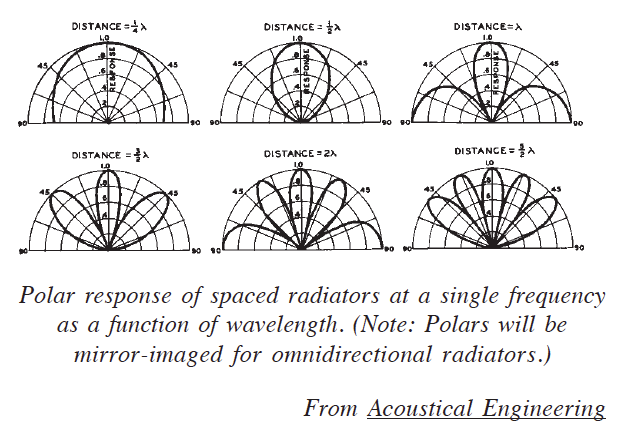
The resultant pattern is based on the ratio between the wavelength (Lambda)
upload_2022-8-14_21-20-47-png.4782575
and the spacing or distance between the drivers.
While reading this post, try to remember that Lambda
upload_2022-8-14_21-20-47-png.4782575
is just a fancy name for wavelength, and distance is the center to center spacing between drivers.
Low_Directivity-polars1.png
Here is the next part from the same post:
Here is the approximate dispersion pattern you get when driver spacing = 1 Lambda. This image assumes vertical alignment of the drivers.
upload_2022-7-30_18-46-28-png.4766968

Notice the ear is in the null between the lobes. So this guy will not hear this frequency very well. For a vertical 210 I believe this pattern occurs at approximately 1,130hz.

This is a higher frequency where driver spacing = 2 Lambda (2,260hz)
upload_2022-7-30_18-49-31-png.4766969

Notice one of the secondary lobes that is shooting up at an angel is pointing straight at the ear. So he will hear this frequency.


But if he moves here, his ear is in the null again.
upload_2022-7-30_18-59-37-png.4766972


Notice the primary lobe always shoots straight out (on axis). So if you make sure your ears are on axis to the primary lobe, you should hear the intended full range response of the cab. You can do this by moving further from the cab, tilting the cab back to aim at your head, or elevating the cab to a suitable height.
upload_2022-7-30_18-45-50-png.4766967
 
In my humble opinion, a single driver, and a low efficiency one at that, is the best choice for home practice.
The bigger the rig, the more you have to turn down. Any cabinet will play at low volume, but some kinda 'wake up' when you cross a certain threshold, and often that is already too much for your home. Adding more speaker surface will get you a bigger sound, but it will also raise the volume.
 
Maybe...depends on the type of tone you want.

I generally prefer a single driver approach for low volume. Multiple drivers tend to produce off-axis comb filtering. You can also call this lobing.

I quoted this from an older message. Click to expand if necessary:


Here is the next part from the same post:

@Wasnex thank you for that detailed explanation.

If I understand correctly:
  • The lobing patterns are why I hear significant tone changes when I walk around my (2x10) R500c when playing, but I hear much less tone change when I move around my (1x12) R60c.
  • Adding a 1x15 under the 2x10 is going to make that position dependence even worse in my music room.
  • On stage, for an audience, the lobing effect isn't as noticeable because their ears are at less of an angle due to the distance from the amp(s), so the combination works better.

Am I understanding that correctly, or am I off in space somewhere?
 
  • Like
Reactions: Wasnex
The lobing patterns are why I hear significant tone changes when I walk around my (2x10) R500c when playing, but I hear much less tone change when I move around my (1x12) R60c.
Lobing is definitely part of the puzzle. There may be other factors as well.

If you already have both cabs, try it and decide for yourself if it's better or worse. Ask two people to asses the results and they may disagree. In general adding cabs results in a fuller thicker sound. Adding cabs also usually increases max volume. So if you want a fuller sound or need more volume, you may find it's worth the trade off.

You could try a vertical array. Turn the 210 on it's side and the align the center of the drivers from bottom to top.
1767723521609.png

The horizontal dispersion will be the same as a single driver. The lobing will occur across the axis of alignment. So vertical dispersion narrows and forms into lobes.

If you are using combo amps, consider if rotating the cab could have a negative impact on the amp's ability to manage heat.

On stage, for an audience, the lobing effect isn't as noticeable because their ears are at less of an angle due to the distance from the amp(s), so the combination works better.
The lobing can definitely cause your tone to vary across the audience area. The audience generally hears a mix of direct and reflected sound that has bounced around the room. As you get further from the sound source the ratio changes: You usually hear more reflected sound and less direct sound. The reflected sound tends to mask the direct sound, making it harder to hear details. At some distance, you may hear more reflected sound than direct sound. There is still plenty of lows frequency energy but there is no detail or focus...just a muddy mess.
 
Last edited:
  • Like
Reactions: Never2Late
I have had lots of different cabs, 1x15,1x12,4x10,15/6 and 2x10. I practice at low'ish volumes (although not according to my wife) and my practice room is much larger. Right now I have the Subway 1x15 and 1x12 which is a bit nicer than just the Subway 1x15 alone. While a single cab would obviously be fine I have found that I much prefer multiple speaker arrangements. The only one that didn't work was the Fearful15/6 which was just way too much.
 
If you can borrow one, you should give a try to the Ampeg RB 112.

It has the vintage Ampeg sound but it goes deep enough at low volume and has a non-fatiguing sound when you practice several hours in a row.

I should clarify that I like the way my Fender Rumbles sound, both the R60 and the R500. With the way I have their tone knobs set, neither is fatiguing for me.

Sometimes I look through CL and FBMP just to see what's out there, and I happened to find a Rumble 115 cab for a good price. That's what prompted my questions in this post, to find out whether buying it would yield an improvement or just be a big waste of time and money.

I'm only 3 years into my bass journey so I'm still experimenting quite a bit and have a lot to learn.

That said, I have tried Ampeg RB amps in GC and I had an Ampeg RB110 in my possession for a little while. When I tried the Ampeg RB amps (110, 112, 115, and 210) side-by-side about 2 years ago , I liked the sound of the RB-112 the most. But then I tried the 112 again recently and didn't like it as much. I found out afterwards from posts from @Yahboy that the driver was changed from Eminence to Lavoce, and they have significantly different sound profiles.
 
Last edited:
If you already have both cabs, try it and decide for yourself if it's better or worse.

I haven't purchased the 115 cab yet, and the drive to get it is pretty far so I'm trying to determine if it's worth the effort and cost.

You could try a vertical array. Turn the 210 on it's side and the align the center of the drivers from bottom to top.
1767803765163.png

If you are using combo amps, consider if rotating the cab could have a negative impact on the amp's ability to manage heat.

The drivers in the R500c are top to bottom, so no need to rotate, but they're offset a bit so I'm not sure how that would affect the lobing/dispersion:
IMG_2272c20.jpg


The horizontal dispersion will be the same as a single driver. The lobing will occur across the axis of alignment. So vertical dispersion narrows and forms into lobes.

Does this mean the tone will be more consistent than it is now when walking around the amp/cab stack?
 
I haven't purchased the 115 cab yet, and the drive to get it is pretty far so I'm trying to determine if it's worth the effort and cost.


The drivers in the R500c are top to bottom, so no need to rotate, but they're offset a bit so I'm not sure how that would affect the lobing/dispersion:
View attachment 7404155


Does this mean the tone will be more consistent than it is now when walking around the amp/cab stack?


The claim is diagonal alignment helps with dispersion. However, the lobing will still occur across the angle of alignment (in this case diagonal).
 
  • Like
Reactions: Never2Late
I have a 30x11 practice room with a low ceiling (basement rec room) and have struggled over the years to get good acoustics probably due to a big null in the low mids according to my testing. Right now I like where things are at with me and the cab at one end of the room, stacked cabs are in the center against the wall but angled to one side slightly. Moving the cab and sitting/standing position/distance has a big effect. You may not have a lot of options but I would try it. Also, last night I just used headphones via the amp headphone out and ran the music into the amp input jack. It sounded really good too.
 
The claim is diagonal alignment helps with dispersion. However, the lobing will still occur across the angle of alignment (in this case diagonal).

I'm sorry. My question was worded badly. What I was trying to ask was related to this:
The horizontal dispersion will be the same as a single driver. The lobing will occur across the axis of alignment. So vertical dispersion narrows and forms into lobes.

Does this mean that the addition of the 115 cab under the 210 combo would provide a more consistent tone (when walking around) than with the 210 combo alone due to the narrower vertical dispersion. In other words, do 3 vertical drivers (15 + 10 + 10) provide a more consistent lobing/dispersion pattern than just the 2x10?

Or does that mean I'll have 3 separate horizontal dispersion lobes, one at each driver's height?

BTW: I really appreciate your knowledge sharing. I'm just trying to make sure I understand it correctly!
 
Last edited:
If you want a better sound, elevate your cabinet to ear level and sit near by. It makes a big difference.

Yes, so far the sound I like best from the R500c is when it's on a stand elevated 2 feet from the floor. Playing while sitting is awkward for me, so I stand 6 to 8 feet away. It also somehow seems to result in less variation in tone when I walk around the amp.

Moving the cab and sitting/standing position/distance has a big effect. You may not have a lot of options but I would try it.

The past 6 months I've been experimenting with (combo) amp positions, including height and proximity to walls, and have been surprised at how much the perceived tone changes.

With the amp on the floor and/or near walls or corners, the low bass sounds much louder and needs to be turned down. 3 feet away from the wall it's reduced.

And 2 feet off the floor on a stand, low bass is reduced a bunch more and needs to be turned up. I also tried on the floor but tilted 45 degrees up, which seemed to split the difference.

This adds to the pile of knowledge that I don't have yet and am trying to understand.

I've heard the terms floor coupling and comb filtering but don't want to use either improperly.

But that's another variable and question when I think about the addition of a 115 cab, as it would remove the option to use a stand and instead would have the 115 cab on its wheels on the floor with the 210 combo sitting on it.

Would there be a lobing, dispersion, reflection or other pattern change that would result in less low bass than the 210 by itself on the floor, or would it result lots of low bass from the 115 as it's close to the floor?
 
Last edited:
  • Like
Reactions: beans-on-toast
In other words, do 3 vertical drivers (15 + 10 + 10) provide a more consistent lobing/dispersion pattern than just the 2x10?


More drivers creates more lobing. However, if the drivers are aligned vertically, the lobing only occurs across the vertical axis. So horizontal dispersion is the same as a single driver.

1767826100298.png

The angle and number of lobes varies by wavelength and the center to center spacing between the drivers. With a vertical 210 + 115 configuration, for a given frequency you have a single wavelength and three spacings: (1. Green) top 10 to 15, (2. Red) top 10 to bottom 10, (3. Orange) bottom 10 to 15.
 
  • Like
Reactions: Never2Late

Latest posts