When buying blind (over the net, no test drive) a 5 string must be 35". I play a 5-string to use that B string so it must be sweet. I have given up on good deals on beautiful basses because I don't want a flabby B. If I had an opportunity to play something before I bought it, I would try any spec arrangement, otherwise I must go with what I know.

Enjoy the benefits of a premium membership!
Upgrade Account
-
TalkBass has been independent since 1998. Add your voice.
Create a free account to reply to discussions, view embedded media, and browse with fewer display ads.
Join free Log in
Want zero display ads or expanded classifieds tools? Compare plans.
You are using an out of date browser. It may not display this or other websites correctly.
You should upgrade or use an alternative browser.
You should upgrade or use an alternative browser.
Does nut width, string spacing and/or scale length influence your bass purchases?
- Thread starter FatStringer52
- Start date
More options
Who Replied?
How about neck specs? D or C shapes ,radius... knowing more about that would help me when deciding on an online purchase that I can't test drive
How about neck specs? D or C shapes ,radius... knowing more about that would help me when deciding on an online purchase that I can't test drive
Totally agree. Neck profile is another important feature. I almost added that to the equation, but decided to leave it out. It seems the "modern C" appears to be the flavor of the month as of late. Personally, I prefer the baseball bat necks; unfortunately, I only have one with that neck.

Scale length is important to the overtones that make the complete tone. String spacing is critical to playing comfort and facility for me. So all of the above.
Example: I've been playing Guild long-scale basses since the company started making long-scale basses, and I have a '90 Pilot Pro V that's wonderful for me. I bought a Pilot-by-Fender fretted five-string as a utility bass, and it sounded OK, but the string spacing made it just too annoying to play. Kinda like a Fender, oddly enough.
Example: I've been playing Guild long-scale basses since the company started making long-scale basses, and I have a '90 Pilot Pro V that's wonderful for me. I bought a Pilot-by-Fender fretted five-string as a utility bass, and it sounded OK, but the string spacing made it just too annoying to play. Kinda like a Fender, oddly enough.

Yep -- short scale first, narrow nut width and string spacing is secondary. I even had the short scale criteria when I moved onto Upright bass. Took a major bit of flak from the purists over in the DB forum, but found it was the best decision I've made. I then moved back onto fretless 30" scale (down from the 35" upright bass 1/4 size, short scale bass) and seem to be able to play both with equally acceptable intonation -- not always perfect, but within range to keep musicians and clients wanting to pay with us and invite us back for more paid gigs. In a very short time (like 8 months, and only 5 months to regular gigs on upright).
Finding a bass that fits you is the first step, in my view. Don't get distracted into thinking nothing but standard sized instruments is right for everyone -- it's not. Only you can judge your body size, and physical needs. And many of the proponents of full scale instruments haven't ever played one either -- they are simply perpetuating what I consider to be false tradition. Granted, there are always liabilities associated with short instruments, but there are many advantages -- such as being the enabling feature of the instrument to get people playing in the first place.
I know first hand that if I had to start on electric or upright on a full scale instrument, I'd have quit almost immediately. give me a short scale and I'll play forever and ever on it. and get better and better.
Finding a bass that fits you is the first step, in my view. Don't get distracted into thinking nothing but standard sized instruments is right for everyone -- it's not. Only you can judge your body size, and physical needs. And many of the proponents of full scale instruments haven't ever played one either -- they are simply perpetuating what I consider to be false tradition. Granted, there are always liabilities associated with short instruments, but there are many advantages -- such as being the enabling feature of the instrument to get people playing in the first place.
I know first hand that if I had to start on electric or upright on a full scale instrument, I'd have quit almost immediately. give me a short scale and I'll play forever and ever on it. and get better and better.
On what basses do they offer that?
Rics are the first ones that come to mind. . .

Ouch! And a few other choice expletives. But at least you persevered, made the right compensations and continued to play. Kudos!
Thanks! The short version: I severed the tendon on the top of the index finger. After surgery to re-attach, 2 months of my finger in a splint, then 2 months of physical therapy, I got 90% mobility back. When I told the physical therapist that I play guitar, we set that as my overall goal and she explained that continued playing would be excellent therapy moving forward. And she was right! Other than the aforementioned fatigue and soreness, my playing proficiency on the bass was not really lost - I had to make minor adjustments - but it's not lost. Acoustic guitar on the other hand, which I occasionally play just for fun, is more difficult because of the tight string spacing and because of chords vs. the linear notes on a bass.

Haven't thought about it a lot up until now - I adapt more to what I've got, but at nearly 65 I'm starting to feel some soreness between my knuckles on the left hand. I've got an Amer. Jazz Dlxe 5 and it always felt on the wide side so I'm thinking about G&L's - 1 5/8" / 1 3/4" and 17mm at the Bridge, might ease my soreness I hope.
Maurie.
Maurie.
at nearly 65 I'm starting to feel some soreness between my knuckles on the left hand.
I know what you mean. I just turned 65 a few days ago. My joint pain on my left hand (fretting hand) is where the thumb connects to the hand. I was surprised to learn just how instrumental of a role the thumb plays in fretting notes.
ll
I've been wanting to go Fretless and was thinking of a 35" until the soreness started,
maybe I'll end up having to go short scale if it keeps getting worse but I really like
5's and so I'll try the slimmer neck first.
I am trying to play with a lighter right hand touch too for easier fast sequences so 17mm should be okay - I had an Ibby SDGR in the past and it was pretty comfortable, just not the sound I like : )
I'm also working away at my left hand
"shifting" technique so I'm not stretching as much : )
I think as we get older we may have to "refine" and improve our technique to stop our "bad habits" inhibiting us.
With your soreness being in your thumb I 'd be interested to know if you play a thin neck (front to back) I can imagine if it's too thin you might get cramps in the web between thumb and palm?
Cheers Maurie.
I know what you mean. I just turned 65 a few days ago. My joint pain on my left hand (fretting hand) is where the thumb connects to the hand. I was surprised to learn just how instrumental of a role the thumb plays in fretting notes.
I've been wanting to go Fretless and was thinking of a 35" until the soreness started,
maybe I'll end up having to go short scale if it keeps getting worse but I really like
5's and so I'll try the slimmer neck first.
I am trying to play with a lighter right hand touch too for easier fast sequences so 17mm should be okay - I had an Ibby SDGR in the past and it was pretty comfortable, just not the sound I like : )
I'm also working away at my left hand
"shifting" technique so I'm not stretching as much : )
I think as we get older we may have to "refine" and improve our technique to stop our "bad habits" inhibiting us.
With your soreness being in your thumb I 'd be interested to know if you play a thin neck (front to back) I can imagine if it's too thin you might get cramps in the web between thumb and palm?
Cheers Maurie.
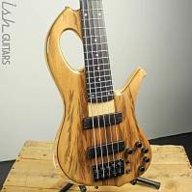
I am comfortable with 1 7/8" at the nut and 3/4 spacing at the bridget and am comfortable with anything from 32 to 36" scale length.
Dan
Dan
Sunday afternoon, too darn hot to go out and work in the yard, so here I am stuck inside with my music and you, my fellow TB’ers. And that is a good thing; I couldn’t be in better company. Let’s give this a shot and see where it leads us.
We all look for certain features and specifications when purchasing a bass. And we all have our personal reasons for what we look for in a bass. I’m also quite sure that the reasons are vast and varied. So, just how important is the nut width, and/or string spacing, and/or scale length when you are buying a bass?
I have allowed three votes, intended so someone would have the opportunity to vote once in each of the three categories: nut width, string spacing and scale length. But, since there does not appear to be a way to apply that restriction, the results of the poll may be somewhat skewed.
The terms narrow and wide are ambiguous at best. But, when applied to the bass guitar, I think you all get the gist of what is being said. There is just no way to establish a finite measurement to divide the two.
With regard to scale length, the standard Short Scale (30”), Medium Scale (32”), Long Scale (34”) and Super Long Scale (35” and longer) is used. I do know there are exceptions, but you can just use rounding.
Question doesn't work for me.
I like long necks and I cannot lie.......
If I don't like the neck width it's a no go, but nut width does not encompass neck thickness and feel.
String spacing can be changed, but I'm not shaving a neck.
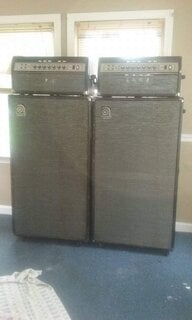
I consider the scale length nut, width etc but in the end if I like the bass, it plays and sounds good in my hands I'll buy it no matter what it is. I do like 34" scales (longtime P bass player and it feels "right") and prefer wider nuts though but have a Jazz and like it and also have an EB-2 and EB-3 and like them, so there are no absolutes with me and that is what I picked: none of this matters etc.
Last edited:
I like narrow string spacing, wide nut width, and 33.25" scale.
You should try a Rickenbacker

I'm also working away at my left hand
"shifting" technique so I'm not stretching as much : )
I think as we get older we may have to "refine" and improve our technique to stop our "bad habits" inhibiting us.
With your soreness being in your thumb I 'd be interested to know if you play a thin neck (front to back) I can imagine if it's too thin you might get cramps in the web between thumb and palm?
Fortunately, my thumb pain is sporadic. And it usually rears its' ugly head on the first note after a position shift. Especially, when going to first position on the E and A string when I have to "dip" my hand a little to reach up on the fingerboard. So far, no pain when stretching, thank goodness. Also, no cramping. All but one of my instruments have what Fender refers to as a Modern C profile or fairly similar; the other being closer to what Fender calls a U profile.
Does the "U" happen to feel more comfy?
I'm not sure about G&L's neck profiles yet,
but for width in 5's they get down to
1 5/8" - Trib's 5's are 1 3/4" only and my
Jazz 5 is 1 7/8". I'm not sure that 1/8" less
on the Trib will change that first position
reach much and so lean towards the "real thing" in 1 5/8" - the Mid and Upper Neck
width should feel a bit better with the 17mm spacing on the bridge though.
Maurie.
I'm not sure about G&L's neck profiles yet,
but for width in 5's they get down to
1 5/8" - Trib's 5's are 1 3/4" only and my
Jazz 5 is 1 7/8". I'm not sure that 1/8" less
on the Trib will change that first position
reach much and so lean towards the "real thing" in 1 5/8" - the Mid and Upper Neck
width should feel a bit better with the 17mm spacing on the bridge though.
Maurie.

Does the "U" happen to feel more comfy?
To me, no more or less than the others.

Massage is a good idea - especially if someone else is doing itI know what you mean. I just turned 65 a few days ago. My joint pain on my left hand (fretting hand) is where the thumb connects to the hand. I was surprised to learn just how instrumental of a role the thumb plays in fretting notes.
 And start eating fresh broccoli regularly - sprouts if you can get them - and pineapple, if you can manage it, for their natural anti-inflammatory properties. Strengthening and stretching exercises too should help. But go easy. Getting some physio might be the best way to start.


