One knob on the T-45 (which has a single humbucker in roughly the P position) is a "spin-a-split", basically a volume control for the bridge side pickup of the humbucker. It affects the timbre by controlling how humbucker-y the pickup is. It's a neat idea but not completely intuitive in practice since the pot has a long shelf where there's no discernible difference in the sound, and then a steep tail-off. This might make you think the pot is flawed but you can take the unaffected (neck) pickup out of the circuit observe that it's just a run of the mill volume pot.I believe it's a feature on Peavey T-40's.

Enjoy the benefits of a premium membership!
Upgrade Account
-
TalkBass has been independent since 1998. Add your voice.
Create a free account to reply to discussions, view embedded media, and browse with fewer display ads.
Join free Log in
Want zero display ads or expanded classifieds tools? Compare plans.
You are using an out of date browser. It may not display this or other websites correctly.
You should upgrade or use an alternative browser.
You should upgrade or use an alternative browser.
Does the volume pot position affect the timbre?
- Thread starter doran.dragic
- Start date
More options
Who Replied?

Can I add a negative resistor of 1 so mine goes to 11?
Yes - see my priot post (#24)

MDBass
Supporting Member
- Nov 7, 2012
- 8,590
- 14,892
- Disclosures
- Endorsing Artist: Dingwall-Fender-Bergantino-Dunlop-Tech 21-Darkglass-Nordstrand
Hello everyone,
I own a beautiful Torzal bass that has Nordstrand Big Splits and Big Man pickups.
I love the way the bass sounds - it's very direct and responsive, but I was trying to get a pleasant old school roots reggae / dub sound out of the bass today and I just couldn't get the bass to sound right no matter which playing or muting technique I tried. Too much attack and too robust.
But after I took a short break the bass started to sounded much better, although a little quieter. Very rounded, very bassy and not as direct.
After checking my bass I noticed that the volume on my bass was only about 80% up.
I made a short recording of both volume pot positions which I matched the recordings for volume and the difference in sound was very obvious.
Could somebody explain me if this is the normal way for all pickups to behave? Will the change of the strength of the output signal not only change the volume but also the timbre? Or is there something else going on?
On a passive bass, yes that's totally normal and actually why some people prefer fully passive basses.
 Perfect!
One knob on the T-45 (which has a single humbucker in roughly the P position) is a "spin-a-split", basically a volume control for the bridge side pickup of the humbucker. It affects the timbre by controlling how humbucker-y the pickup is. It's a neat idea but not completely intuitive in practice since the pot has a long shelf where there's no discernible difference in the sound, and then a steep tail-off. This might make you think the pot is flawed but you can take the unaffected (neck) pickup out of the circuit observe that it's just a run of the mill volume pot.
Different taper required?
Different taper required?
I can't recall which way the shelf goes right now. It's possible a log taper would make the shelf even longer

The spin-a-split pot is R2 in the diagram above.
For whatever it's worth, Peavey patented this method of controlling a split humbucker. That link includes simplified diagrams for, iirc, both the T-45 and T-40. They didn't bother renewing the patent so it expired in 1997. (edit: And now I've fallen down a rabbit hole of guitar circuit patents. Interestingly, Leo Fender has some patents citing this one at around the time he would have been working on the G&L L2000)

I thought this has to do with how the vol pot on an active bass works.
I have one bass where it feels like on a passive bass, where you roll off the highs on the first bit.
Both my Carvin and my Ibanez active models have no difference in tone, only in volume. I've used that feature on the Carvin for a long time, where I'd turn it up 2/3 for gigs and then use the remainder as a boost option for certain passages.
All passive basses I ever owned rolled off highs when I backed off from full - same as most guitars do.
I have one bass where it feels like on a passive bass, where you roll off the highs on the first bit.
Both my Carvin and my Ibanez active models have no difference in tone, only in volume. I've used that feature on the Carvin for a long time, where I'd turn it up 2/3 for gigs and then use the remainder as a boost option for certain passages.
All passive basses I ever owned rolled off highs when I backed off from full - same as most guitars do.

Ric5
Inactive
- Jan 29, 2008
- 29,772
- 30,452
- Disclosures
- I like 5, 8, 10, and 12 string basses
Hello everyone,
I own a beautiful Torzal bass that has Nordstrand Big Splits and Big Man pickups.
I love the way the bass sounds - it's very direct and responsive, but I was trying to get a pleasant old school roots reggae / dub sound out of the bass today and I just couldn't get the bass to sound right no matter which playing or muting technique I tried. Too much attack and too robust.
But after I took a short break the bass started to sounded much better, although a little quieter. Very rounded, very bassy and not as direct.
After checking my bass I noticed that the volume on my bass was only about 80% up.
I made a short recording of both volume pot positions which I matched the recordings for volume and the difference in sound was very obvious.
Could somebody explain me if this is the normal way for all pickups to behave? Will the change of the strength of the output signal not only change the volume but also the timbre? Or is there something else going on?
I think you answered your own question
Isn't that more about the blend between the two pickups?
Prob'ly, but the thread title question is "Does the volume pot position affect the timbre?" and so I think the answer is still "yes".
Further, I'll note that the cheat sheets for the T-40 seem to indicate others perceive that the volume pot settings affect the sound - I think it's subtle, but there is such effect.

Do you think that this would be achievable by installing a toggle switch so that the volume pot stays fully open all the time? That way I wouldn't have to worry about finding the sweet spot or being too loud if I accidentally hit the volume knob.
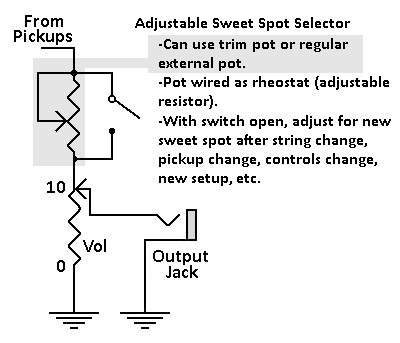
The following might work for you (and me, too LOL). I mentioned it earlier, and @micguy had previously verified, that adding an inline resistor to the volume pot input will simulate a volume control that's backed off. Looking online, this has been around awhile. Didn't see it with a switch, though.
Add a toggle bypass switch around the resistor and it seems to satisfy your concerns. With switch closed (bypassing the resistor), normal higher freqs are present with vol at 10. Open the switch and the resistor immediately cuts the high end down to your chosen sweet spot level while volume is still at 10 (volume will also be reduced, same as rolling back the volume control anyway).
Here's how I'd determine a starting point for a resistor value.:
Might be useful for you, me, and anyone else who runs with their volumes dialed back.
Last edited:

If I understand this correctly, this is an alternative for painting little markers on & around your pots?Might be useful for you, me, and anyone else who runs with their volumes dialed back.
If I understand this correctly, this is an alternative for painting little markers on & around your pots?
Not really, but the markers are a good idea.
The OP, @doran.dragic, accidentally found a sweet spot rounded tone that he likes with the volume pot rolled back to about 8. I think he is asking for a way to get that sweet spot while the volume pot is at 10, and not 8, so he could nail it every time instead of hunting for it. He also mentioned a concern of accidently bumping it out of the 8 sweet spot and getting too loud. So now, he can switch in that '8' sweet spot while on 10 as he'd asked. My post was specifically related to all that.
That was my interpretation. May be wrong. It happens more regular these days LOL.
But I really like this idea. A 'full volume' and 'rolled back' volume/freq setting at the flick of a switch while the volume pot stays on 10 in both modes. I usually roll my volume back to remove some bite (as a few others in here do, too), so I'll be trying this later. This selectability between the two seems a nice convenience.
If I'm playing with the volume up for a gig and a mellower song comes along, switch it to the lower vol/less bitey sweet spot. If the gig is normally a 'sweet spot' gig and I need to punch it up a bit for a solo, switch it to higher vol/more bitey mode. Won't know how practical that theory is until I install it to test in the real world LOL.
Last edited:
It hit me today to change the fixed resistor to a variable resistor. The 'sweet spot at 10' will change with a string change (brand and/or gauge), amp change, cabinet change, bass setup change, onboard control changes (different caps, different pots), pickup change, maybe even mood change LOL. Would be a pain to unsolder/solder in a new fixed resistor to get a new sweet spot.
Just not sure of what value pot to use, but that'll be determined later with experimentation.
Just not sure of what value pot to use, but that'll be determined later with experimentation.
Last edited:
I've used that feature on the Carvin for a long time, where I'd turn it up 2/3 for gigs and then use the remainder as a boost option for certain passages.
I do this too..I use that last 1/3 or so for headroom...or whatever but then when I'm DI'd into the board I don't touch it ever, actually I rarely do anything to tone, or volume or my amp after I get it where I want it in soundcheck..the only thing I will do occasionally on certain songs is split the humbucker which gives me a thinner tone...depending on what the song calls for as some songs have a thicker bass tone like motown / R&B..ymmv

You'll also notice that the treble-cut & volume are often interactive.
For instance:
on my bass I can roll the treble-cut back halfway before there's any noticeable cutting
similarly I can roll the volume back 1/4 of a turn & still no discernible change
but if I do both, then there is less volume & it's more dark
For instance:
on my bass I can roll the treble-cut back halfway before there's any noticeable cutting
similarly I can roll the volume back 1/4 of a turn & still no discernible change
but if I do both, then there is less volume & it's more dark
- Feb 5, 2013
- 1,686
- 2,281
- Disclosures
- Endorsing Artist: Used Fender Lead Sleds and Hartke cabs with bent grills
I solder a cap for treble bleed on all my guitars if there's not one already. But on my basses I've never felt the need.

You absolutely correct. There might be another way, but I'm not sure how realistic: I did some research and I've read that you can get detented pots (pretty much like what's used on a pickup blend pot) that are custom made and don't have detents in the middle.Not really, but the markers are a good idea.
The OP, @doran.dragic, accidentally found a sweet spot rounded tone that he likes with the volume pot rolled back to about 8. I think he is asking for a way to get that sweet spot while the volume pot is at 10, and not 8, so he could nail it every time instead of hunting for it. He also mentioned a concern of accidently bumping it out of the 8 sweet spot and getting too loud. So now, he can switch in that '8' sweet spot while on 10 as he'd asked. My post was specifically related to all that.
That was my interpretation. May be wrong. It happens more regular these days LOL.
Now I don't have an idea where such a pot might be ordered or how much would it cost or where exactly should the detent be but maybe somebody with some experience in this field could chime in.
I don't know a source at all. Maybe someone will chime in for you.Now I don't have an idea where such a pot might be ordered or how much would it cost...
But, the negative issues that I see in a specialized pot is if it goes bad, it may not being easy to get another specialized pot (original company may change inventory/processes based on demand). The other issue might be is when you change strings (brand/gauge), change caps, change pickups, etc, the sweet spot may change. Now you gotta locate a pot with a different positioned detent. Those would be my considerations.
When I first read your question, I had a mental image of your bass having ONE pot with multiple markings. Hence, my answer, "Not really". Re-reading just now, I think you were speaking in generalities concerning all players that put ONE mark on their pot marking their sweet spot. In which case, yes, my post was addressing exactly that. My apologies for my confusion, if that's the case. You understood it correctly.If I understand this correctly, this is an alternative for painting little markers on & around your pots?
For anyone passing thru, my earlier post was about removing the higher freqs to make 10 on the volume knob into your sweet spot. The sweet spot being the 'dialed back' spot, as in, "My bass sounds great with the volume dialed back." The switch (optional) selects between full range or sweet spot range of the volume control.
The above removed the unwanted higher freqs. Lower unwanted freqs can be removed at the tone control. The low freqs that can cause muddy or indistinct bass when the control is dimed back. After mod, the maxed bass end of tone control will be the sweet spot. Similar to the 'add a resistor' method of the volume control mod.:
I haven't tried either one yet. Both ideas are used in guitar world. Simple, minimal parts, worth trying. Still putting together a parts list for this and some other projects.


