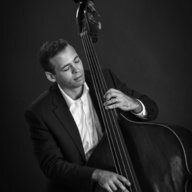
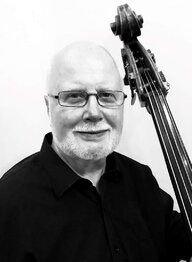
I'm an orchestral player who spends most of his time seated. When I do have to play standing I adopt the same basic principle - an arrow points from my chest towards the bridge, the fingerboard is about in line with the front of my face and I just miss my trouser leg with the bow.
I'm 5' 7" tall. When standing I use a boxer's stance so my left foot goes slightly forward and turns out a bit (same as a tennis player when about to serve). I draw the bass towards me and lean the rear corner of the upper bout into my left groin then adjust the three angles (side-to-side, front-to back, and rotation around the end pin) until the bass balances with very little weight against the thumb, the fingerboard is level with my face but not too close to my neck, the nut is an inch or two above my left ear and I just miss my trouser leg with the bow on the E string. My chest arrow is pointing at the bridge and I am close to the G string too. I can comfortably reach the usual bow contact points as well as lower positions with my left hand.
For lower positions this works well for orchestra and jazz. My left knee is slightly bent and most of the weight is on my right leg. My left forearm, wrist and fingers align well for ease of fingering the the top three strings and I can minimise pronation of the wrist on the E string.I can progress fairly easily into thumb position by sticking my bottom out a little more so the bass neck will drop back to my shoulder for support. Coming down I pull my bottom in again to push the neck away.
All this and my knee is not touching the back of the bass. This is as close as I can get to my usual seating position, where I support the bass on the inside of my left knee with that rear corner of the upper bout further across my body, under my ribs. My right calf is against the lower rib and again the arrow is pointing at the bridge, the fingerboard is slightly further forward than standing and the bow is just missing my leg.
Much depends on your style of music, the shape and size of your bass, your height and and how high up the fingerboard you wish to play. The seating position I use is good for orchestra but not for high solo playing. I would need a smaller bass with more dropped shoulders and a slightly different relation to the instrument to reach high harmonics.
I have an unverified theory that not having your left knee in contact with the back of the bass allows more tone from the instrument. What do people think?
I have seen Gary Karr and Tom Martin standing beside with the bass almost vertical but leaning slightly forward into their left fingers and controlled with the left knee but I could never make this work for me. I envy jazz players who can stand side on and rest the ribs flat against their stomach, but what worries me is to see how much their wrist pronates to play on the E string, risking injury.
All the above raving on is to demonstrate that I had to find ways of doing the job that suited me while keeping good posture. My ways are a compromise for my height and, er, weight (say no more).
If you can use the inside of your left knee to support the bass without compromising your posture and giving yourself physical problems down the line, go for it?
Happy hunting!
David Potts