• TalkBass has been independent since 1998. Add your voice.
    Create a free account to reply to discussions, view embedded media, and browse with fewer display ads.
    Join freeLog in
    Want zero display ads or expanded classifieds tools? Compare plans.

Downsides/Cons of Headless Basses?

I used a buddy's Cort headless (Steiny-style with the small concave body) at a gig about 8 years back. Using the strap buttons, the positioning balance was simply wrong. Reaching to the lower positions felt equivalent to reaching for a D or G tuner on a conventional P bass. Fast-forward to about a year ago, I buy the same model bass minus electronics and bridge saddles for $20. After obtaining the missing parts and setting the thing up, I made a homemade strap extender as other TBers have documented. That made all the difference in playability and comfort and I'm actually enjoying the thing.
 
Bridge limitations is the only one I can think of.

About two years ago, I picked up a headless Kiesel Vader 6 with a 30" scale with the hopes of stringing it with Fender Bass VI strings, as the scale length is the same and I don't really like the string spacing of your average Bass VI style bass.

Unfortunately, the ball end holder on the bridge was slotted so wide it would not hold the Bass VI ball end. I tried to work out a solution, but concerns over tuning reliability made me give up and eventually sell it.

Still dreamin' of a Bass VI with wider string spacing. Someday...
 
Last edited:
  • Like
Reactions: Snert
I'm just now seeing this thread, so will just jump right in as a headless owner since 2002, and the founder of the main Steinberger Spirit thread. I own a good number of "headed" (ha!) basses and five headless ones. The five are two Steinberger Synapses and three Steinberger Spirit XZ's. All excellent basses. The Synapses have the traditional "oar" body which is too narrow to sit on a normal bass floor stand. Obviously none will hang from a normal wall hanger, but there are some hangers out there that solve the headless problem.

Also, I think you need to make sure you get a headless bass that has its body going underneath the tuning knobs under the bridge. Some basses have the tuner knobs extending beneath the bottom when the bass is standing upright, and if the bass hits the floor, it can damage the knobs and bridge. Kiesel's headless models have one, the Vader, that has the exposed bridge, but the other models (Thanos, Osiris, Zeus) do not.

There is a better-than-ever selection of headlesses these days. Ibanez getting into it was a real boost, although their color options are limited. (I would get their short scale headless in a second if it came in something other than pink gold and that weird sea foam green.) The only production Steinberger is the Spirit XT-2 and XT-25. Their graphite models went away a long time back. That was a loss. Thankfully, Status is still making headless graphite basses. NS Design is still making great headlesses as well.
 
I don’t use double ball and strings on any of my current headless basses. I do have basses with normal headstocks as well, but I’m a big fan of headless as they’re just so much easier to manage.

Possible negatives
You will often have to explain what it is to non-musicians and some folks just don’t like the looks of them (and I’m totally OK with all of that) :woot:

If you restrict yourself to using only double ball end strings that could be a downside/expensive. Hanging them on the wall can be a challenge if there’s no vestibule at the end (replacing the headstock - think Ibanez) it does require a special wall hanger as it cannot use a standard wall hanger. Normal guitar stands that you might use at rehearsal or on stage are different as they have to sit in a tripod-style stand instead of hanging on their own.

Positives (IMO)
  • They always balance better and never have neck dive
  • Typically the tuners are higher tuning ratio and they stay in tune much better. My one custom that’s traveled with me for over 500k miles around the world rarely needs to be tuned after I land somewhere it just seems to be stable and stays in tune.
  • They are typically less weight
  • They are definitely easier to travel with, because even a full 34 inch scale is shorter overall
  • Definitely easier to manage in a tight rehearsal space or on stage as the additional 6-7 inches of headstock is not there to bang into mic stands, cymbals etc.
  • There’s no limitation to what you can build!
I have owned multiple over the last 30yrs and currently have 3 headless basses now (Maruszczyk, Status and a custom that I built using Steinberger bridge/headpiece) I also have 2 more custom headless basses on order from Maruszczyk, and I’m currently in the process of building 3 more custom headless basses myself (see my new post in the Luthier’s Corner). :thumbsup:
 
I had a Hohner Jack many years ago and, over not much time, the neck got slightly twisted. Man, I hated that thing. So, this might be a question of physics...

At the time I attributed the neck problem to it having a headless design but no graphite strengthening in the neck like the other headless basses of the time. It seemed to me that, without the headstock, the pressure on the end of the neck would be stronger that it would be if the ends were on an angled headstock and would be likely to cause warpage due to one side having heavier strings than the other, therefore different tension.

Does anyone know if that is actually the case? It could be that it was simply a crappy instrument and that I was wrong in my assumption that it was due to it being a headless wooden neck. I know that there are plenty of other luthiers today who make headless basses with wooden necks but don't know if perhaps the woods they use would be stronger than what Hohner used (I would guess they would be since that was a "value" brand) or if perhaps many of them strengthen their necks with graphite rods?

I got a Kubicki after the Jack but, if you know those, they came with a 32-layer laminate neck. That thing was not going anywhere, despite being all wood.
 
  • Like
Reactions: halcyo
As I read through this thread, I’m quickly reminded that there will always be a lot of opinions from non-experts or folks that have never owned a Headless instrument… or aren’t aware of what’s available in the market or current models of headless basses. Or their expertise is limited to only awareness of the small original rectangular box body basses like the original Steinberger, Hohner, etc.

When in fact, there are several manufactures that offer a Headless version of their normal bass models. e.g.- Status, Maruszczyk and many other custom builders. All offering full-size bodies with a full upper bout that comes up to about the 12th fret which is typical of a great balancing instrument.

If you’re looking for an instrument design with a full-size body that does not require double ball end strings or does not clamp the string end in the head stock with Allen screws (which is a completely acceptable and effective solution)… then you may want to take look at the NS Design instruments that have a new bridge system that does not require clamping the string end with screws and reverses a normal string that is inserted into the bridge for tuning instead.
 
Been formulating a “dream bass” build in my mind for a time. For some reason, without any significant proof, I’ve fixated on ideas like doing a headless bass (and maybe even multiscale).

For the sake of discussion, I’ll keep the question vague and open ended- what’s the DOWNSIDE to a headless instrument? Seems like the obvious cure for an ugly headstock, and why not have the instrument be a little less lengthy? ;)
Your hand can slip off in open, first position.

:)
 
No, you account for this when you do the set up on new strings to ensure the tuner/saddle has plenty of travel in both directions while being properly intonated.

Yeah i make sure I loosen up the tuners when I change strings then clamp the string with just a touch of tension, then tune it up. no issue, I can change strings on my headless in half the time or less than on a headed bass.
 
Bridge limitations is the only one I can think of.

About two years ago, I picked up a headless Kiesel Vader 6 with a 30" scale with the hopes of stringing it with Fender Bass VI strings, as the scale length is the same and I don't really like the string spacing of your average Bass VI style bass.

Unfortunately, the ball end holder on the bridge was slotted so wide it would not hold the Bass VI ball end. I tried to work out a solution, but concerns over tuning reliability made me give up and eventually sell it.
Why not simply use the same gauge in normal length strings?
I do recall someone suggesting somewhere that you could use the cut off ball ends of normal strings to do it, but I think you'd have to slot them into a C shape first.

Still dreamin' of a Bass VI with wider string spacing. Someday...
It's on my to-do list but I have to get my instrument building skill set up to speed first. I'm a decent woodworker already, so shouldn't take too long, I hope.
 
I guess I did not consider it at the time. Now I think of it, There's a place nearby that sells strings in bulk and may be able to help me get a custom set together.

Maybe I'll look for another Vader 6 at some point. Thanks.
 
Got me????????

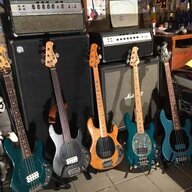
Bass Group.jpg
 
String choices are slim. I have a Spirit and use a string adaptor. It works and allows the use of regular strings.

For short-scale bassists, string choices might be much wider. I bought this bass:
SOLD - Ibanez Gary Willis Fretless w/ Short Scale Nova Headless Mod

...a headless, fretless, short-scale 5-string, and had no options at all for an appropriate short-scale string set. So I just bought one of many available long-scale sets (La Bella LTF-5A flats), chopped them off to fit, and they work perfectly.
 
Been formulating a “dream bass” build in my mind for a time. For some reason, without any significant proof, I’ve fixated on ideas like doing a headless bass (and maybe even multiscale).

For the sake of discussion, I’ll keep the question vague and open ended- what’s the DOWNSIDE to a headless instrument? Seems like the obvious cure for an ugly headstock, and why not have the instrument be a little less lengthy? ;)


Besides the fact that they're extremely cosmetically challenged you mean? :laugh:
 
I have a Kiesel Zeus 6 strings.

The only problem I have with mine is the B string. It is a bitch. You need shortscale or small gauge like 120 to make it in the hole at the headstock.

with their system you can use normal string so it isn’t more difficult than changing string on a guitar with a Floyd rose tremolo


As pros well it is light since it doesn’t have a headstock putting weight at the other end of the bass. It balances so well. Smaller gig bag.
 

Latest posts