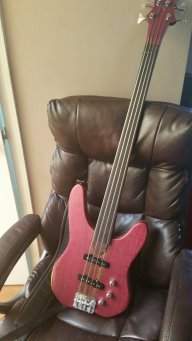
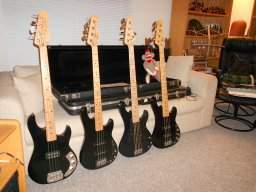
Stays in tune better and longer, straight pull on the string, not wrapped around a tuning peg, no ungainly headstock, shorter instrument, less neckdive if any and less chance of deadspots from the
resonance of a headstock.
This is an interesting topic - dead spots on headless basses. The usual one on the G string doesn't show up, because the mass loading on the bar (a bass neck is a mass loaded bar to the parlance of us Physicists) is different - no, the headstock doesn't resonate, the whole neck does, and the headstock is part of that, but removing the headstock does NOT remove the resonances from a neck - it just changes where things like dead spots will show up.
A headless neck does indeed have resonances that can lead to dead spots. One resonance that a regular neck doesn't suffer that much from is the lowest mode, where the entire neck flexes at once. It doesn't suffer that much, because the strings end well before the end of the neck, where the antinode is. Kramer's aluminum necked basses have a touch of this - the open A string has a bit less sustain than other areas of the neck, because the headstock is relatively short, but it's not really a "DEAD" spot - just a bit less sustain.
Any headless bass will have a frequency where the whole thing vibrates, and if there's an open string tuned to that frequency, it will be VERY dead. Most basses avoid this by being tuned elsewhere, but if you try alternate tunings, be aware that you can walk right into a
very dead spot if you re-tune. The bass with the absolute worst dead spot that I've ever encountered was a Traveler headless - the one that looks like a mini P with a sawed off headstock. The open A string, when you played that note, just shook the neck - it was a dull thud, without any real semblance of a pitch.
As far as other downsides, I'm not a fan of the leftward shift that comes from having the bridge saddles move further from the end of the instrument - I'm fine with standard FSO'ish ergonomics; the added reach of a headless is a step (albeit usually a small one) in the wrong direction.