• TalkBass has been independent since 1998. Add your voice.
    Create a free account to reply to discussions, view embedded media, and browse with fewer display ads.
    Join freeLog in
    Want zero display ads or expanded classifieds tools? Compare plans.

Dremel Tutorial / Help

Does anyone have any useful links to some online tutorials/videos on how to use a dremel tool to rout pickup cavitites and such? I'm apparently "pretty slow" in figuring out how to use one without it getting away from me and buggering things up. The routing I've done so far looks horribly rough, and there are numerous places where the tool ate up or routed more than it was supposed to - so I'll have to use wood filler to fix the goof ups. I have the tool itself, a bunch of bits, and a plunge router/holder thing. Am I missing some other crucial piece? I have a custom Carvin bass project that I that I started a few years ago, but I got frustrated and set it aside and would like to finally cross it off my "to do" list.
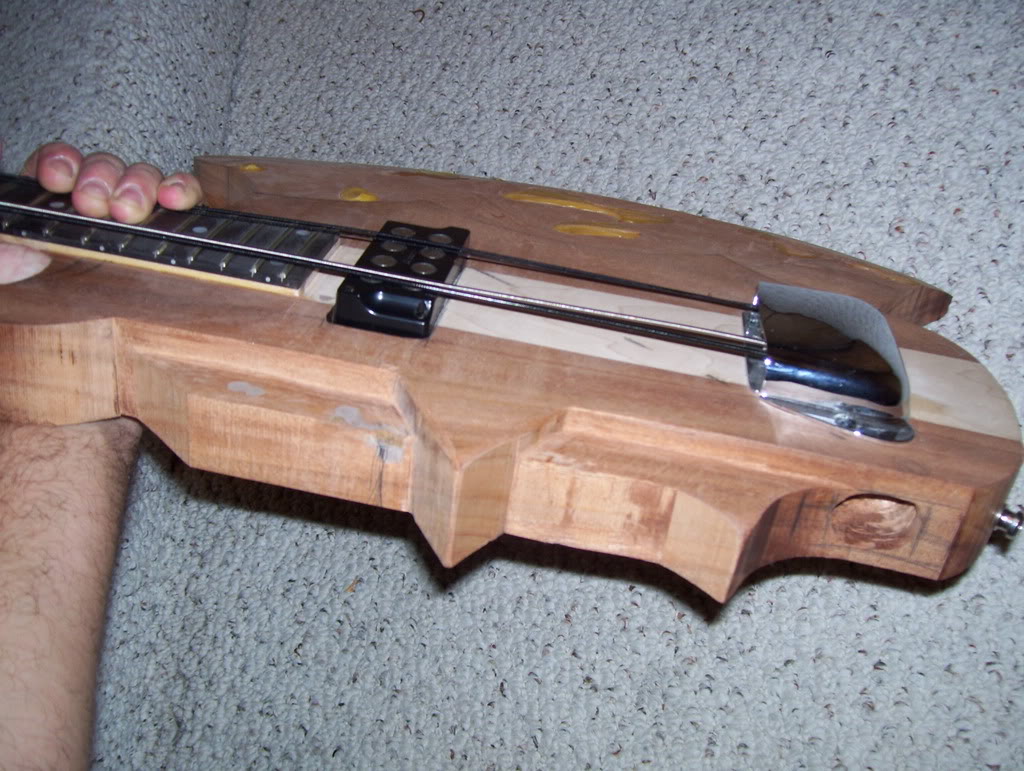
axebass2008005.jpg
 
Like Rickett said, they're not great for heavy duty routing, but they're alright for light detailing. It is hard to keep them from running away though.

Here's some tips:

Run the dremel at the highest safe speed and take small bites. I almost always have mine at the fastest setting. The high speed makes the tool much less likely to grab the workpiece. Just go slow the avoid burning. Taking too large of a cut will also cause extreme chatter (newer dremels are pretty shoddy), which can also lead to kickback.

Tuck your elbows into your sides. This helps steady your arms. If possible, brace one hand holding the tool against the workpiece. Use a thumb or knuckle as a fulcrum.

Avoid climb-cutting.This is when the bit is rotating it the same direction as the cut. This usually leads to kickback unless you go veeerrry slowly.

Finally, take your time! Rushing is the surest way to botch it up, and it's easy enough with a dremel.
 
Don't know about Dremel routing tutorials online...
My GF used a Dremel with their router attachment to make a swimming pool cavity on a Warmoth bass body of mine. Unlike me, she's patient & enjoys working with her hands; my offer of buying her the routing attachment was too strong for her to pass up. She did a darn good job, the route turned out pretty clean but we also had the benefit of the cavity being covered by a pickguard. If I decide to add a J pickup in the bridge position, I'll take it to a pro. I can't imagine a novice trying to do a J or P route without a guide. One little slip and you could end up with an unsightly gash in the bass (or your hands). Guys around town had quoted me around $50-60 for two pickup routes, pretty reasonable.
 
The problem with the Dremel tool is that it only has one setting - ON, and it feels like its running too fast. Thats why it gets away from me. I have a big router, but I've only ever used it once to round corners off of bass cabs, and I dont see how I could use that big thing in such a tiny area. Guess thats why I need some kind of instructional video or something. I don't have any templates or guides so I was just doing this all by hand / sight. Originally I got the Dremel tool because someone told me thats what I need for inlays, but after using it so far I dont see that working out very well either.
 
There are tons of dremels models-- mostof the newer ones have variable speed controls. I have a few of them, but I'd never route a cavity with them. The issue is that they lack power, and the small shaft sizes they use are qite flexible and prone to chattering. They are also not compatible with bearing/template bits- which is key when working on a something that needs to be very accurate.
If you have a real router- practice on some scrap wood. A REAL router may seem big for just a little pickup cavity, but their size is what allows them to be very stable, predictable, precise and powerful.
 
I don't have any templates or guides so I was just doing this all by hand / sight. Originally I got the Dremel tool because someone told me thats what I need for inlays, but after using it so far I dont see that working out very well either.

While it is true that a dremel is excellent for routing inlay cavities........

You can make your own templates, out of scrap pieces of wood, that you may already have. You can either "freehand" a template, or take 4 separate pieces of scrap (all of the same thickness, that is) and a bigger piece of scrap, that you'll make the template out of. For example, fit them around a pickup, then take your router with a 1/4" straight bit (most of which, the shank part can be used as a guide, while it cuts into the material below, that you'll use for the final template). Making templates aren't too terribly hard to make, plus it's much easier than "Freehanding" them.


Link Removed

Link Removed