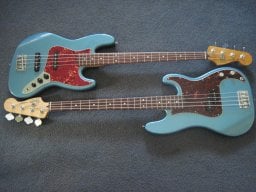
I've been experimenting (as usual), currently with scale length(s). I've got a new Chinese 32" scale neck paired with a mid-nineties Fender road-worn body, and so far the results are promising. One problem though: the neck is displaying some forward bow with the strings at pitch. I already have cranked the truss nut down as far as it will go with the strings slacked, but still the bow returns with the strings at pitch.
The truss nut is of the bullet type which adjusts at the headstock, and as I type this I can barely see the nut when I sight down the access hole. I would like to remove the nut and drop some washers over the rod and then replace the nut. Only thing is, the rod is so counter-sunk in the neck I cannot even see it. How do I drop washers when I cannot even see the target? How do I know if they dropped in right on target or if they are off to one side (tilted) or not even seated at all? I cannot see my targeted work area.
If adding washers is not a viable option the only alternative I see is to slack the strings and loosen the truss rod nut, and then clamp the neck into a viscious back-bow under a heat lamp and leave it set for a few days. If that fails I will just have to go to the lightest, lowest-tension strings I can find.
Can anyone suggest any other approaches?
The truss nut is of the bullet type which adjusts at the headstock, and as I type this I can barely see the nut when I sight down the access hole. I would like to remove the nut and drop some washers over the rod and then replace the nut. Only thing is, the rod is so counter-sunk in the neck I cannot even see it. How do I drop washers when I cannot even see the target? How do I know if they dropped in right on target or if they are off to one side (tilted) or not even seated at all? I cannot see my targeted work area.
If adding washers is not a viable option the only alternative I see is to slack the strings and loosen the truss rod nut, and then clamp the neck into a viscious back-bow under a heat lamp and leave it set for a few days. If that fails I will just have to go to the lightest, lowest-tension strings I can find.
Can anyone suggest any other approaches?