• TalkBass has been independent since 1998. Add your voice.
    Create a free account to reply to discussions, view embedded media, and browse with fewer display ads.
    Join freeLog in
    Want zero display ads or expanded classifieds tools? Compare plans.

Dual Peavey 1820's Bi-Amp Rewiring Question

Hey all, long time lurker, first time poster. This is definitely the place to find pretty much any info on anything bass related.
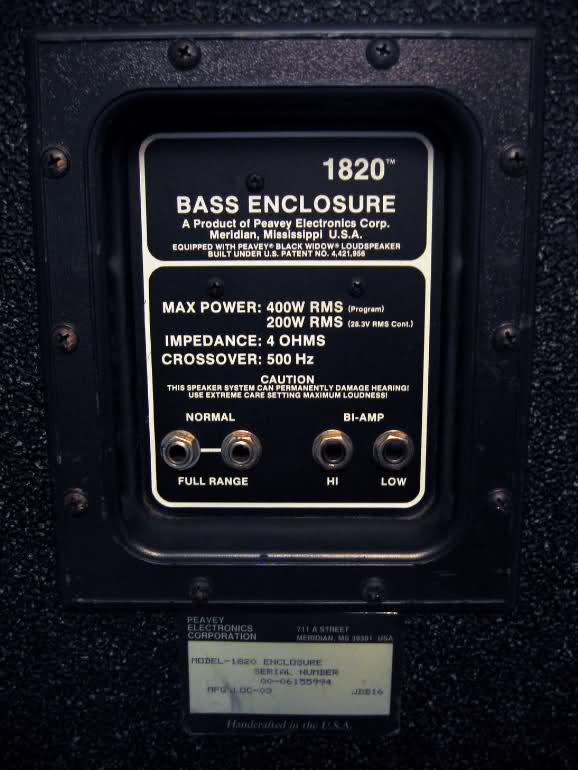

2ltkewh.jpg


On to the question: Is it possible to take the two bi amp inputs and wire two more in parallel (one each to the high and low) so that the cabinets could be daisy chained? If so, how would I go about this?

Thanks!

 
Thanks for the info!

Yes, my head will handle the 2 ohm load fine. And I'll use a wye cable if thats my only option, but I'm talking about the possibility of adding additional inputs to the existing faceplate (possibly right above them were the warning text is?). That way i could use regular speaker cables and not have to worry about having to use a special one.

Go like Amp>low, added low (wired in parallel to original low)>low in second cabinet, and then do the same for the highs.
 
I've been mulling this one over for a little while. At first blush drilling two holes and adding jacks wired in parallel would seem to be a simple job. BUT there are switching contacts to those that make things less simple. That plate probably has the crossover components mounted on it as well and there may not be room for the new jacks. You should take a look and tell us what you find.
 
I assume this is for a mono bass guitar signal and just want to make sure that you understand some basics of your endeavor. You need a two way electronic crossover. Also you want more power on the lows than the highs. Not sure at what ratio for this application since we're talking an 18 and two tens presumably crossed at 500 Hz.
 
BassmanPaul - Thanks, I hadn't even considered that. I'll take a look and post results.

Wighat - I was planning on using the two 1820s with a Carvin BX1500, and setting the crossover and power that way. That would work, right?

Also, after I figured out how to word my question more sensibly, I found this post from awhile ago: http://www.talkbass.com/forum/f15/ampeg-810-single-1-4-input-question-718901/

In that post they have a parallel daisy chain box

parallel_diaisychain.jpg


Would something like that work?
 
That route would be my suggestion of how to go. a simple plastic box with jacks mounted to it.

The BX1500 will indeed do what you want but I see it as a waste of resources. I run mine with a 4Ω 2x10 (Acme) on each channel. I feel you'd be better off forgetting the bi-amp aspect and running the same, one cabinet per channel.

At one time I ran a bi-amped system using four 1x12s for highs and two 1x15s for lows. The results were really good. That said, one five minute session with my first Acme convinced me to sell the whole bi-amp rig and buy three more Acmes.
 
Are the crossovers good in both Peaveys? I think they were kind of a weak link in those. I've probably seen at least as many with issues there as ones with blown drivers, though it could've been due to just old, dry electrolytics.

Anyway, your Carvin will do what you want. Advantages being the ability to control crossovers points and power distribution, giving you the ability to sort of "re-voice" the cabs from their current state if you'd like.
 
The BX1500 will indeed do what you want but I see it as a waste of resources... I feel you'd be better off forgetting the bi-amp aspect and running the same, one cabinet per channel.

I'd want to hear it both ways before deciding. I've watched opinions on this cab for a while, and have noticed that evaluations are generally more favorable from those who've run it bi-amped. Might be because the passive crossover in the cab isn't that great, or at least, not as good as the active crossovers being used.

Also, the BX1500 crossover goes lower than 500hz, so you could probably get a better power balance going active.
 
You can add parallel jacks, understanding these are switching jacks, that disconnect the speakers from the crossover.

Use mono jacks and wire each to the tip and ground connections of the existing switching jacks. Then when you plug your amp in, plug into the switching jacks (exisiting jacks) first, and run from the added parallel jacks to the second cabinet(s).
 
You can add parallel jacks, understanding these are switching jacks, that disconnect the speakers from the crossover.

Use mono jacks and wire each to the tip and ground connections of the existing switching jacks. Then when you plug your amp in, plug into the switching jacks (exisiting jacks) first, and run from the added parallel jacks to the second cabinet(s).

That was the nicest way of answering the original question, thank you! :hyper:
 
You can add parallel jacks, understanding these are switching jacks, that disconnect the speakers from the crossover.

Use mono jacks and wire each to the tip and ground connections of the existing switching jacks. Then when you plug your amp in, plug into the switching jacks (exisiting jacks) first, and run from the added parallel jacks to the second cabinet(s).

I thought of this too thus my mention of the switching contacts. I feel that it would be too easy to make a mistake when connecting up in a rush. You could end up with the high and low amps connected together.