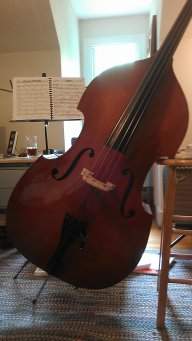
As mentioned in an earlier thread, Ryan @ Northern Lutherie provided me with a Dual Sensor model to review. I've logged about a dozen playing hours on it over the past several days, both solo and with a band. Although I do not currently have the means to provide good quality audio samples, here is my experience with the pickup....
Installation: This was the first piezo pickup I've installed in a DB. I was a bit apprehensive to do the install at first, but I took a look at Ryan's installation video on YouTube and I realized that this would be a pretty simple job.
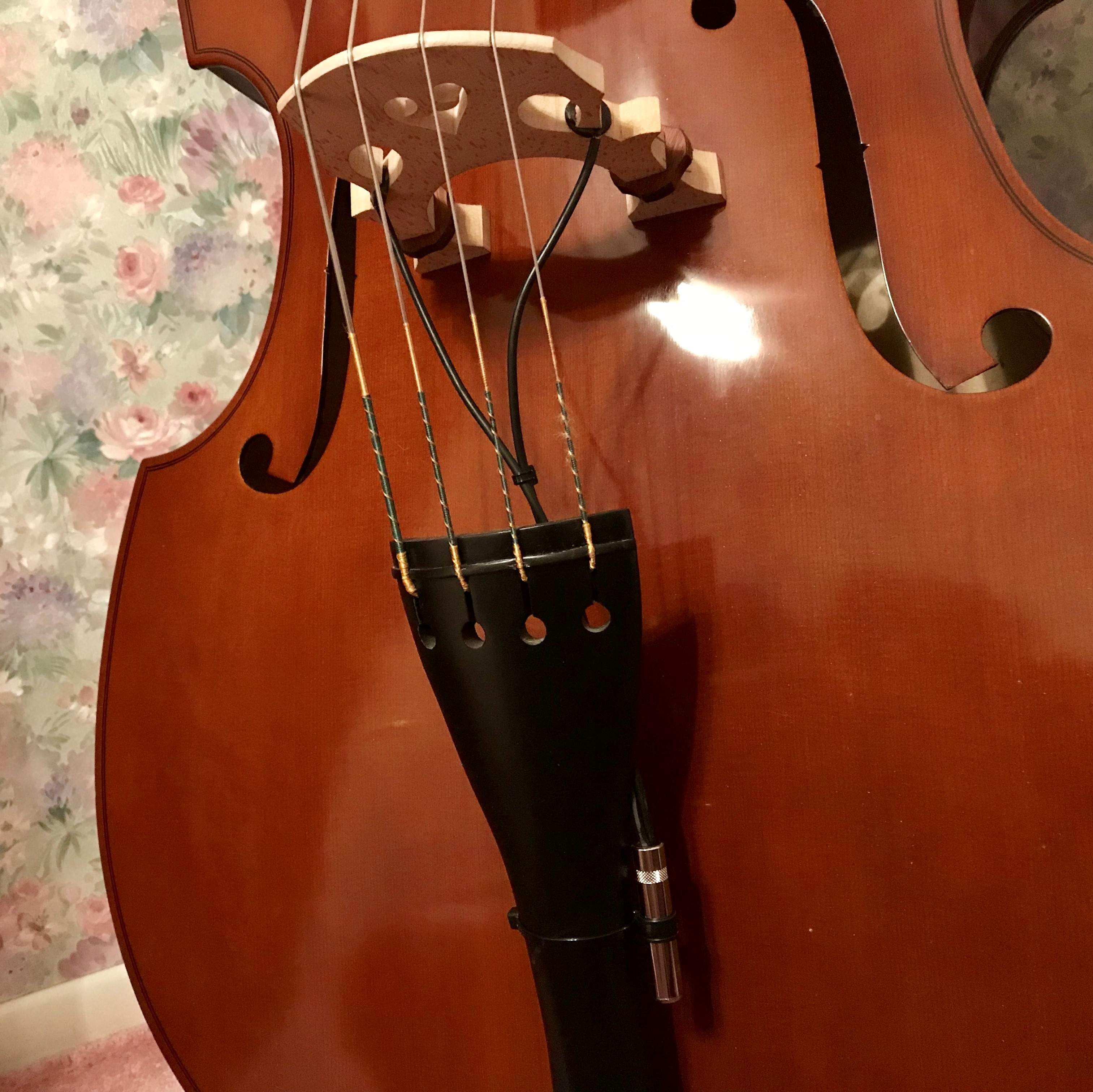
Both the bass- and treble-side wing tip openings on my bridge measured exactly 1/4". The piezo sensors were to slide into these openings. The design of the sensors was great; there was a large exposed metal underside and a soft rubberized top to help hold it in place. Each piezo sensor slid firmly into the openings and stayed put very well. The sensors' leads combined to a long metal jack assembly; the leads were made of fairly heavy-duty wire that should be able to handle most abuse nicely. The 1/4" jack assembly was well-made and came with a small "R" clip to hold it in place. The directions call for the G string to be temporarily removed and the clip to be strung through it. I chose to deviate from the instructions by instead fixing the jack assembly to the side of my tailpiece with a standard nylon zip tie (See picture).
In less than five minutes, I had the pickup completely installed and ready for initial testing.
First test: It was time to hear how this pickup performed in a solo setting. My signal path was as follows: Pickup > Fishman Pro-EQ > GK 1001RB-II (set flat) > GK Neo 112-II. As I was connected my lead to the output jack of the pickup, I immediately noticed that the jack was very solid and held the lead in place well.
My Fishman started out set flat as I fired up my rig and began playing some basic pizz runs. As I went through an E scale using all four strings, it became apparent that the pickup was reproducing each string with perfect balance. I started playing further down the neck; the tone remained balanced. No strings sounded louder or quieter than the others. The next thing that became apparent was that the pickup was doing an excellent job of recreating the natural tone of my bass. There was no "coloring" from the pickup that I could identify. I could clearly hear all of the nuances of my bass and the dynamics of my playing. Even during quieter parts, I noticed that there was no noise or even a hint of feedback. I jacked the volume way up to see at what point the bass would begin to go into feedback. I had to get the amp up insanely loud before it would howl at me; certainly much louder than I would ever need to be.
It was time for some arco playing next. Keep in mind that I have Helicore Hybrids on my bass; they aren't exactly a perfect match for the bow. I ran my (French) bow through some scales and varied my dynamics to hear how the pickup responded. It reacted perfectly and represented my bass's tone well. I noticed that the pickup did a great job of reproducing the "good" reverberation left from my louder bowed notes. This is an area that I have not had good luck with when using a microphone, so this was a pleasant surprise.
I continued to play solo for several more hours to experiment with the pickup's response to different EQ settings, volumes, playing styles, etc. By the end of it, my overall findings were that the pickup represented my bass's tone authentically and without adding tonal color.
With a band: My band is a four-piece -- Vocalist/acoustic guitar, electric guitar, hand percussion, bass. We primarily do folksy and jazzy renditions of covers and some originals. We did a rehearsal using the same Dual Sensor-equipped bass and rig. This was a PA-supported rehearsal, which we do whenever we are preparing for a louder show. This also gave me a great opportunity to hear how the pickup reacted to high volume with a combination of other instruments.
We started running through some basic folk and rock tunes. I noticed that all sounded well as I played some pizz, except the mid-low frequencies were not quite as pronounced as they sounded solo. A quick bump to my 1001RB-II's mid-low EQ control took care of that easily. I then noticed that my E string appeared just a tad quieter than the other strings. Between songs, I nudged the bass-side pickup sensor to a slightly different position. This made a huge difference in terms of bringing the E string back up to volume!
There are only two songs that I have arco parts in. For these songs, I found that I had to turn the amp down a bit, otherwise the DB's tone overwhelmed the other instruments. It still provided that nice bowed reverberation that I noted from my solo playing.
Overall: My experience with the pickup and Northern Lutherie, as a whole, has been quite positive. The Dual Sensor was exactly what I was looking for: A low-cost, natural sounding, responsive pickup that rejects feedback well. It hit all of these points in spades. The only trouble that I ran into with the pickup was in a live setting when I needed to EQ it a bit....which really wasn't much trouble at all.
Ryan has been great to work with. He clearly has a strong interest in making sure that his customers are well-supported. It's also apparent that he put quite a bit of time and effort into designing this pickup to be "just right". If/when the time comes for me to purchase another DB piezo, Northern Lutherie will certainly be high up on my list for contenders!
Installation: This was the first piezo pickup I've installed in a DB. I was a bit apprehensive to do the install at first, but I took a look at Ryan's installation video on YouTube and I realized that this would be a pretty simple job.
Both the bass- and treble-side wing tip openings on my bridge measured exactly 1/4". The piezo sensors were to slide into these openings. The design of the sensors was great; there was a large exposed metal underside and a soft rubberized top to help hold it in place. Each piezo sensor slid firmly into the openings and stayed put very well. The sensors' leads combined to a long metal jack assembly; the leads were made of fairly heavy-duty wire that should be able to handle most abuse nicely. The 1/4" jack assembly was well-made and came with a small "R" clip to hold it in place. The directions call for the G string to be temporarily removed and the clip to be strung through it. I chose to deviate from the instructions by instead fixing the jack assembly to the side of my tailpiece with a standard nylon zip tie (See picture).
In less than five minutes, I had the pickup completely installed and ready for initial testing.
First test: It was time to hear how this pickup performed in a solo setting. My signal path was as follows: Pickup > Fishman Pro-EQ > GK 1001RB-II (set flat) > GK Neo 112-II. As I was connected my lead to the output jack of the pickup, I immediately noticed that the jack was very solid and held the lead in place well.
My Fishman started out set flat as I fired up my rig and began playing some basic pizz runs. As I went through an E scale using all four strings, it became apparent that the pickup was reproducing each string with perfect balance. I started playing further down the neck; the tone remained balanced. No strings sounded louder or quieter than the others. The next thing that became apparent was that the pickup was doing an excellent job of recreating the natural tone of my bass. There was no "coloring" from the pickup that I could identify. I could clearly hear all of the nuances of my bass and the dynamics of my playing. Even during quieter parts, I noticed that there was no noise or even a hint of feedback. I jacked the volume way up to see at what point the bass would begin to go into feedback. I had to get the amp up insanely loud before it would howl at me; certainly much louder than I would ever need to be.
It was time for some arco playing next. Keep in mind that I have Helicore Hybrids on my bass; they aren't exactly a perfect match for the bow. I ran my (French) bow through some scales and varied my dynamics to hear how the pickup responded. It reacted perfectly and represented my bass's tone well. I noticed that the pickup did a great job of reproducing the "good" reverberation left from my louder bowed notes. This is an area that I have not had good luck with when using a microphone, so this was a pleasant surprise.
I continued to play solo for several more hours to experiment with the pickup's response to different EQ settings, volumes, playing styles, etc. By the end of it, my overall findings were that the pickup represented my bass's tone authentically and without adding tonal color.
With a band: My band is a four-piece -- Vocalist/acoustic guitar, electric guitar, hand percussion, bass. We primarily do folksy and jazzy renditions of covers and some originals. We did a rehearsal using the same Dual Sensor-equipped bass and rig. This was a PA-supported rehearsal, which we do whenever we are preparing for a louder show. This also gave me a great opportunity to hear how the pickup reacted to high volume with a combination of other instruments.
We started running through some basic folk and rock tunes. I noticed that all sounded well as I played some pizz, except the mid-low frequencies were not quite as pronounced as they sounded solo. A quick bump to my 1001RB-II's mid-low EQ control took care of that easily. I then noticed that my E string appeared just a tad quieter than the other strings. Between songs, I nudged the bass-side pickup sensor to a slightly different position. This made a huge difference in terms of bringing the E string back up to volume!
There are only two songs that I have arco parts in. For these songs, I found that I had to turn the amp down a bit, otherwise the DB's tone overwhelmed the other instruments. It still provided that nice bowed reverberation that I noted from my solo playing.
Overall: My experience with the pickup and Northern Lutherie, as a whole, has been quite positive. The Dual Sensor was exactly what I was looking for: A low-cost, natural sounding, responsive pickup that rejects feedback well. It hit all of these points in spades. The only trouble that I ran into with the pickup was in a live setting when I needed to EQ it a bit....which really wasn't much trouble at all.
Ryan has been great to work with. He clearly has a strong interest in making sure that his customers are well-supported. It's also apparent that he put quite a bit of time and effort into designing this pickup to be "just right". If/when the time comes for me to purchase another DB piezo, Northern Lutherie will certainly be high up on my list for contenders!
Last edited: