• TalkBass has been independent since 1998. Add your voice.
    Create a free account to reply to discussions, view embedded media, and browse with fewer display ads.
    Join freeLog in
    Want zero display ads or expanded classifieds tools? Compare plans.

dynacord BA300

Something I always wanted to do with the Dynacord amps was to use effects to run into the extra inputs, then mixing these with the controls. But my current band calls for a Precision Straight In Preferably With Flats, so I never got around doing it. My G-2000 is now the amp I practice with with the band. (Thanks Beate, again, for hooking me up with the seller :)
 
My Eminent II has arrived, it all seems to work, there are no issues with hum or noise, it has the correct fuses and the valves are not red-plating or microphonic. The valves are a Telefunken ECC81 and a pair of Hoges EL34, which I gather are re-badged RFT EL34s. I haven't had the chance to check voltages or bias yet, but I will do that.
I used a tuner pedal in bypass mode to act as a buffer so that my bass was seeing 1Mohm impedance, and it sounds quite good - very clean. I haven't had a chance to turn it up yet.
While the amp doesn't seem to require troubleshooting, I still intend to replace the filter capacitors for the HT and bias supplies and replace the bias trimmers with more modern types just to make it a little more reliable. One section of the can capacitors has been disconnected and replaced with a pair of 350V axial capacitors in series, though from the appearance of the capacitors this must have been done more than 20 years ago.
I might add a direct input to the power amp section so that I can build a B15n style preamp in a small box to use with it - this feels less invasive than replacing the preamp section of the Dynacord.
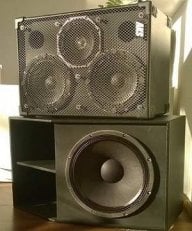
This cab is a small 1x10" which I use for quieter settings, though the Dynacord will mostly be used with the pair of 1x12" cabs I am building at the moment.

20160120_165251_zpsdxleb9wy.jpg
 
I might add a direct input to the power amp section so that I can build a B15n style preamp in a small box to use with it - this feels less invasive than replacing the preamp section of the Dynacord.

Nice. This one seems to be newer than mine.

I don't believe You'll need to modify the amp for using it a different preamp. There are plenty of inputs on the back of the amp. But if You do, i would suggest feeding it through a decoupling resistor parallel to R400 into the connection between R400 and C400 into the input of the first tube stage. In that case Your preamp must be able to deliver 7 Veff = 20V peak to peak.
BTW: schematics are on Invalid Link Removed.
 
Nice. This one seems to be newer than mine.

I don't believe You'll need to modify the amp for using it a different preamp. There are plenty of inputs on the back of the amp. But if You do, i would suggest feeding it through a decoupling resistor parallel to R400 into the connection between R400 and C400 into the input of the first tube stage. In that case Your preamp must be able to deliver 7 Veff = 20V peak to peak.

I think this must have been towards the end of this model's run, as there's a factory label inside the back which dates it to May 1978.
Regarding a power amp input, I could add a socket on the back with a 100k resistor (duplicating R400) feeding into C400 as you suggest. It looks like the input impedance here should be high, and reckon a B15n preamp may well be able to provide enough voltage swing into this input, but if not I'm sure I can find a way around that.
 
Probably. In 1979, an Eminent III appeared, which was completely solid state.

BTW: You might add a buffer for full decoupling and maybe give it some gain (e.g. a FET gain stage with strong local negative feedback). An opamp might be problematic due to the large voltages in the preamp section.
 
Last edited:
Make sure there is a opening at the bottom and top. The thing wich puts Dynacord tube amps at the top of the foodchain in terms of tubelife is its cooling. Heat goes up. And while it moves up, cool air gets in from the bottom. It's called convection cooling.
 
Probably. In 1979, an Eminent III appeared, which was completely solid state.

BTW: You might add a buffer for full decoupling and maybe give it some gain (e.g. a FET gain stage with strong local negative feedback). An opamp might be problematic due to the large voltages in the preamp section.

I'm going to do some work on my Eminent II this week, replacing the filter capacitors and bias trimmers. When you talk about adding a FET buffer to the inputs of these, do you have a preferred circuit? I think I have some BF245 and 2N5457 FETs stored away which might be useful for this job, as I recall you had mentioned the BF245 earlier in the thread. Initially I will work on adding buffers to the existing inputs rather than trying to add a power-amp in.

 
Last edited:
Here the amp again. An old image: currently all buttons except the vol and tone controls of the lower channel are missing.

g2000-jpg.jpg


I will add them back as additional functionality will be added. That will definitely be a 2nd channel, and the switches to extend the tone control will come back as well. My idea is to use this amp as the main amp for my duo project, where i need two or maybe even three channels.

This evening i ran the amp with a rectangle signal over load resistances, and everything seemed functional. Tomorrow i'll test it with the bass - the first time at all, since the amp was unusable when i bought it.
 
  • Like
Reactions: rust_preacher
Wow, it sounds great, even with the old tubes. Not quite as transparent as the Mywatt, but really powerful. I would guess in a band context it would have more punch than the Mywatt. I'll take it to our rehearsal room...

I think it might need a few extensions, e.g. a bright switch. And the sensitivity could be a bit larger. But it seems sufficient to fully drive the power stage.

Addition: back from the rehearsal room. At least one tube seems to be microphonic. I'll check that ASAP. Really bad: apparently it killed a speaker - an Eminence Kappalite 3015 :-(

I am a bit surprised that an amplifier with about 130 W (that's what is to be expected as well as measured because of the rail voltage of 230 V into the 240 V power input) kills a speaker with a nominal power rating of 450 W / 900 W :-( :-( :-(
 
Impressive. My impression is that a G-2000 will always sound massive. I plan to play it through a pair of Oberton 15L400.

BTW, i am really impressed on the Bone Ray tonestack in my preamp. For practical reasons that tonestack can be imagined as an AMZ one knob tone control for treble and bass plus a contour pot reducing the frequencies around 250 Hz.

I just started to restore a HiFi-Favorit 2 - that's the smaller version of the G-2000, which again is so heavily worn (a lot heavier than the G-2000 was), that it is again a candidate for a new preamp.