• TalkBass has been independent since 1998. Add your voice.
    Create a free account to reply to discussions, view embedded media, and browse with fewer display ads.
    Join freeLog in
    Want zero display ads or expanded classifieds tools? Compare plans.

Ebonol Fingerboards

Do you like ebonal fingerboards?

  • Yes

    Votes: 87 50.6%
  • No

    Votes: 35 20.3%
  • Whuzzat?

    Votes: 50 29.1%

  • Total voters
    172
I can't really decide if I like ebonal fingerboards on fretless basses or not... anyone else have an opinion?

Ebonal is a synthetic polymer (I think) that is being used on fretless fingerboards instead of ebony. To me it doesn't sound as good as a wood fingerboard and acts almost as one giant fret. It also seems that intonation is easier or doesn't matter as much on ebonal somehow. The new Squier Jaco signature model and the Pedulla Buzz basses use this material, and I'm sure others do as well.
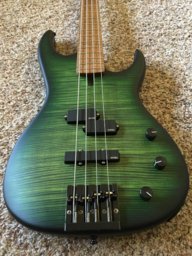
 
I have one with ebony, and one with rosewood coated multiple times with a non-petorleum based epoxy. But I've played a couple fretlesses with some type of composite and found it to be a good way to go too. Perhaps there was something wrong elsewhwre in the bass you tried, or maybe it was a different mix.
 
I think ebonol's fine. I'd prefer epoxy or polyester coated ebony or even uncoated ebony.

It all depends on what kind of tone and feel you're going after. Some guys prefer a real woody feel and tone, in which case they're probably not going to like ebonol.

I grew up playing mainly a fretted Steinberger which has a phenolic board (synthetic material, very hard, black). Ebonol seems similiar so I always get a very familiar feeling when I play ebonol boards.
 
prsbass2 said:
I had an ebonal fingerboard on my Precision..... Had roundwounds on it for 5 minutes....Word of warning...they mark it!!! Always fit flatwounds...Mine was a Mighty Mite neck..

If you use rounds you're going to get marks on almost any fretless board. I've seen plenty of coated boards that were marked. Just because they have marks doesn't mean they're getting eaten up. You can play years with rounds and never have to do anything to the fretboard under normal playing conditions.
 
LifeIsBass said:
Pedulla Buzz basses do NOT have ebonol boards. Their boards are real ebony with a polyester coat. Best fretless sound you can get IMO.

Really? My bad, I was fooled. It's kind of relieving in a way that Squier and Pedulla aren't doing the exact same type of necks.

I think I prefer naked wood, but the Pentabuzz I tried was great.

Is intonation easier on ebonal and epoxy or am I just having a harder time because I have more strings? I haven't tried an epoxy or ebonal six-string, and my fretless six is the only fretless I've had long-term experiance with...
 
Let's talk about that phenyl-impregnated and heavily compressed birch that Zon uses on their fretless and many of their fretless basses. I am a big fan of ebony, but have recently gotten a Zon fretted and think this material is great, and also had two minutes on a fretless Zon with a fretboard made from this stuff, and found it pretty darned impressive!
 
Ebonol boards? Love it!

They sound great, lending a nice clear tone to the bass, with a lot more definition than you'd get from rosewood. As Squier have shown, it's a cost effective alternative to ebony.

I played an Ibanez Gary Willis and it was fantastic. I love Ebonol!

(Plus, I also love the coated ebony of the Buzz basses!)
 
I had have many different kinds of fretless boards on my basses with Fender, Carvin, Steinberger Synapse, Traben, Wishbass, and the new Vintage modified Squier. Hell if I can tell a difference between one material and the other or how it effects the sound. Sure, all the basses sound a little different, but how much the board has to do with that I really don't know. My guess it not nearly as much as most other components of the bass. As long as the neck/board material feel fine to you, I wouldn't worry about it. Besides, at least for me, my fingers touch the strings, not the board so I really don't care what material is being used as long as it is a decently put together bass. I've never had a problem with any fretless boards other than having my oldest (Carvin) smoothed out one time after years of playing.
 
BassDudeSA said:
I had have many different kinds of fretless boards on my basses with Fender, Carvin, Steinberger Synapse, Traben, Wishbass, and the new Vintage modified Squier. Hell if I can tell a difference between one material and the other or how it effects the sound. Sure, all the basses sound a little different, but how much the board has to do with that I really don't know. My guess it not nearly as much as most other components of the bass. As long as the neck/board material feel fine to you, I wouldn't worry about it. Besides, at least for me, my fingers touch the strings, not the board so I really don't care what material is being used as long as it is a decently put together bass. I've never had a problem with any fretless boards other than having my oldest (Carvin) smoothed out one time after years of playing.

+1
 
BassDudeSA said:
I had have many different kinds of fretless boards on my basses with Fender, Carvin, Steinberger Synapse, Traben, Wishbass, and the new Vintage modified Squier. Hell if I can tell a difference between one material and the other or how it effects the sound. Sure, all the basses sound a little different, but how much the board has to do with that I really don't know. My guess it not nearly as much as most other components of the bass. As long as the neck/board material feel fine to you, I wouldn't worry about it. Besides, at least for me, my fingers touch the strings, not the board so I really don't care what material is being used as long as it is a decently put together bass. I've never had a problem with any fretless boards other than having my oldest (Carvin) smoothed out one time after years of playing.
I'd respectfully disagree with this. The fingerboard material is essentially acting as a fret on a fretless. The point the strings touches the board, and the slight angle in which it moves away from the board are going to make a difference. The harder the wood (or material) the cleaner the seperation between board and string. Over-the-top comparison, but think of fretting a string on a piece of steel compared to a sponge. I think, all thing created equal, the board will make an obvious difference.

Hell, people argue the difference of, say Rosewood and Maple, on a fretted. I think it's a generality, but there is a difference. Take the frets away, and it becomes an even more integral part of the sound.
 
Eric618 said:
Hell, people argue the difference of, say Rosewood and Maple, on a fretted. I think it's a generality, but there is a difference. Take the frets away, and it becomes an even more integral part of the sound.

Obviously every little component of a bass will make somewhat of a difference, even down to the plastic used on the pickguard (if any) and the kind of screws and bolts used. Perhaps the material the board is made from has more impact than those, just HOW much impact is debatable. If you like a bass, it sounds good overall, don't worry about the board material. All things being equal, if you had the choice of board material as an option on a custom bass, then make your pick, otherwise don't worry about it. I never have, and surprisingly I've actually been fine.
 
I am not certain of the process by which Ebonal is arrived at, but I have become a huge proponent of Garolyte/phenolic - I suspect they are very similar materials.

It works and sounds like ebony, and holds up better. A definite plus is that it is absolutely black and polishes to a very high gloss with no finish on it at all. It holds a finish well too, which can be an issue with some non-organic material and oily woods such as ebony and rosewood.

Sorry for the builder geek-speak... just wanted to share.
 

Latest posts