• TalkBass has been independent since 1998. Add your voice.
    Create a free account to reply to discussions, view embedded media, and browse with fewer display ads.
    Join freeLog in
    Want zero display ads or expanded classifieds tools? Compare plans.

Ebony or rosewood...which is best?

Thanks to the bone-headed implementation of CITES, rosewood is 'RIGHT OUT' for the foreseeable future. :mad::mad::mad::mad::mad::mad::mad::mad::mad::mad::mad::mad:

Aside from that I don't really care what a fretboard is made of. Some is more aesthetically pleasing in certain situations, but whether Rosewood, Ebony, Maple, or any of a host of other materials - it all seems to hold the frets in place ... :bassist:
Ah... There's my cue for a quick sidebar.
How about....... Black Walnut. :nailbiting::rolleyes::eyebrow:
Looking at the new Gretsch Junior Jet Bass, they come in Olive Green :vomit: and Walnut Stain :smug:.
Unlike the previous Black and Burst (RIP) which have CITESwood (Rosewood) these two new ones have Black Walnut fretboards.
Deal breaker or worth givin it a go?

OK back to the Rosebonymaple discuss... Thanks
 
For me it seems mostly a matter of cosmetics which to prefer. To my ears, I don’t think fingerboard wood has enough of an effect on tone or playability (assuming it has any effect at all) to worry about it.

Although ebony is technically harder than rosewood, and rosewood harder than maple per the Janka Hardness Scale, for the amount of force necessary to damage any of them it’s pretty much immaterial. You can’t press down hard enough with your hands for it to make any difference.

More interesting from a fingerboard perspective would be a comparison of the relative resistance to abrasion since you’re more likely to be able to abrade a fingerboard (especially with steel roundwounds) than you’d be to dent it like the Janka test does. Unfortunately I haven’t been able to find a comprehensive list showing relative abrasion resistances among different wood species. But based in my own casual observations over the years, I’d suggest maple is best, rosewood worst, and ebony somewhere in the middle for holding up to wear.
 
For fretless, ebony because it's a harder wood. For fretted, either is fine, and I like both. The only fretboard wood I sometime have an issue with is maple. It's not the wood itself, but sometimes maple boards come with a sticky lacquer finish.

This. My 6 is ebony and my 7 is rosewood. What I notice is the ebony has a faster and brighter mwah, where the rosewood the swell is slower and darker. I also agree with the durability of the ebony.

I love the glowing look of a maple fingerboard between a darker body and matching headstock.

All of these are for unfinished. Or at least some oil finish. I don't like finish over the playing contact surface that will wear off.
 
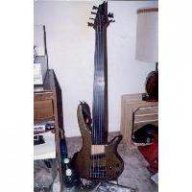
Sorry :D I prolly should take a familly shot

maple, rosewood, rosewood, ebony. I love them all!

15012017090 - Copie.jpg
DSC Copie.jpg
small pic.jpg
19052011121 - Copie.jpg


may the bass be with you

Wise(b)ass
 
  • Like
Reactions: wmmj
Most of my basses are quite old, pre-CITES and my preferences are based on looks and touch-feel. "Rosewood" was my least favourite because, as pointed out previously, Indian Rosewood isn't; and I don't massively like that multiple-needle-hole look, and it subjectively feels just a touch spongier. I have an old Yamato which is a plank and tin in all respects except the neck which is a lovely, glossy maple back (providing a brilliant excuse for my slow playing) and what really appears to be a south american rosewood fingerboard. Lovely colour and grain, and less mushy touch. A granite-black ebony looks and feels great; chocolatey, stripy ebony doesn't appeal so much to me.
If my money and talent justified a Stingray 5 brand new to my choice, I'd want the maple fingerboard. Again, just on looks and touch, not tone emphasis. Buying used/relic'd, a 50s Precision with a maple board tells people I'm too r'n'r to wash my hands and I use the 3rd and 5th frets a lot.

If I wanted tone emphasis, abalone blocks give me the 800-1500Hz boost for Fusion whereas MOP boosts the 70-320Hz region for classic rock. Clay dots allow me to grow extremely small root vegetables.
 
  • Like
Reactions: Wisebass
Neither is best. They're just different.

I strongly prefer ebony for fretless fingerboards because it's harder.
It really depends on the bass. I tend to prefer Ebony over Maple, and Maple over Rosewood. But... if the bass speaks to you, then it doesn't really matter.

I agree, although what I have on my Warwick is a little odd looking after looking at mostly rosewood or maple fingerboards for 60 years,,
 
On a fretted bass, if given the choice between Rosewood and Ebony I'd choose .... wenge.

My basses have...
Rosewood
Ebony
Pao Ferro
Wenge
Ebonal
Maple
Carbon Fiber
And probably some other wood as well. They all sound great.

In fretless I've got ebony, rosewood, and maple and something I don't remember what on my Wishbasses. They do all sound great! But if I have to make a choice for fretless I'd go with Ebony first. Then I'd go with rosewood. It's more mellow than ebony but still great. All the others after that.
 
  • Like
Reactions: GBassNorth
I just was wondering which one most bassplayers prefered and why.

It's a matter of personal taste for color and tone. A higher wood density tends to make the sound brighter. Color is just subjective.

Ebony is a dark wood, and bright sounding wood.

Rosewood is a slightly warmer sounding wood, but is actually a fairly hard wood.

Maple is the softest wood, so it's finished more heavily to harden it up, which makes it brighter than Rosewood.

Or at least that's my understanding. It boils down to what color you want your fretboard to be, and minor considerations for tone. Bright vs. Warm.
 
  • Like
Reactions: Watchootognbout