• TalkBass has been independent since 1998. Add your voice.
    Create a free account to reply to discussions, view embedded media, and browse with fewer display ads.
    Join freeLog in
    Want zero display ads or expanded classifieds tools? Compare plans.

End grain glue joints stronger?

Hmmm. I would assume that it's a simple matter of the grain always follows the length of boards and when making something like a bass body, the the grain always just follows the length. Plus it looks better having the grain run lengthwise. So it just always ends up that you're gluing side grain.
Let me think about this for a sec.......

...yeah, it would look funny, having the grain go across the body. No?
 
Hmmm. I would assume that it's a simple matter of the grain always follows the length of boards and when making something like a bass body, the the grain always just follows the length. Plus it looks better having the grain run lengthwise. So it just always ends up that you're gluing side grain.
Let me think about this for a sec.......

...yeah, it would look funny, having the grain go across the body. No?

Well, I would say yes, but maybe some people would think it is cool. Either way, the example was a bit contrived for the bass audience here and other things would also come into play. You wouldn't want your neck pocket on the side grain for instance. But if you only wanted the strongest possible slab in the joint axis then go with the end grain.
 
There are some major problems with a cross grain body that have nothing to do with the strength of glue joints.

A piece of wood that's wider in crossgrain than it is in length is inherently unstable and will want to cup over time. It's just the nature of wood grain. In a cross grain body this cupping would be happening in a way that would actually change the distance from the bridge to the nut and raise or lower your action. Keep in mind that the natural shrinking and swelling happens mostly in that direction as well so any seasonal changes would also affect your intonation.

Another thing to consider is that while his results about glue joints are incomplete (and inherently flawed in my opinion) he did successfully show that long grain is many times harder to break under pressure than crossgrain. Remember how the edge grain joints never actually broke but the wood did? You've now put the tension of the strings against the grain orientation that consistenly broke instead of against the long grain that took thousands of pounds of pressure to break.

The most immediate problem that Jeff has already mentioned is that an end grain neck pocket would be terribly weak to bolt a neck to. We've already seen in the video that the wood breaks most easily in that orientation but you also have to consider the potential of the bolts splitting the woodgrain the same way a screw or nail can. You're going to have the same issue with the two end grain horns. All the weight of the body and neck, plus the added stress of just moving around and playing the bass is going to put a lot of pressure on that upper horn where your strap button is attached. That's a point that is going to be inherently weak and prone to breaking.
 
Last edited:
I am probably stating the obvious here, but I don't think we really design basses in order to optimize glued joint strength for any particular joint. We design them in order to optimize stability and stiffness along the path that supports the strings, and then come up with the best joinery for the joining problems that result from the design optimized for stability and stiffness. To me, the decision hierarchy is pretty clearly: 1) orient wood for stability along the string path, 2) choose the best joinery for good stability/strength/ease of use, 3) tweak the joinery based on the fastening method (glue, screws, etc).

That approach pretty much dictates that the neck, fretboard, and body (at least the center) have grain running in parallel with the strings. That leaves you with a possible scarf at the headstock, and either a glued or screwed tenon at the body or a through neck. Glue or screw strength is important of course but the "win" is in the decisions you're making prior to making decisions about glue. A bass designed with the right parameters optimized will be great regardless of whether or not the glue joints are 100% optimized for strength, since the design overall is already optimized and a glued joint that, in theory, has some sub-optimal properties is still way more than good enough to support the design.

To make an analogy, when someone at Toyota is designing a new car, they don't throw out the concept of using 5 lugs to hold the wheel on to the hub just because there are other fastening methods that will clamp the wheel on even stronger. And hey, you know, the wheel would be held to the body even more strongly if they just took the bearing out of the hub and welded it together! A wheel that doesn't turn is stronger than one that turns, right?

Many moons ago when I was in engineering school, I had a mentor who's mantra was "don't try to optimize everything, just optimize the right things." Just because end grain glued joints are stronger doesn't mean that we should try to take advantage of that, because doing so would de-optimize other parts of the design.
 
At any rate I feel like there's a conclusion from the video that's on the verge of getting missed, because the video really just seems to be an obvious conclusion wrapped in a (perhaps unintentional) clickbait presentation. It isn't a matter of if endgrain or sidegrain glued joints are stronger. This video is really showing two conclusions: 1) glue is stronger than a piece of wood across the grain, and 2) glue is weaker than a piece of wood along the grain. I think we all already knew that, and it doesn't really tell us anything AT ALL about joinery. It's just restating the obvious truth that it's easier to break a piece of wood across the grain than along it.
 
I think the 4"x4" squares affected that end grain result. The pressure points are almost on top of the glue joint. If those were 8"×4" pieces you would get way more leverage and the joint would fail under much less pressure. If you glued two 16"×4" boards together end to end you could break that joint over your knee fairly easily.
What you are referring to is torque. Torque increases based on a lever arm. So if you apply 1lb of force on the end of a 4 inch lever it will cause less force at the joint than if you apply 1lb of force on the end of an 8 foot lever. But the force the glue fails at is still the same regardless of the arm.

Also, my arms are only 2.5ft long, so I can't reach the ends of a 16 foot board.

My impression of the vid wasn't that he was telling people to use end grain glue joints. Or that they should/could be used in any particular application.
My impression was that this was simply informational and explorative. Designed to confirm or dispell the belief that end grain glue joints are weak.
All things being equal, I came away from this believing that they are not weak, on their own. In fact, the data showed it took 3x the force to cause a failure.
So, for the folks calling BS,..... What part is BS? Is the data fake? Did I miss something?
I agree. He wasn't saying you should do end grain glue ups as your preferred joint. He was just saying end grain does not inherently weaken a joint compared to side grain. At least that was my take away. He even said no good wood worker would make this joint on one of the tests.
 
  • Like
Reactions: TrustRod
I saw an interesting experiment carried out in a reasonable way with a surprising result, and quite a few people who seem to be a bit upset by it!
Yes we all expected the butt joint to fail on the glue line but none of us thought that it would actually take more force to break that joint than a side grain joint.

It's just restating the obvious truth that it's easier to break a piece of wood across the grain than along it.

You've got that the wrong way round haven't you? It's much easier to split a piece of wood along the grain than across it.
 
  • Like
Reactions: Max Bogosity
It makes sense to me that an end grain-to-end grain glue joint can be stronger than a side grain-to-side grain glue joint, if all else is equal. The glue will probably get a better grip into the fibers of the wood in the end grain.

But.....That depends on several big factors. Like GilmourisGod said, a critical thing is that the glue doesn't soak in to the end grain too much and starve the joint. Likewise, if there's any gap filled with glue, the glue needs be able to fully cure. Many woodworking glues have a real problem curing in the middle of a joint, if they can't get enough moisture and air.
In the violin making world, end grain is usually sized by applying a few thin coats of hide glue before actually gluing the joint. This prevents a glue-starved joint.

Of course, this won't work with PVA and other glues, unless you mix up a little that is thinned, apply and let it soak in for a short time, and then apply the full strength glue and clamp up while the sizing is still partially wet.

This is why long cure time epoxies work so well, is because they allow deep penetration into the pores of the wood, before curing.
 
The other factor about an end grain butt joint is that it's usually very small cross-sectional surface area. As compared to most side grain joints, which have much more contact area. The butt joint, in bending, will have very tensile load on one side. And we know from experience that a glued butt joint will break easily in bending. A fair test is a side-grain joint of the same cross-sectional size and area. In that test, I can believe that the end grain joint will be stronger.

The scarf joints commonly used in instrument necks are actually half-and-half; end grain glued to side grain!
In the context of a bass neck, the string pull forces act more as a shearing load on a long scarf joint, and because of the large gluing surface area, is really quite strong.
 
This was an experiment designed to test the strength of 3 different glue joints. The glue joint that every professional woodworker in the world would advise against is the only one where the actual glue line broke. To claim that the joint that broke is 3x stronger than the joints that didn't just doesn't hold up to any logical scrutiny. As far as a scientific measurement, he's going to have to measure the force it takes to break those edge grain glue joints, not the wood around them, before he can even make any conclusions based in his data. Right now he only has 1/3 of the data that he needs.
 
Last edited:
  • Like
Reactions: Beej
in my acoustic guitars here's how i typically make an end block:

111.jpg


222.jpg


333.jpg


semi-finished Spanish Cedar. the rim, top, and back all get attached here and it's a critical component. tongue and groove using three pieces oriented to where no endgrain gets glued to those parts. typical furniture construction tactic -props to Ignacio Fleta.

there are some builders that make their blocks from plywood and some that do a carbon fiber sandwich as well.
 
Last edited:
wouldn't a scarf joint be an end grain joint, just with more surface area?
Speaking of scarf joints, I still haven't figured out the point of a scarf joint being so far down into the neck.
Does it have something to do with head stock angle? If it does, it seems like it would make more sense to do the scarf in the headstock itself.
Then again, I'm relatively new to instrument building. But I've been able to understand most of it so far. The neck scarf joint I'm still struggling with.
My scarf joints end up way down the neck sometimes...I've noticed the thicker my neck blank the further they move...Iv never had one break(actually have tried without success/failure...,didn't break)but it doesn't quiet look right
 
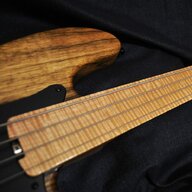
I'm not sure where I seen it but there was a recent builder that used entrain to make finger boards and it looked like a really cool design ill have to see if I can track the video down but he was explaining how it was a way more durable option for fretless applications. I love seeing people try things that are out of the normal wheel house.