• TalkBass has been independent since 1998. Add your voice.
    Create a free account to reply to discussions, view embedded media, and browse with fewer display ads.
    Join freeLog in
    Want zero display ads or expanded classifieds tools? Compare plans.

Engineers and Precision Basses. The truth comes out.

Status
Not open for further replies.
Not everything in life needs to aim to be top shelf...but at the same time, let's be honest and admit that going the easy route means not taking risks, and taking risks is where it becomes possible to deliver something better. Or worse.

The or worse part is exactly the reason why the p-bass is so popular. I am not saying that I agree with this but I do understand it.
 
Alright, Mr. Passive Aggressive. It's just an opinion shared on the Internet. You don't have to think too hard into it.

Not passive aggressive at all. Pretty blatantly calling a spade for a spade is what it was. You made a snotty statement, somebody else called it out in kind. Simple.

What's the majority of recorded music. Some generic demo/jingle/recording or some creative new Jaco? Just because you and I may not like what's going on, doesn't mean that is reality, and for some very valid business reasons. All I said is that the OP confirmed why the P-Bass is so popular when recording. It's quick, it is easy, it works, and it safes money. I never said it's the best option.

Well, if it is just some jingle (in my opinion) it is simple. Just play what the boss says, do what he says, etc., etc. It is music for hire. A day job. Nothing wrong with that at all.

But if you (again, in my opinion) are going into a studio to record something original of your own nobody should be telling you what to play or what to play it on. That is part of the contract. I brought in some ideas, you record them, I pay you. We all go home happy. That's the distinction to me. It takes longer to EQ my bass of choice? So what? I am the customer. Do it. Charge me accordingly.

The way many people post about these topics it seems like they are trying to save Warner Brothers some production costs and keep some of their advance, but in all likelihood are recording Doobie Brothers covers out of pocket...
 
Time is money and if you bring in a P bass where the "lazy" engineer just has to set a level and you're good to go versus bringing you're favorite bass of the month that is a relative unknown and requires more work to dial in. Who is going to get the call next time?
It's not even necessary for a recording engineer to EQ a bass while tracking. That's for the mixing stage. A bright bass can be EQ'd later on to sound however you want it to sound. A darker bass is going to keep that basic character. This is why so many people record with fresh stainless rounds even though you can't tell in the final mix. I'm not saying that's the best philosophy but it's a valid one.

In any case it really depends on the project. Not everyone is going for familiar, traditional sounds. Not everyone cares what the bass sounds like. But, everyone expects that the mixing engineer will spend some time with each track to get it to sound its best. If you don't expect that you can't afford a mixing engineer.
 
It's not even necessary for a recording engineer to EQ a bass while tracking. That's for the mixing stage. A bright bass can be EQ'd later on to sound however you want it to sound. A darker bass is going to keep that basic character. This is why so many people record with fresh stainless rounds even though you can't tell in the final mix. I'm not saying that's the best philosophy but it's a valid one.

In any case it really depends on the project. Not everyone is going for familiar, traditional sounds. Not everyone cares what the bass sounds like. But, everyone expects that the mixing engineer will spend some time with each track to get it to sound its best. If you don't expect that you can't afford a mixing engineer.
Producers have relationships with engineers that they gel with, and those are the guys/gals they use over and over again. The tracking engineer is not necessarily the engineer doing the final mix - often not. Again, I emphasize, the tracking engineer is not deciding what bass is used. The producer is, often in conjunction with the artist. At least at major label level sessions.
 
Last edited:
  • Like
Reactions: MDBass
Producers have relationships with engineers that they gel with, and those are the guys/gals they use over and over again. The tracking engineer is not necessarily the engineer doing the final mix - often not. Again, I emphasize, the tracking engineer is not deciding what bass is used. The producer is, often in conjunction with the artist. At least at pro level sessions.
I'm not sure why you quoted me with your statement. Are you saying something that contradicts what I said? I'm not talking about who chooses which bass to use.

Edit: That's why I said it depends on the project. Going in as a hired gun to record a McDonald's jingle is not the same as me paying the studio to record Matante's solo album. Let's not make assumptions about the type of project that's being recorded.
 
Last edited:
  • Like
Reactions: pbass2
The or worse part is exactly the reason why the p-bass is so popular. I am not saying that I agree with this but I do understand it.

That's exactly why I included it. It's possible to have a bass that sounds horrible...but it's also possible to have a bass that does something that pushes the music in a new direction.

I know people on here aren't a fan of KoRn and the bass tone, but dang if that tone didn't fit PERFECTLY with the rest of the music. The bass would have been, "Meh, it's bass" with a Precision.
 
Last week, I had a session with a very seasoned sound engineer. I’ve known him a long time and he always digs the tone of my basses… until now.

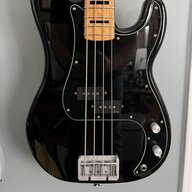
I normally play something with 2 pickups, like a jazz or jazz-adjacent bass. They’re versatile and I like the tone. This time, I decided to bring my righteous Olinto Precision bass, since we all know sound engineers prefer to mix a P, right? Ummm… not exactly.

We had a good session. When it was done the sound engineer and I were talking and I asked him how much he was digging that beautiful bass. His response was very ‘meh’. He then proceeded to go into a deep dive about frequencies & such that I didn’t quite understand. But in the end, he definitely preferred something with a bit more ‘zing’ in the higher frequencies.

So I asked him, “what about all the stories we hear about some pro bassist who went to the studio with his fancy boutique bass and the engineer had him play the whole session on the in-house p-bass… and the rest is history?”

He laughed and said, “That’s not because the p-bass is better. It’s because the engineer is lazy and doesn’t want to waste time dialing in a new bass tone.”

That was a humbling and enlightening response. And also more proof that the only person bass tone matters to is the bassist.
:laugh::rollno::thumbsup:


Disclaimer- Yes, I recognize this is only one guy’s opinion. But it’s a pretty good one.
I’ve literally been saying this for YEARS! That whole “p bass is best in the mix blah blah blah” nonsense is nothing more than a lazy sound engineer who doesn’t know how to do anything more than just be lazy and do nothing at all. If I ever went to a studio and the engineer told me not to play what I wanted to get the sound I wanted, and to just play some muddy old p-bass so he doesn’t have to work, I would tell the band it’s time to find a different studio. P bass being “the best” in the studio, was, is, and always will be a laughable joke perpetuated by lazy “engineers”.
 
  • Like
Reactions: HolmeBass
About as much a reality as batteries in an active circuit ever "going dead" on a gig, in other words?

Ah, bass players and our myths.

I literally sweated a Spector preamp dead on a gig once.

Rare things still happen occasionally, they’re just the exception rather than the rule.
 
Not passive aggressive at all. Pretty blatantly calling a spade for a spade is what it was. You made a snotty statement, somebody else called it out in kind. Simple.


Well, if it is just some jingle (in my opinion) it is simple. Just play what the boss says, do what he says, etc., etc. It is music for hire. A day job. Nothing wrong with that at all.

But if you (again, in my opinion) are going into a studio to record something original of your own nobody should be telling you what to play or what to play it on. That is part of the contract. I brought in some ideas, you record them, I pay you. We all go home happy. That's the distinction to me. It takes longer to EQ my bass of choice? So what? I am the customer. Do it. Charge me accordingly.

The way many people post about these topics it seems like they are trying to save Warner Brothers some production costs and keep some of their advance, but in all likelihood are recording Doobie Brothers covers out of pocket...

So, did an engineer, who you paid, tell you, they'd only record you playing a p-bass?
 
Pretty funny how pissy some (presumably) adult men are getting over a few pieces of wood with a single split coil pickup screwed into it.

Plenty of amazing songs have been recorded with a P bass: some with remarkably good bass tones.

Plenty of amazing songs have been recorded without a P bass: some with remarkably good bass tones.

Play what you like, who cares :thumbsup:
 
:vomit:


Also, I hope that the Fishman Fluence pickups aren't prone to the same issue.

Those HAZ preamps are large circuit boards with the volume/blend and EQ controls mounted directly on it: presumably that’s how enough moisture got into the control cavity to short circuit the board.

I’d guess the Fluence pickups would be safe from similar levels of perspiration :cool:
 
Last edited:
  • Like
Reactions: g-dude
Never in my 50 years of playing did anyone ever ask or tell me to play a Precision or even a Fender of any description. I did get good comments from producers though on the sound of my ‘73 Precision. The one time I took a brand new Stingray into a session no-one objected. After the session I asked the engineer his opinion. His response? Not exactly ‘meh’ but he was less than enthusiastic about it.
Although McCartney’s playing caught my attention as a youngster, his tone wasn’t what I liked about it. The Precision is my personal favourite but that’s just me. Play what you want.
I might add that a quote from one engineer as though his opinion is some sort of universal truth is not going to travel well.
 
Last edited:
Also funny how people with the least experience recording or mixing tend to have the most black and white views of what’s true about recording or mixing.

As mentioned before, on paid sessions the producer or the artist is making the call on what bass the session musician uses: not the studio engineer, unless the producer is also engineering.

There’s no reason an engineer you’re paying for own band’s session should tell you to play a P bass instead of whatever bass you’d prefer, but they may make useful suggestions like using fresh strings, recording a DI in addition to your amp, checking tuning between takes, etc.

You can absolutely tell when a bass has brand new strings on it, both when recording and mixing.

Getting certain kinds of bass tones without fresh strings is impossible, regardless of what you do with EQ or any other post processing, because the harmonic content you need literally doesn’t exist in the signal.

This is likely why the myth of P basses sounding inherently dull exists: many bassists change their strings less often than they change the oil in their cars :roflmao:

Nothing “dull” sounding about a P bass with fresh roundwounds on it: Geddy still sounds like Geddy playing a P, just not identical to how he sounds with a J or a Ric.

As with everything, context is pretty important.
 
All this tells us is what that one engineer prefers. He likes "zing." OK. My response is, "What does the song need and let's use the right tool to get there." That engineer is just as closed minded as he thinks the lazy-I'd-rather-just-use-a-P crowd is.
To be completely fair though - you're assuming that the engineer meant that he always/generally prefers something with more zing. It was after the session, and the engineer could have easily been referring to the bass tone for that specific session...just sayin'
 
Those HAZ preamps are large circuit boards with the volume/blend and EQ controls mounted directly on it: presumably that’s how enough moisture got into the control cavity to short circuit the board.

I’d guess the Fluence pickups would be safe from similar levels of perspiration :cool:

The Fluence pickups are essentially stacked circuit boards with a printed circuit forming the "coils" so to speak...which sounds like the opposite of being safer!
 
  • Like
Reactions: MDBass
Status
Not open for further replies.