• TalkBass has been independent since 1998. Add your voice.
    Create a free account to reply to discussions, view embedded media, and browse with fewer display ads.
    Join freeLog in
    Want zero display ads or expanded classifieds tools? Compare plans.

Double Bass EQ For Doublebass Gigs

Mar 14, 2003
8,127
10,484
Seattle, WA
I've posted on this before and have done a search, but I wanted to try to start over, really simply. I need a better baseline understanding.

Imagine a 4 band EQ: Bass - Lo Mid - Hi Mid - Treble

I understand and appreciate that one pre-amp to the next will center the pitch of each of those settings differently unless it's parametric and that the Q might be narrow or wide, etc. If we have to get into that, we can, but maybe let's start simple:

  • When do you dial each of those 4 bands up or down on a gig?
  • What do you hear that makes you think: "I should cut the low-mids."? ...or the other bands...
  • What do you expect to happen to your sound when you boost or cut each of those bands?

I have been learning and experimenting with this for years and I'm better at it than I used to be, but I can't express how stupid I feel on this subject. Historically asking this question on TBDB has made me feel dumber, rather than enlightened. Of course, what I'm going for is MBOL and also clear in the room with whoever I'm playing with and whatever else is happening in the space. I get that there are a million factors other than eq settings, but when I am on a gig all of those other factors are static for the night and what I'm left with is EQ adjustments and I'd love a simple clear understanding...to be followed by a lot of experimentation, of course. I feel like I'm just throwing darts at a map right now, especially with a parametric eq.
 
It's so dependent on the room, band, voicing of the amp etc but I usually like some mid cut to reduce piezo twang, usually cutting more low mids than high mids if it's a 4 band EQ. Lows may be cut to suit the room

Thanks, yeah. That's one thing that I have been doing. Cutting mids tend to make it warmer and more acoustic sounding, bumping them can bring back some clarity if things are nebulous.
 
For many years I just turned the knobs, without actually knowing much about EQ. That all changed when I decided to record my bass into Logic Pro (any DAW, really) and insert Logic’s own Channel EQ which is a fully parametric EQ, but also has a graphic view of the entire spectrum, plus a real-time spectrum analyzer that shows the actual frequencies of your recording (pre or post EQ).

70297693-3A13-4F9A-B9AE-DCD100B1D332.jpeg


Playing around with the frequencies, Q and boost/attenuation on the bass recording, while simultaneously hearing AND seeing how the changes on each band affect the recording, really opened up my understanding of EQ in general, but also for DB in particular. F.ex : a lot of ‘boxiness’ resides around 220Hz (on both DB and slab). Luckily, my Clarus’s Low Mid is centered at exactly 220Hz, so when I play DB I always turn down the Low Mid completely. Piezo quack is usually around 700’ish Hz.

You’ll need to know the specific frequencies the 4 bands on your amp is centered around, to get a better understanding of how your specific amp will react when boosting/attenuating each knob. Maybe try to replicate the 4 EQ bands of your amp in the software EQ, and just play around with to see what each band does to the sound. Having the visual spectrum really helps a lot.

If the suggestion above is possible for you, I’d highly recommend giving it a try. It was very educational for me, and that knowledge has helped me a lot.

Just for reference, here’s a link about the Channel EQ above, which might help (or might confuse)

Understand the Logic Pro X Channel EQ. - Francis BACONNET
 
If you hear something you don't like, you fiddle with the controls to try to make it sound better. A four band tone control network is not a very effective tool for upright. The frequency centers and bandwidth are fixed, so they can not be adjusted to address specific problems, that tend to vary from one gig to the next.

I think a good approach is to turn up one control at a time. Turn it up just enough to hear the frequency range it is effecting. I.E. listen to how the control effects your tone. After you try all four bands, dial down the band that seems most associated with your problem. Don't go crazy. Just dial it down enough to make the sound better. If you go too far, it will most likely make the sound worse...so you have to listen and choose the setting you like best.

When feedback is a potential problem, you use primarily a cut EQ strategy, because boosting is likely to push the system into feedback. That does not mean you can't boost, only that you have to do so carefully.

A better tool is an EQ that with adjustable frequency centers and adjustable bandwidth that can be set very narrow. A fully parametric EQ is the ideal tool. The closest I can think of in a pedal format is the Empress ParaEQ MKII Deluxe.

The ParaEQ has three variable frequency controls. However, a limiting factor is they cannot be adjusted over the entire audio bandwidth. You essentially get Bass, Mid, and Treble control that overlap a bit. Bass = 35Hz to 500Hz, Mids = 250Hz to 5kHz, and Treble = 1kHz to 20kHz. My guess is the bass and mid control would be useful as notch filters. Probably the best use of the Treble range would be to use a medium to narrow band filter to sweeten up the high mids.

I would use the 4-band controls on your amp to get a basic sound. Most likely I would use them to try and make the response as even as possible across the range of the bass. Then I would use the ParaEQ as a utility EQ. Notch out the strongest feedback modes within the range of the Bass and Mid control. The sweeten the high mids with the Treble control.

The problem is to do this sort of thing successfully, you actually have to be interest in and enjoy fiddling with the controls to dial in your sound. Many people don't have the necessary interest and expect more of a set it and forget result. IMHO, for optimal results you need to dial in your sound every time you set up...I.E. set it and forget will not get you optimal results.

Regarding graphic EQs.

A 1/3rd band graphic EQ will actually work really well. These have 30 or 31 sliders. Probably not a good choice for most players as they are 19" rack mounted and operate at line-level. I used to run one in the utility rack of a SWR RedHead. The EQ was inserted into the effects loop.

5 and 10 band graphics are fairly common in pedal format.. But the frequency centers are too far apart and the bandwidth too wide for them to really be used effectively to mitigate feedback problems.

If you like to fiddle, you might want to consider the Source Audio EQ2. I believe this pedal can be set up to function essentially like a 10-band parametric.

shopping


No idea how user friendly the interface is.
EQ2 Programmable Equalizer - Source Audio Website

Found this video and cued it up to the parametric discussion...The user interface looks pretty confusing and clunky IMHO.

Way easier when synced to a computer or phone.
 
@Martin Spure I don't have Logic Pro, but I'll see if I have access to something that I could do that with. I can see how that would open my eyes up.

@Wasnex My iAmp has a parametric EQ. The frequency ranges are:

Bass: 40 - 180
Low-Mid: 180 - 1k
Hi-Mid: 880 - 8k
Treble: 1k - 8k

@Mark Gollihur wrote on their website (as I understand) that he uses the bass frequency as a HPF. Is that right, Mark?
 
  • Like
Reactions: Martin Spure
@Wasnex My iAmp has a parametric EQ. The frequency ranges are:

Bass: 40 - 180
Low-Mid: 180 - 1k
Hi-Mid: 880 - 8k
Treble: 1k - 8k

These are semi-parametric as you can't adjust the band width. Although the utility is higher than fixed frequency centers, they are still not precise enough to deal well with specific feedback problems.

However, you can try peaking the bands and sweeping the frequency controls to find the most offensive frequencies and then dip them to taste.

Perhaps the problem is there multiple types of problems and there is no single strategy that fixes every problem. You need to know multiple strategies so you can address multiple types of problems.
 
Thanks, I knew "semi-parametric", but honestly I didn't understand what the difference was. (I told you I was ignorant on this)

What you advise is what I usually get told to do, but honestly I've not learned that much from it. It would be easier with a BG where I sit there and do it, it's harder with double bass because I feel like I need to be far enough to hear it over the acoustic volume and then walk over, twiddle, come back...etc. I need to have a friend over to play, while I twiddle.

And, again, feedback is really not a problem for me. I'm not playing Rock-a-billy (though it looks fun). This is more about tone and dealing with how that tone changes on stages and in various rooms.
 
I think the “idiot’s way” to do it is cut a fair amount of the lower mids, cut a bit less of the upper mids, adjust the bass to taste, usually a bit of a cut. These (with slight variations depending on the situation) have served me well for many years, and require a minimum of knob twisting on the gig, allowing me to focus more on actually what I’m playing. YMMV.
 
Thanks, I knew "semi-parametric", but honestly I didn't understand what the difference was. (I told you I was ignorant on this)

What you advise is what I usually get told to do, but honestly I've not learned that much from it. It would be easier with a BG where I sit there and do it, it's harder with double bass because I feel like I need to be far enough to hear it over the acoustic volume and then walk over, twiddle, come back...etc. I need to have a friend over to play, while I twiddle.

And, again, feedback is really not a problem for me. I'm not playing Rock-a-billy (though it looks fun). This is more about tone and dealing with how that tone changes on stages and in various rooms.


IMHO tuning out the feedback can be beneficial even if it's not a problem. Think of your bass, pickup, amp, and speaker as a system with a closed feedback loop. The acoustics of the room interact with this feedback loop, and may become part of it.

The frequency response of the system is nowhere near flat to begin with. Also the system has various resonances that will be excited as you turn up.

The feedback loop will develop comb filtering because multiple signals will come together at different phase angles. The idea here is you pluck a note and the sound comes out of the bass and amp almost simultaneously. Then it takes time for the sound to travel from your speaker back to the bass. By the time the sound has covered the necessary distance, some time will have passed, so there will be a phase variance between the sound the bass is producing and the sound coming back from the speaker.

Depending on the phase angle, the waves add or subtract. Which frequencies add and which subtract depend on factors such as the speed of sound; wavelength, which varies by frequency; and distance between the bass and speakers.

The room will cause lot's of reflections that create another set of problems that can bleed into the feedback loop.

IMHO tuning out the feedback mitigates some of these problems so you get a clearer and more authentic sound.

Think of it this way, as you turn up the gain it changes the frequency response contour. Resonances tend to get excited and peaks will form around the resonance. If you turn up the gain enough, these resonances will start to feedback. If you put a corrective notch where the feedback occurs and apply an appropriate amount of cut, you actually push the frequency response contour closer to flat, and you also put less energy into the resonance. It doesn't exactly dampen the resonance. Rather it avoids exciting the resonance which I believe has a similar result to suppressing it.

For optimal results, the corrective EQ should be a perfect mirror image of the peaks. Obviously this is not something you can do without appropriate test equipment...the point is theoretical to help you understand.

Also since the gain level has an impact on the resonances, the optimal amount of cut can vary depending on how loud you need to play. As you turn up, the cuts must be made deeper and deeper. Also you must apply more and more cuts...eventually it starts taking a toll. I believe I already mentioned that I think the point of diminishing returns typically occurs between about 4-6 notches.


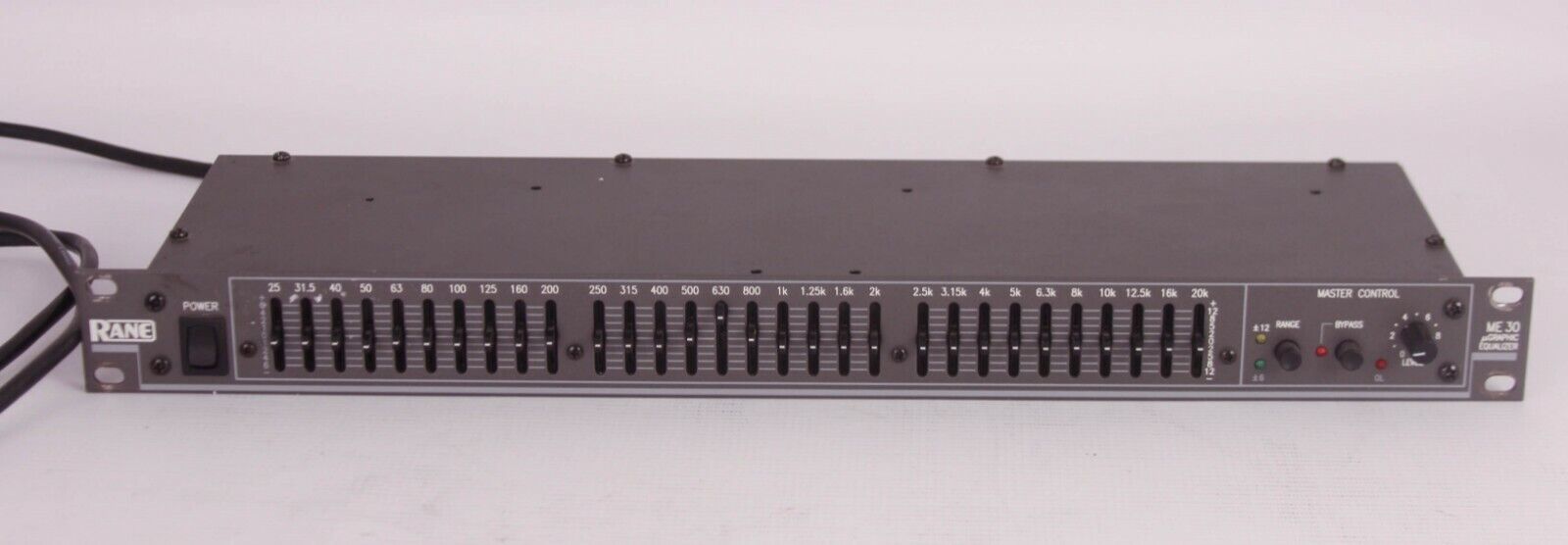
Back when I was running a Rane ME30 EQ in my bass rig, I would tune my upright for feedback exactly the same way I tune a PA and room. Increase the gain and then find the frequencies that are most prone to feedback and notch them out. When you are done, return the gain to the normal level and I believe you will find the sound is more authentic and clear.

FYI Rane ME30
s-l1600.jpg
 
I ... I ... I ...

I'm sure you're right, but this ... I have no idea how to anticipate the feedback peaks and proactively notch them when I don't get feedback. Honestly, even if I did get feedback, I know some of you hear "228 hz", I don't. Those numbers are part of what seems overwhelming to me. Maybe if I could do what @Martin Spure suggested, I could train my ear. I'm going to look into it.

I also have no idea how to tune a PA to a room. I'm just a dumb bass player.
 
I have no idea how to anticipate the feedback peaks and proactively notch them when I don't get feedback.

You don't anticipate the peaks...you force them. Crank up the gain until the bass is on the verge of feeding back. Then put a little boost on a sweepable mid. Sweep the mids and note frequencies that actually break over into feedback.
 
  • Like
Reactions: AGCurry
I don’t believe you have to posses a degree in sound engineering, to set up a bass amp and play a gig. A good rule of thumb is to zero out the EQ and
add a little bit of each band and to see what you get. You can always back off each band of it gets to be to much. I equate it with tuning the four strings of my bass
one at a time. Each band Treble, Midrange, and Bass may need some tweaking but not a lot. Sometimes the EQ settings I used for the last gig work but
usually they need some minor adjustment Keeping them “centered” gets you “in the ballpark”. Additionally I generally have the HPF set @ at or above 70 Hz.
 
I don’t believe you have to posses a degree in sound engineering, to set up a bass amp and play a gig. A good rule of thumb is to zero out the EQ and
add a little bit of each band and to see what you get. You can always back off each band of it gets to be to much. I equate it with tuning the four strings of my bass
one at a time. Each band Treble, Midrange, and Bass may need some tweaking but not a lot. Sometimes the EQ settings I used for the last gig work but
usually they need some minor adjustment Keeping them “centered” gets you “in the ballpark”. Additionally I generally have the HPF set @ at or above 70 Hz.

In my experience different amps seem to benefit from different EQ strategies. Some tone networks seem more suited for dialing in a sound. In other words you can use the tone controls to create a range of unique tones.

Other tone networks seem more suited for balancing the sound across the range of the instrument. I put my GK 700RB in this category. I don't feel like I can get all that many different types of tones from it, but works really well to balance the sound in different rooms.

Over time, I usually learn sort of a default setting that a particular amp usually work at. This is often not with tone controls at 12:00.

As I go from gig to gig, I rarely reset the controls. Rather, I typically just start with the last known good setting. However, sometimes it is best to simply reset the controls and start over.
 
I use the EQ2. I can't rave about it enough, especially with the software that is easy to use and makes the whole setup quite powerful. It does work like a parametric with Q and frequency adjustments for each of those 10 points. Though the display looks like a graphical once you use the software you realize it's way more than that. Then you can save each setting in your PC and upload them to the pedal for quick access during performances. I save setups according to venues.

I even assigned the main pedal switch to attenuate for arco.

If you can't sculpt your sound to your liking using this, your problem is unsolvable with any EQ. Works as a crossover as well so I actually use it to split my lows and highs to a subwoofer and mains on my mini PA system that I use as my bass rig.

Downsides for me. No DI out. Input impedance is 1M ohm. So you might still need to add a DI and you likely will need a buffer pre from your piezo. Also needs external power.

Edit: Add Screenshot of software. Here's one of my setups for example:

Screenshot 2023-05-10 204856.png
 
Last edited:
I think recording and gigging EQ operation is very different thing. I'll try to describe both methods the way I use it after 20+ years of practise, backed with some (but way less than optimal) theoretical knowledge. The summary of the lenghty post might be:

It's not about frequency numbers, it's about the right procedure. Follow the steps in the right order and you will set your EQ nicely on almost any system.

1) recording.
1a. I use mic, not a pickup, in an adequately dampened room.
1b. I place a mic on a stand in front of the bass bride, then do a test record.
1c. Listen to the test record and readjust the mic placement for more ideal sound. Repeat 1b till I'm satisfied.
1d. Do the recording.
1e. When mixing after the recording is done, I generally follow the advice 'repair only what is broken'. I start EQ with notch filter, looking for a problematic frequency with it. Notch is a huge boost (or cut) of a small frequency area, like this:
Snímek obrazovky 2023-05-11 123159.jpg

1f. When I find the ugliest frequency (ie. sound that messes with something else, like finger clicking messing with rhythm), I widen the EQ area and take it down (not severely, only so that it sounds better than before).
1g. Repeat 1e+1f till necessary, using more and more EQ 'notches', usually it's about 4-6. Do it in context, with other instruments on. Solo the bass only when not sure.
1h. Rest my ears, sometimes even till another day.
1i. Bypass all the EQs, listen to the record again, and turn the EQs on one by one. Usually I find that my EQing was too complicated and there are ways to make it simpler. When I can't hear the change that particular EQ adjustment does, I dont use it. It's better to cut down than to boost, because boosting makes the overall bass sound louder, therefore I tend to think it sounds better, which might be wrong. Substracting is safer that way.
So in general, I use only the very basic stuff - lows are below 100 Hz, highs above 2kHz. Adjusting lows changes the power, adjusting highs changes the clarity. Mids are a glue and here you can utilize your musical taste. Less adjustment is usually more. Don't get rid of too many little unpleasantnesses, or you lose the natural character.

2) gig
2a. I use pickup. Over year, I try to find the sound as clear and natural as possible. Presently, it's Ehrlund pickup, GR Bass one amp, Eich 1x10 cab.
2b. Setting the stage: cab on a chair, spot for cab and myself out of the corner of the room, cab not too close to the bass.
2c. Playing the bass acoustically for a while, to get its sound into my head.
2d. Turning the amp volume up till I hear the feedback. Then, find the right position of Phase switch (ie. where the sound is less worsened by feedback). Then, turn the volume a bit (or more) down.
2e. Compare the sound with the mental image I created in 2c.
2f. Adjust the bass knob (with my current setup, up a bit. With realist pickups, it was always a lot down.)
2g. Adjust the highs knob (with my current setup, down a bit. With realist, it was alwys a lot up).
2h. If I'm not happy, I twiddle with the lo-mid (when the body of the sound is not right) and hi-mid (when the clarity seems weird). With my current setup, I usually end up with B+, LM0, HM0, H-. Or B++, LM+, HM-, H--.
2i. There are switches to move the lo mid and hi mid frequencies on my GR bass; I don't remember last time I used these.
In general, I don't really care for frequency numbers. When I use weird combination of EQ (like B+++, LM--, HM+++, H--) it usually means something is wrong. Sometimes, though not very often, the room might be acoustically so wrong that severe EQ setup is neccesarry. More often, I bypass the amp, listen again acoustically, turn on again, and readjust, looking for a mistake in my routine, and usually finding it.

If I were to name one thing that helped me most with how to use EQ, I'd name home recording and home mixing - here you are present at all steps of the process, and can hear how one affects the other.
 
I've posted on this before and have done a search, but I wanted to try to start over, really simply. I need a better baseline understanding.

Imagine a 4 band EQ: Bass - Lo Mid - Hi Mid - Treble

I understand and appreciate that one pre-amp to the next will center the pitch of each of those settings differently unless it's parametric and that the Q might be narrow or wide, etc. If we have to get into that, we can, but maybe let's start simple:

  • When do you dial each of those 4 bands up or down on a gig?
  • What do you hear that makes you think: "I should cut the low-mids."? ...or the other bands...
  • What do you expect to happen to your sound when you boost or cut each of those bands?

I have been learning and experimenting with this for years and I'm better at it than I used to be, but I can't express how stupid I feel on this subject. Historically asking this question on TBDB has made me feel dumber, rather than enlightened. Of course, what I'm going for is MBOL and also clear in the room with whoever I'm playing with and whatever else is happening in the space. I get that there are a million factors other than eq settings, but when I am on a gig all of those other factors are static for the night and what I'm left with is EQ adjustments and I'd love a simple clear understanding...to be followed by a lot of experimentation, of course. I feel like I'm just throwing darts at a map right now, especially with a parametric eq.


In my humble opinion, the more sliders, knobs, and buttons you have to fuss with on a gig - the more counterproductive the setup gets. All of the analyzing and tech in the world goes out the window on gig in a bad room with clanging glasses and a marginal PA setup.

I have a Tech 21 Para Driver, which is 3-band with some other bells. The most important feature to me is the mid-shift. I think this is referred to as "sweepable" mids on other gear. This allows one to find that garbage mid-band for your piezo and cut it.

On the gig:

bass - If it sounds muddy in the room, I cut. Rarely ever boost. If I need a lot of volume, I usually decrease bass with my HPF pedal so I can push my cabinets harder.
mids - If I can't hear enough definition in what I'm playing, I boost.
highs - rarely ever touch it. Can't remember the last time I had to even think about this on a gig.
 
In my humble opinion, the more sliders, knobs, and buttons you have to fuss with on a gig - the more counterproductive the setup gets………..[QUOTE/]

Amen to that! Every amp I’ve pwned for the most part has 3 or 4 bands of EQ
and I once I’ve set the controls where I’m comfortable with the timbre within a specific volume range, I leave the EQ alone.

On the gig:

bass - If it sounds muddy in the room, I cut. Rarely ever boost. If I need a lot of volume, I usually decrease bass with my HPF pedal so I can push my cabinets harder.
mids - If I can't hear enough definition in what I'm playing, I boost.
highs - rarely ever touch it. Can't remember the last time I had to even think about this on a gig.

Pretty much the same in my world. I have the bass backed off, the midrange tweaked, and the treble slightly boosted. With those settings the tone quality i.e. timbre doesn’t change as much when you increase or decrease the volume. Just my take.
 
Last edited:
A lot of good thoughts here. EQ is a correction tool. Yes, for DB, the EQ is more to compensate align the pickup and amp to sound like the bass unamplified. Once you get that dialed in, then any additional EQ is then to correct for the room's acoustics. When the room makes your bass sound different than what you normally sound like, you HPF, boost and cut here and there to make it sound like you again.

You have a reference sound which is the bass unamplified. It's not like BG where EQ is often considered and used as a way of making and creating the sound of the instrument itself.
 
  • Like
Reactions: Ric Vice and Wasnex
There has recently been a discussion on another thread relating to how different our bass can sound to us players as opposed to out front. I may have missed this as part of this thread but in terms of eq or other tone shaping I'm not clear on what perspective we're talking about.Personally, I'm more concerned with how the bass comes across from a listener perspective than mine. I've worked with others, generally guitarists(no offence) who only care about how they sound to themselves. I feel that I have enough of an idea in my head about how my bass sounds by itself that I can deal with less than good sound on the bandstand if I know it is okay for bandmates and the audience. It also makes for a lot less stress on the gig IMO. As a player or leader I've never liked a lot of(or really any) messing with sound once the gig starts. JMO
 
  • Like
Reactions: Ric Vice and TroyK