• TalkBass has been independent since 1998. Add your voice.
    Create a free account to reply to discussions, view embedded media, and browse with fewer display ads.
    Join freeLog in
    Want zero display ads or expanded classifieds tools? Compare plans.

Ernie Ball Cobalts On a fretless?

06D02E94-D80C-4CE3-9542-21FBBFC0E409.png
Ernie Ball makes a flatwound set with cobalt you might try.
 
Don't use the rounds unless the wood is acrylized or stablilized in some other way. EB makes cobalt flats like the poster above said. Rounds on a fretless can sound really cool if the fretboard is hard enough to take it but don't use them if the board is just regular wood

Opinions on this topic vary greatly. Many people advise against rounds of any type on an untreated board. Others see no problem. The salient points seem to be:
  • Guitar-style (perpendicular to string) vibrato will cause damage, while cello-style (parallel to string) won’t.
  • Rounds on an untreated board will cause visible marks, but those marks are superficial, and they don’t get worse over time.
  • Some players play what they want to play, with the expectation that the fingerboard may need dressing every X years (X ranging from 5 to 20).
  • Nickel is kinder than stainless.
  • Compression wounds or ground wounds are an alternative.
 
Opinions on this topic vary greatly. Many people advise against rounds of any type on an untreated board. Others see no problem. The salient points seem to be:
  • Guitar-style (perpendicular to string) vibrato will cause damage, while cello-style (parallel to string) won’t.
  • Rounds on an untreated board will cause visible marks, but those marks are superficial, and they don’t get worse over time.
  • Some players play what they want to play, with the expectation that the fingerboard may need dressing every X years (X ranging from 5 to 20).
  • Nickel is kinder than stainless.
  • Compression wounds or ground wounds are an alternative.
Right. My only worry with using rounds on an untreated board is the gouges potentially causing more dryness in the wood (which can be cured with good maintenance of the fretboard but still). If OP doesn't care about the appearance of the board or wants a worn-in look, then they should go ahead but it's gonna need more maintenance
 
  • Like
Reactions: ctmullins
IMHO, Pau Ferro is a great wood for fretless. It is generally a bit harder than garden variety rosewoods, but not quite as hard as ebony. I have one fretless with Pau Ferro, and one with Mac ebony. Both have marks without any depth. To be honest, they haven’t gotten much play time the last few years... :(
 
How about cobalt flat ?

Cobalt flat 2814 in my fretless pbass and She dint chew fretboard.

Compare to Ti on same pbass, cobalt flat has more upper bright and growl along with fuller low end.

String to string stiffness are better balance than GHS PF3025 I use before.

But the first set I install meet rusty issue in just 3 months, after report to EB customer service, I get a replacement set (new batch) and no rust problem.

Hopehelp
 
Last edited:
  • Like
Reactions: tindrum
Right. My only worry with using rounds on an untreated board is the gouges potentially causing more dryness in the wood (which can be cured with good maintenance of the fretboard but still). If OP doesn't care about the appearance of the board or wants a worn-in look, then they should go ahead but it's gonna need more maintenance

I don’t understand. Unless you are using the new Ernie Ball Silica Gels, I don’t think this should be a problem.
 
The most damage I ever saw on a fretless was on a 1978 Precision bass with Rosewood board. It looked like whoever owned it, plucked the strings very hard and up close to the neck, causing the strings to contact the board at the heel on every pluck. This will surely gouge the fingerboard, much more rapidly and with much more vigor than with a lighter, more focused technique.
 
  • Like
Reactions: JGbassman
If you’re just starting on fretless, neck wear from your strings is among the least of the things you need to to be concerned about. So feel free to go with whatever your preferred string for fretted bass is for starters if you like.

I’ve used GHS Pressurewounds, TI Jazz Flats, Dean Markley SR2000s, DR Jonas Hellborgs, and easily a dozen other string sets at one time or another on a fretless bass.

About all I’d suggest is going with a light or medium light gauge rather than a heavier gauge for your first set.
 
Last edited:
  • Like
Reactions: MateoG78 and mcnach
EB Cobalts sound great on fretless.

A Pau Ferro board should hold up to rounds just fine, as long as you don't mash the strings into the board unnecessarily, or bend the strings up/down across the fingerboard to achieve vibrato or slurs. With a light touch, you shouldn't have to dress the board for many, many years.

If it's the aesthetics of string wear on the board that concerns you, don't bother playing fretless; even flats will cause some scratching on the board over time.
 
  • Like
Reactions: tindrum
I played rounds on a fretless with a pau ferro board for about 20 years with no issues. I loved how it sounded and that’s what’s important. It barely needed a dressing after all that time. Use cello style vibrato, which sounds better on a fretless, and enjoy. Cobalt rounds have a very pronounced upper midrange, which might be nice on that bass. I usually go for a mellower fretless tone so I frequently use nickels, give us a review of the cobalts bc I’d be interested in how they sound.
 
I've used Cobalt flats on fretless for roughly a year. The fretboard was fine, although I couldn't get over the slightly sticky feeling of the strings. I much prefer pressurewound strings, specifically Ken Smith Compressors, but the GHS pressurewounds are pretty damn good as well.
 
I was thinking about buying a fretless bass, this one to be exact: https://www.sweetwater.com/store/de...z-bass-polar-white-with-pau-ferro-fingerboard

Would Ernie Ball Cobalts mess up the fretboard? I don’t want my new fretboard to be worn down to quickly, so how would the cobalts affect it?
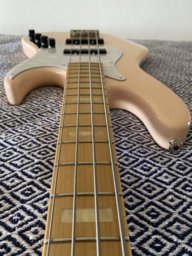
Using roundwounds the fingerboard (I find it weird to call it a fretboard if it's a fretless ;) ) you'll get marks. But it does take a LOT of playing before it's significant and by that I mean affecting playability. The marks would be visible but chances are they will not really be noticeable by anyone except you. At least that's been my experience. Re-planing a fingerboard, when it comes to that (long way down the line, many years unless you're playing it for hours every day) is relatively simple and not expensive.
Now... if the reason to use those is because you don't like flats... give the Cobalt flatwounds a try. They feel like flats, they're smooth, but the sound like rounds that have been on the bass for a bit so they lost just a bit of their zing. You can get traditional flats sound from them if you roll off the treble, but they are bright enough to play classic slap bass lines with them.

When I tried them, I called them "the flats for people who don't want flats" :)
 
I've only used cobalt round wound on fretted basses. I love the tone and growl but I soon noticed that the fret wear on my newer basses that had cobalts was much more than basses 30 years older which always had nickel strings. For that reason, I stopped using cobalt strings.

As others have mentioned, Ernie Ball does make cobalt flat wound strings. They will be less aggressive than round wound but more aggressive than nickel or stainless flat wound strings. I think there are better options for a fretless bass which will give you great tone and not cause as much wear.