• TalkBass has been independent since 1998. Add your voice.
    Create a free account to reply to discussions, view embedded media, and browse with fewer display ads.
    Join freeLog in
    Want zero display ads or expanded classifieds tools? Compare plans.

EVM 15b OEM (in a GK 115B cab) power rating?

I purchased this cab recently and I've been hesitant to push it because I didn't know the power rating. Its 8 ohm and I'm using an 800rb so I'm not pushing some crazy 1000 watt amp...but I don't want to blow a speaker that could remain intact either.

I finally got around to taking the cab apart today and it has a EVM 15B OEM in it. Searching for this yields quite a few different results. The later version was 200 watts but earlier versions have been quoted as being 100, 150, and 200 watts...and I don't know if the OEM version is a I, II or something different.

Does anyone know how to find out more information about this speaker?
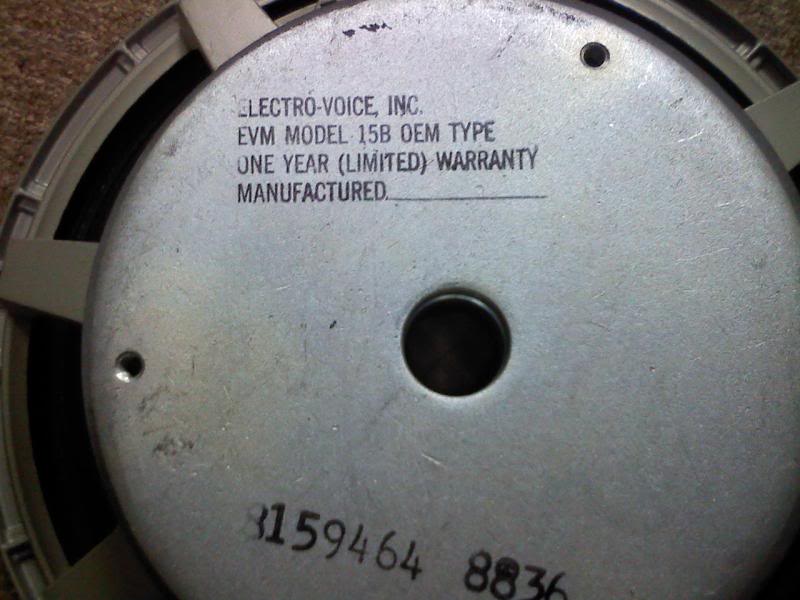
0328121141.jpg
 
Some later versions I think went even higher, but, like most other drivers are displacement limited lower than that. Like most other things, use your ears. Maybe creep up the volume gradually with a clean tone until you hear the first sign of any distortion, so you know where the line is.
 
Also keep the bass tone control a few notches down as you turn it up. Then bring up the bass slowly. When you gig with it, go FOH and hear how it sounds with the bass tone turned down and the mids up a bit. Tweak from there.
 
Using the OEM part number, it crosses back to 200 watts RMS, probably best powered with 300 watt amp or less (unless you are very careful)
 
Play close attention to what Will and Stumbo advised. At 8 ohm your amp has 200W undistorted clean bass to push at whatever EQ you choose. That's easily enough power to shred the speaker with the wrong EQ. And if you make the amp clip it will be able to cook the speaker too, hence the great undead "underpowering kills speakers" myth.
 
Thanks!

I won't be using it alone very often...I have a couple of different cabs to get me to 4 ohms. I'll always have another cab when I really want volume...but i wanted to know how careful I needed to be. 200 watts into a 200 watt speaker at moderately low volumes shouldn't give me any problems.

The should be obvious "use your ears" advice is quite useful too. I guess power ratings don't mean much when your speaker sounds like its about to explode.
 
Play close attention to what Will and Stumbo advised. At 8 ohm your amp has 200W undistorted clean bass to push at whatever EQ you choose. That's easily enough power to shred the speaker with the wrong EQ. And if you make the amp clip it will be able to cook the speaker too, hence the great undead "underpowering kills speakers" myth.

+1, I have a II series and I power it w/a GK400RB (150 watts at 8 ohms), they're very nice sounding speakers, but one does have to be careful.
 
As far back as 1985 the Electro-Voice EVM-15B was rated for 200 watts RMS.
Back to 1975 or so. In any event all EVM 15s have the same 3.3mm xmax, so all are displacement limited to the vicinity of 150 watts in the bass frequencies. The higher rated later versions will take more abuse before the coil burns out, but they won't go any louder.
 
You sure about that? The Electro-Voice website states the EVM series was introduced in 1983, which certainly jibes more with my (admittedly age-altered) memory.

The only musical instrument speakers I remember E-V offering in 1975 were the SRO series.
I bought an EVM12-L in 1979, I'm positive on the date as I bought it in New York a few months before moving from there. Prior to their calling them the EVM they were called SRO, which is confusing, as there was also an earlier SRO. I bought one of those in 1970. The first generation SRO had a flimsy frame, that's why they changed the design. The new heavier frame kept the SRO name for a few years before being re-named the EVM.
 
The EV drivers in the GK cabinets are definitely 200 watts and a good match up with the 800RB. You can, of course, turn it up loud enough to melt the coil. The 800RB should put 150 or 200 watts into 8 ohms un-clipped, but clipped hard, it will double that. The 800RB actually didn't have enough capacitors in it for cost reasons, so it actually puts out almost 500 watts (into 4 ohms) for a couple hundred milliseconds, so it has a real bite when you pop a string, but only puts out 300 watts continuous tone.
Your first clue you're being bad is when the voice coil bangs into the back plate of the motor. The second clue is the smell of burning varnish. The EV's are brutes and will survive both a bit. When I made the 1001RB I first tested it on one of the old cabinets with the EV 15B OEM and I heard the voice coil hit on string pops. Before I figured out it wasn't the amplifier misbehaving I had folded the cone up like an accordion, but the coil was still fine.
 
im actually picking up a gk115b tomorrow in great condition for 75 bux! i'll be using it as well with a gk800rb and it will definitely do fine together. im currently using my new 800rb with a hartke 4x10xl which sounds great , but i wanted to get some more 80's sounding stuff with a 15" and my Yamaha BB Bass!
 
Twelve years late to the party, I'm interested because I recently picked up an identical GK TL606 bin with oem EVM-15B. I'm using it with a wee Gnome class D amp for bass, and was curious about the 15B's rms rating.
 
Last edited:
Here it be. I'm occasionally using it for strat in combo with the Boogie TL806 pictured. In that config I'm powering them both with a 50watt Mesa head, though I've been warned about feeding guitar frequency into a bass speaker it sounds huge.
20241104_005624.jpg
 
Last edited:
The EVM-15B is good for about 200 watts RMS for bass applications.

With guitar cabinets, be careful how much power you use because on the average, guitar speakers have much less mechanical power handling.
 
  • Like
Reactions: Arohana
I'm piggybacking the EVM-15B cab with a 12L in the top box. Unfortunately, to do this means running both my 50 watt Boogie's 4 Ohm extn speaker outputs (one to each cab for combined 8 Ohm amp load) - so I don't think I can use/build an active crossover.