• TalkBass has been independent since 1998. Add your voice.
    Create a free account to reply to discussions, view embedded media, and browse with fewer display ads.
    Join freeLog in
    Want zero display ads or expanded classifieds tools? Compare plans.

Experimental 5-string build

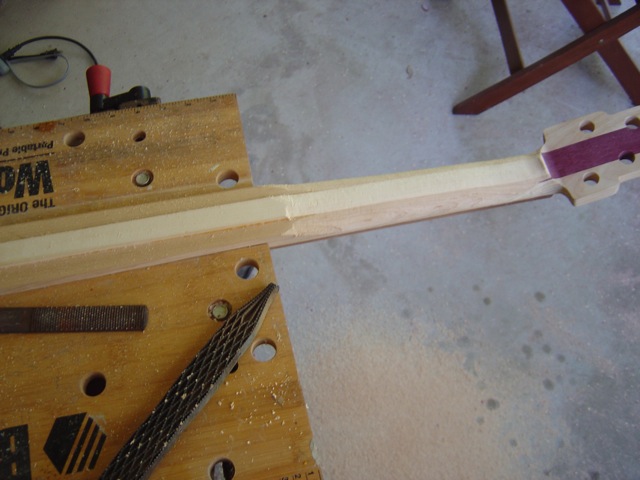
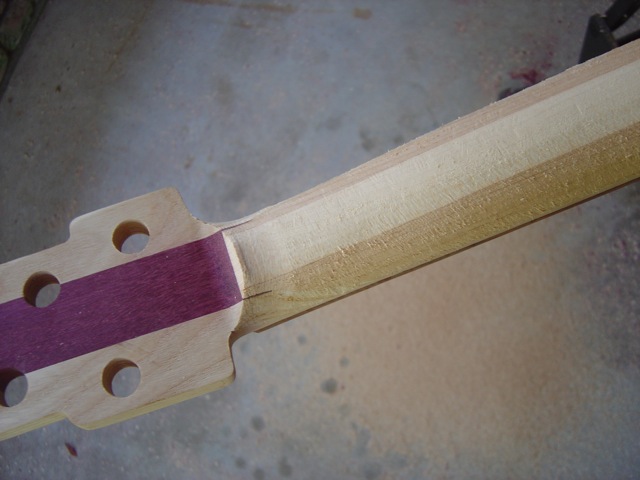
Rough shaping the neck with the fearsome Shinto saw rasp (I also used the curved portion of my cheapo combo rasp for the volute):
DSC00379.jpg


DSC00380.jpg


As others have mentioned, this is a most satisfying portion of the build. I feel a tiny bit like Michelangelo, carving away "everything that isn't neck". Although I was a little disappointed at the tiny bits of purpleheart that began peeking through at the volute...

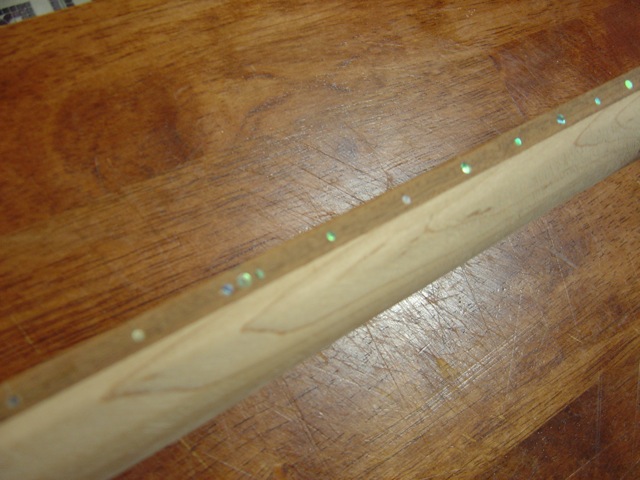
And an admittedly blurry picture of the paua abalone side dots - the major positions are 3mm, and the minor positions 2mm, with a trio at the octave:
DSC00381.jpg
 
Last edited:
Been refining the neck profile, a slow but rewarding process. It's almost done now. :bassist:

Routed for pickups. Two MM-style pickups, but I'm not ready to reveal the exact configuration yet - not sure if it's gonna work, so it may change. Had to make a new template, as my old one was far too sloppy. The new one is nice and tight. :)

Does anybody else think that fresh ash chips smell like Cheerios?
 
Drilled for neck screws and ferrules, and installed the threaded inserts into the neck. Also made a rough nut. Installed tuners, then it was time for a first string-up!

Now for the first experiment:

We have all seen instruments where the pickup polepieces don't exactly line up underneath the strings. For some people, it's a cosmetic issue, but rarely does it actually cause response problems - the pickups almost always do their job, even if the strings don't line up perfectly. In fact, the original Fender pickup designs, with their twin polepieces per string, are particularly forgiving in this regard.

So I like narrow-spaced five strings, and I happen to own (and love) a rare Gibson Tobias fiver that has 16mm spacing, and has Thunderbird pickups in it. But wait - the T-bird is a four-string! It turns out that the five strings on the Tobias are only marginally wider than the "normal" four-string spread on the T-bird. I'm pretty sure the T-Bird/Tobias pickups use a blade, and not individual polepieces, so it works just fine, but it became very apparent to me that many four-string pickups might just work fine for fivers as well.

(This is nothing new - lots of people have done this. There's even a guy here who has a habit of converting Rickenbacker fours to fives, and he's done quite a lot of them!)

But do you have to use blade-style four-string pickups with a fiver? Again, judging by others' experiences, no. Lots of people have used Jazz-style pickups (with their eight polepieces) and others with success.

So how far can you take this? Without any actual measuring equipment, we know that each pole creates a magnetic field for its corresponding string, but how big is this magnetic field, and how well is the string sensed if it's off by 10%? 20%? 50%? Where does it start to drop off?

One way to find out is to just do it:

DSC00383.jpg


This is a Duncan SMB-4D, the ceramic-magnet version of the four-string MusicMan replacement pickup. We see that the outermost strings are just barely "inside" the visual polepiece area, while the D and E strings are off by a little bit, and the A string is dead center between polepieces. I used alligator clips to jumper from the pickup wires to an instrument lead, turned the amp on, and began to play.

Any of you care to guess the outcome here? :)
 
Last edited:
The answer: It works perfectly.

I was surprised. I had fully expected for the A string to be weak, situated as it is between the polepieces. I even had a pair of five-string MM pickups on hand, ready to be installed when the four-string ones failed to provide even string response.

Granted, a sample size of one is not sufficient to draw a meaningful generalization. It could be that the ceramic magnets provide a wider, more uniform magnetic field. Or it could be that the large MM-style polepieces do the same thing. I really don't know. But I'm intrigued.
 
Worst comes to the worst....remember those snake oil "Adders" advertised in 80s/90s guitar mags? Literally just a strip of paramagnetic material (probably steel) which laid over the pole pieces of a pickup in a "scientific" shape. That would maybe make any unevenness in the magnetic field less so. They were probably only ever useful before the advent of trembuckers....
 
Been gone a while - had to go to Florida to see a man about a mouse...

Found some time last night and tonight to route for the battery box and control cavity. I've decided to install a Bart NTBT-918 (love those TB Classifieds!), so I'm using a double battery box. Sliced a cavity cover from some offcut, and sanded it down. Used it to trace the route, and started chipping away at it. Ran out of time tonight, so I still need to deepen it, but at least it's progress!

DSC00387.jpg


Probably should have placed the battery box a little closer to the control cavity, but oh well... :)
 
Last edited:
Been running the wiring for the Bart preamp, as well as the pickup wiring. The pickup layout is inspired by this thread, which I thought was really pretty interesting (be sure to click on the attached image in the first post; it's an animated GIF that brilliantly illustrates the author's idea):

http://www.talkbass.com/forum/f38/mm-mm-idea-432831/

My own variation of this idea: I'm going to treat the two Duncans as four individual coils, with an on/off switch for each one:

DSC00467.jpg


The two pots below the switches are bass/treble for the Bart, and the other one is master volume.

The rearmost coil is pretty close to a Jazz bridge pickup location; the two middle coils are pretty close to the MM position, and the frontmost coil is not too far off from a Jazz neck pickup.

I should be finished wiring within the week, and then I'll find out whether or not this idea will actually work!
 
Last edited:
you should think about series wiring for all 4 coils too. would make for an intersesting setup. I assume at the moment it's all setup to run paralell right?

Yep, parallel so far. I've run the Duncan before with a series/parallel/single switch, and the series tone is indeed usable, but I'm not sure of the best switching arrangement to get me there. I'm going to start with this, and then later perhaps think about adding a couple of series switches. :bassist:
 
It's a Kahler 7450 - it's supposed to be mounted at an angle. It could be that the angle of the photograph distorts it somewhat, though.
 
I the pic it appears to be mounted at not nearly enough of an angle. The long edges of the bridge pieces should be parallel to the centerline of the neck. Otherwise the strings will shift sideways as you adjust intonation, and it will look bizarre when strung up.

Could be just the pic though.
 

Latest posts