• TalkBass has been independent since 1998. Add your voice.
    Create a free account to reply to discussions, view embedded media, and browse with fewer display ads.
    Join freeLog in
    Want zero display ads or expanded classifieds tools? Compare plans.

Double Bass Eyeballing adjuster thread size

Chris Fitzgerald

Student of Life
Staff member
Administrator
Gold Supporting Member
Oct 19, 2000
27,572
38,459
Louisville, KY
www.chrisfitzgeraldmusic.com
I have a student with a defective Full Circle pickup. He needs to send it back to Fishman for repair. We were told by the shop installed it that is was probably a 1/4x20 adjuster. But that shop is out of town, so he went to an in town shop to get an adjuster to put on while the pickup was away and based on the previous advice, they gave him this:
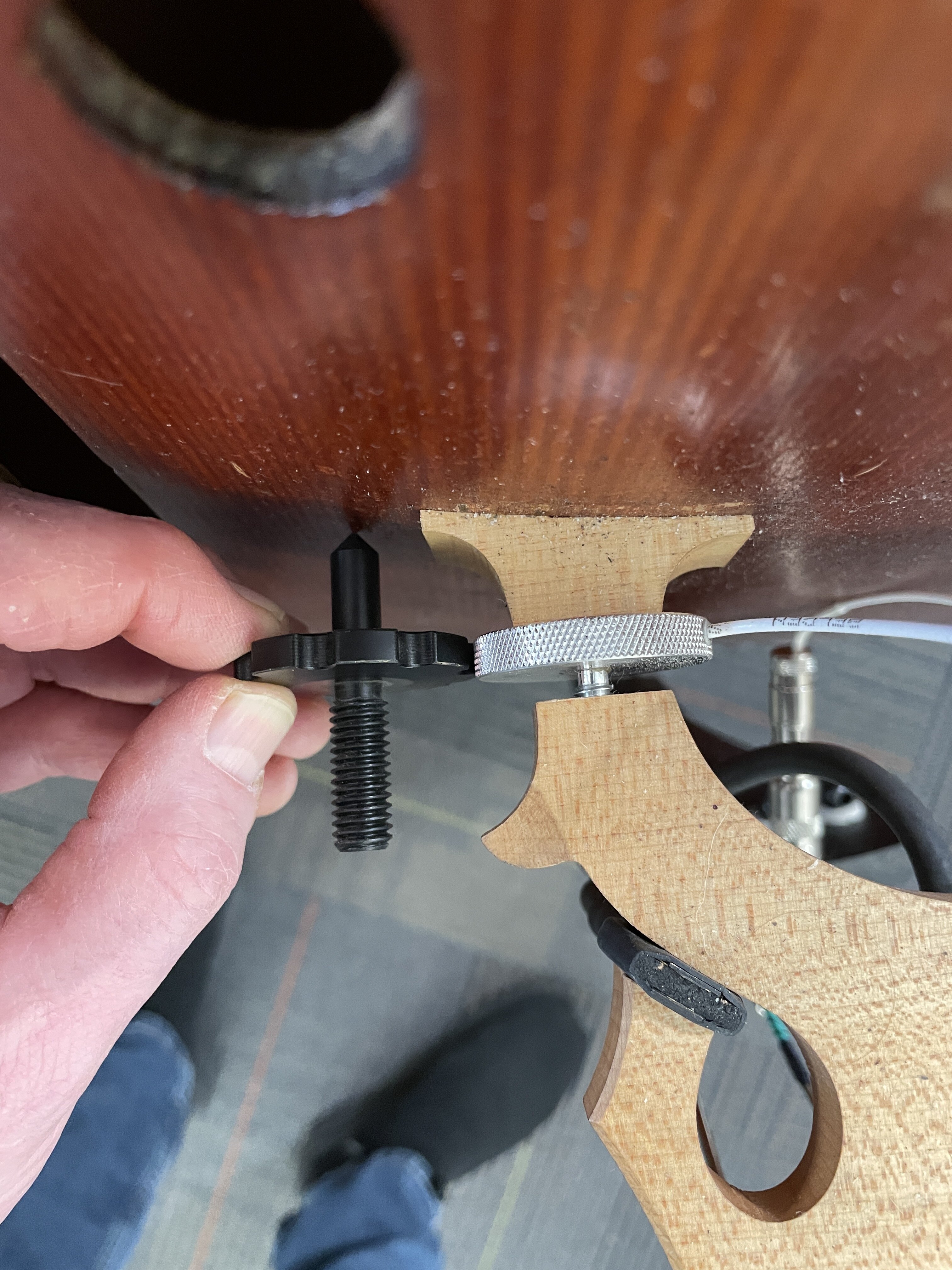
jaden's adjusters.JPG


Which is obviously too big. According to the Fishman site, the Full Circle comes in the following adjuster sizes.
Screen Shot 2025-02-18 at 1.58.25 PM.png


Based on the picture, which thread size would you say the FC adjuster on his bass is sporting?

Thanks!
 
Why not have the shop swap out the adjuster?
Conversely if’n you’re swapping them yourself, take the full circle off and take it to the local shop to match threads.

The student only has the one bass, and is giving their recital soon. So we planned to swap out the adjuster in a lesson, then send the FC off to Fishman, while leaving the bass still playable.
 
And on this topic, I suggest a rule that I follow when doing bike repairs: When you try the new adjuster, you should be able to thread it all the way in by hand with no tools. If it won't go all the way, investigate why. You can line the old and new screws side by side and it will be obvious that they mate together if they're the same pitch.
 
If you can remove the adjuster from the bridge, flip them so the threads are facing each other then lay the threaded portion of one on top of the other and see how the treads mesh and how the inner diameters compare. That will tell you right quick if they are the same or larger/smaller
 
  • Like
Reactions: neilG
Fishman uses different knurling on the various thread pitches, you have the 1/4"-20 there with the diamond knurling. The M6 and the 5/16"-16 both have vertical knurling (the M6 to 1/4" is the most easily confused and utilize the different knurling)


Brilliant! Thank you.
 
  • Like
Reactions: Jason Hollar
Off topic, but I once got into an argument with a lab-mate when I was in grad school. He was from China, and one day got completely fed up while working in the lab, and asked: "What's with you dumb Americans and your stupid screw threads?" So I decided to play the game, looked at the screw, and identified the thread by eye. He assumed I was either pulling his leg, or had lucked out. So he brought me a handful of screws and I identified all of them.

It has taken me longer, but I've gotten pretty good at identifying the metric threads as well. It's kind of a sixth sense, but when I see a metric thread, it just looks weird. The typical threads are finer than the US standard threads for similar diameters.
 
Fishman uses different knurling on the various thread pitches, you have the 1/4"-20 there with the diamond knurling. The M6 and the 5/16"-16 both have vertical knurling (the M6 to 1/4" is the most easily confused and utilize the different knurling)

I have never noticed that before, and none of my reps have ever mentioned it in over 20 years of carrying their pickups. However, I wonder if that's an old difference that no longer applies? I just pulled some brand new 1/4"x20 and M6x1mm Full Circles from my stockroom, and both sizes have +diamond crosshatched knurled edges. The 5/16 ones I have in stock do have vertical (more accurately, slightly diagonal) knurlings.

I do feel like I remember some of the older models having vertical knurling, so maybe the comparison was of a 1/4x20 from the newer batch against the 6x1 and 5/16x18 from an older batch? That would make sense, as the 1/4" model is far more popular and more likely to have sold out and been re-ordered. Though, even the Full Circle on my Dad's Juzek, which I'm sure has been on his bass for over 10+ years, has diamond knurlings.

In any case - it seems that this differentiation may not be an intentional feature, so don't 100% count on it.
 
Off topic, but I once got into an argument with a lab-mate when I was in grad school. He was from China, and one day got completely fed up while working in the lab, and asked: "What's with you dumb Americans and your stupid screw threads?" So I decided to play the game, looked at the screw, and identified the thread by eye. He assumed I was either pulling his leg, or had lucked out. So he brought me a handful of screws and I identified all of them.

It has taken me longer, but I've gotten pretty good at identifying the metric threads as well. It's kind of a sixth sense, but when I see a metric thread, it just looks weird. The typical threads are finer than the US standard threads for similar diameters.
Sounds like a "savant" skill! ;) Not something I would trust myself doing...

 
  • Like
Reactions: JBarz
I'm sure the Full Circle sounds great; lots and lots of very reliable folks here have them and really like them...

Probably a different topic, but needs to be said: It seems self-defeating to have two different systems tied together and both of them stop working when a single one of those two systems fails. Adjusters in double bass bridges are tenuous enough and fail just in normal usage by themselves; adding a pickup to the same structure means it also fails. Similarly, when the pickup fails, the adjuster needs to be replaced.

It just seems there are some things that should be kept separate so when one system fails, the other can keep on working.

Sorry for the mini-rant.
 
  • Like
Reactions: james condino