• TalkBass has been independent since 1998. Add your voice.
    Create a free account to reply to discussions, view embedded media, and browse with fewer display ads.
    Join freeLog in
    Want zero display ads or expanded classifieds tools? Compare plans.

Double Bass False Nut

I have been leaning the DB for a couple of years and the last 3 months with a teacher.

My hands are very small and I am unable to reach E to F#. I have developed a technique of keeping my thumb planted under the neck and pivoting my hand to reach. My teacher is uncomfortable with this but it is the only way I can reach without shifting.

I purchased the Book "The setup and repair of the Double Bass" by Traeger which is a comprehensive text for DB Luthers. It suggests adding a "False Nut" which basically means cutting the fingerboard two inches down and adding a second nut, reducing the string length by two inches. My bass is currently 42.5" from nut to bridge.

I am interested in comments on this. How much would it reduce the span from E to F# because this is kind of a one way process.

I tried out a 1/2 size bass but I hated it.

Rod :bassist:
 
I'm not a luthier, but if my calculation is correct, reducing your mensure by 2 inches will reduce your finger span in first position by about two tenths of an inch.

At 42.5 inches, your bass may be on the big side for a 3/4. My new 3/4 bass is just a bit over 41 inches. So, it might not be necessary to compromise all the way down to a 1/2 size bass.
 
I'm not a luthier, but if my calculation is correct, reducing your mensure by 2 inches will reduce your finger span in first position by about two tenths of an inch.

At 42.5 inches, your bass may be on the big side for a 3/4. My new 3/4 bass is just a bit over 41 inches. So, it might not be necessary to compromise all the way down to a 1/2 size bass.

I made a similar calculation and arrived at 0.25". My span is currently 4 7/8". Please tell me the length of the span from E to F# first position on your 41" instrument.
 
I made this table of the "fret" positions for various scale lengths, measured from the nut. This is pure mathematical theory, based on the formula of the twelfth root of two.

But for instance on my 41" bass, 8.46 - 4.47 = 4 inches from E to F#.

The change in finger span from 42.5 to 41 isn't going to be vast, because after all, it's only a ~ 4% difference.

One thing you can do with my table is look for an interval on your bass that equals the shorter interval that you would like to achieve, and see how comfortably you can reach it. So for instance F - G on your 42.5 bass will have the same reach as E to F# on a 40.5 bass. I suppose you could keep working your way up the board until it gets comfortable, then you know what size bass to choose.

But of course I am living in the land of abstract mathematical entities here, and not real basses. Surely a lot of other things are important, e.g., the entire geometry of the bass. Is your nut set up correctly?
 

Attachments

  • dbfrets.JPG
    dbfrets.JPG
    55.1 KB · Views: 257
  • Like
Reactions: JBarz
I have been leaning the DB for a couple of years and the last 3 months with a teacher.

My hands are very small and I am unable to reach E to F#. I have developed a technique of keeping my thumb planted under the neck and pivoting my hand to reach. My teacher is uncomfortable with this but it is the only way I can reach without shifting.

I purchased the Book "The setup and repair of the Double Bass" by Traeger which is a comprehensive text for DB Luthers. It suggests adding a "False Nut" which basically means cutting the fingerboard two inches down and adding a second nut, reducing the string length by two inches. My bass is currently 42.5" from nut to bridge.

I am interested in comments on this. How much would it reduce the span from E to F# because this is kind of a one way process.

I tried out a 1/2 size bass but I hated it.

Rod :bassist:

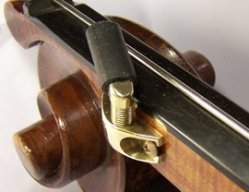
A false nut does not require shortening the fingerboard. It is an extended nut that rides on top the board - hence the 'false' in the name. :)

I would recommend that you play as many basses as you can until you find one that fits you better. As mentioned by others, string length, neck angle, overstand, neck size/shape, body size/shape and setup all work together to affect playability of an instrument.

Have you met with a DB luthier to discuss possibilities?
 
I made this table of the "fret" positions for various scale lengths, measured from the nut. This is pure mathematical theory, based on the formula of the twelfth root of two.

But for instance on my 41" bass, 8.46 - 4.47 = 4 inches from E to F#.

The change in finger span from 42.5 to 41 isn't going to be vast, because after all, it's only a ~ 4% difference.

One thing you can do with my table is look for an interval on your bass that equals the shorter interval that you would like to achieve, and see how comfortably you can reach it. So for instance F - G on your 42.5 bass will have the same reach as E to F# on a 40.5 bass. I suppose you could keep working your way up the board until it gets comfortable, then you know what size bass to choose.

But of course I am living in the land of abstract mathematical entities here, and not real basses. Surely a lot of other things are important, e.g., the entire geometry of the bass. Is your nut set up correctly?

Nice chart Francis! I'm stealing it right now...:D
 
I just got my bass out of the shop a few days ago. I had my
string length changed from a 42" to right about 41". WOW!!
I'm still getting used to it, but so far I'm very happy. The main
thing is not to look at your left hand or you freak out a little.
Since I never look at my left hand, I don't think it will be an
issue.
I like my bass very much, but with my very short fingers, I
was having a hard time in first position for years. I don't know
exactly how much its really changed, but I really feel it.
Also, the bass feels like a true D neck now. Plus, this bass has
a lot of sustain and note. With the shorter string length it
seems to have a little more air around the note. A little more
pop at the front of the note. Hope this helps.
 
  • Like
Reactions: John Chambliss
Yes my question revolves around first position on the D string.

That is a great table.

It appears at 4.9" my bass is not correctly set up. I will be going to a Luthier this coming week but I wanted to be as knowledgeable as possible before committing to work, especially if a different bass is the answer.
 
You can try a false nut to see if you like it!

Put a plastic cable-tie around the neck under the strings at the point you want to try the new nut. Doesn't have to be too tight!

Then tie another cable-tie OVER the strings, just above the first one.

Now tune up and play.

Weird, I always feel.
 
  • Like
Reactions: JBarz
You can try a false nut to see if you like it!

Put a plastic cable-tie around the neck under the strings at the point you want to try the new nut. Doesn't have to be too tight!

Then tie another cable-tie OVER the strings, just above the first one.

Now tune up and play.

Weird, I always feel.

That's great! Easy way to see if you can benefit from changing string length. I like it!
 
I took my bass to a Luthier. He advised me my bridge was placed too far south. By correcting the position, it will bring it closer to 41" and we can test it from there. He also suggested some finger exercises. By massaging the skin between the fingers, it will allow me to spread my span more.

For the record, he also found the following faults:
1. Nut not in full contact with the finger board, reducing the sound
2. groves in the nut too wide and deep causing buzzing
3. strings too far apart at the bridge
4. bridge groves too deep and wide creating buzzing
5. sound post incorrect position

I figured he was running up the bill but the estimate was $75.....what a deal.

Rod
 

Latest posts