• TalkBass has been independent since 1998. Add your voice.
    Create a free account to reply to discussions, view embedded media, and browse with fewer display ads.
    Join freeLog in
    Want zero display ads or expanded classifieds tools? Compare plans.

Double Bass False nuts, Eb and D necks

Oct 12, 2004
1,327
587
72
Burlingame, California
www.steveswandoublebasses.com
Disclosures
Retailer: Shen, Sun, older European
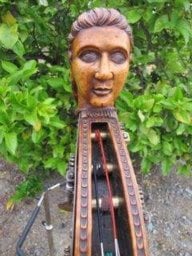
I've been running into more false nuts and customer requests for them on older basses with the extra long prewar string lengths. The easiest situation is to install a false nut on an Eb neck with a length that turns it into a D neck. One customer shortened the string length on his D neck by 1" and had the heel trimmed away to keep the D neck configuration. Another customer is used to playing D necks, so he had a local luthier install a crude frankenstein wooden cap on the heel of his Eb neck Juzek, wrecking the resale value of it. How have you handled the physical problems of false nuts and working with the Eb or D neck configuration?

 
It's a shame that someone hacked up their neck heel to accomplish this. It's actually at least theoretically possible to convert an Eb neck to a D neck without altering the heel, although none of the options is particularly attractive.

The math is kind of interesting, so I thought I'd comment on the problem in case anyone is interested. If you call the existing string length L, then the options are:

1. If you don't mind shortening the mensure (open string length), and don't want to move the bridge, move the nut .055*L closer to the bridge. This shortens the mensure by 5.5 percent (a lot).

2. If you don't mind lengthening the mensure or moving the bridge, but don't want a false nut, move the bridge 0.11*L toward the end pin. This lengthens the mensure by 11% (really a lot -- this option is theoretically sound, but just not practical).

3. If you don't want to change the mensure, but are willing to move both the nut and the bridge, move both 0.367*L closer to the end pin. Mensure is unchanged, but that's still a pretty major move of the bridge.

The most practical solution is probably somewhere between 1 and 3: you're willing to move the nut a little, move the bridge a little, and shorten the mensure a little. The key is to always ensure that the distance from the neck heel to the new bridge position is exactly double the distance from the neck heel to the new nut. That's the definition of a D neck.
 
Do people actually alter there basses just to obtain a D neck? I recently switched to a bass with an Eb neck and while it's taking some time to get used to, I couldn't imagine altering the bass somehow to go back to a D neck.

- Steve
 
For whatever it's worth, I've found that what seems most important to the bass players I've dealt with is to have the location of the thumb stop curve in the neck at a point where they know they'll either get a D or an Eb (depending) when they put their first finger down. Then, with the thumb still anchored in the curve, to be able to extend their hand upward to play the octave harmonic with the third finger without hitting the edge overhang of the top. If you're going to follow any of tstone's excellent suggestions, first try it against these parameters and you should have all your bases covered (sorry, really bad pun).
 
I'm curious about this statement. Were basses with longer mensure common before the 1940s? Is the 3/4 bass a modern preference?

Yes long mensures were more common on older basses, but 3/4 may still describe the body size of a bass with longer than 42" string length. That's why fractional descriptions of size are not detailed enough to be that meaningful, IMO. There are too many parameters to consider including top length, bout widths, mensure, etc.
 
Yes long mensures were more common on older basses, but 3/4 may still describe the body size of a bass with longer than 42" string length. That's why fractional descriptions of size are not detailed enough to be that meaningful, IMO. There are too many parameters to consider including top length, bout widths, mensure, etc.

String length is the parameter that interests me. I don't know how to enter equations here, so the relevant physics is here:
Changing the pitch of a vibrating string.

The tuning of the instrument must not change, so if you increase the linear density of the string, such as going from gut to steel, you must increase the tension, decrease the length, or some combination of the two. I have this idea that greater mensure is desirable for gut strings, but that shorter mensure is more manageable for the average hand size. Thus, I think that steel strings allowed luthiers to shorten the strings so that people without gigantic hands can play the bass. The problem that I have is that this is just a half-formed idea, with some basic physics behind it, but no historical evidence. I would love to hear from some of the luthiers around here, or the older guys who may have been around 50 years ago.
 

Latest posts