• TalkBass has been independent since 1998. Add your voice.
    Create a free account to reply to discussions, view embedded media, and browse with fewer display ads.
    Join freeLog in
    Want zero display ads or expanded classifieds tools? Compare plans.
Fanned Fretless?

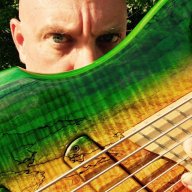
Sorta? Ben Strange (Strange Guitarworks) turned an Ovation Magnum (II?) into a fanned fretless, owing to the length of the intonation adjustment available.

e2285e24.jpg
 
  • Like
Reactions: zontar
I've wondered & asked this myself--especially after I played someone else's fan fret bass--and found it wasn't as weird as I thought it would be--it was actually quite comfortable & intuitive
 

That’s got to be hard as hell to play. Side dots alone on an unlined non-fanned 6-string fretless are of not much help due to parallax- on an unlined you’re going to be in no man’s land constantly.
 
  • Like
Reactions: Watchootognbout
That’s got to be hard as hell to play. Side dots alone on an unlined non-fanned 6-string fretless are of not much help due to parallax- on an unlined you’re going to be in no man’s land constantly.
Except for the fact that after a while you rely on muscle memory and your ear. If you figure that every fretless is going to have a little wiggle room for where each note properly intimates, unlined makes it easier to focus on what sounds right rather than what sounds wrong and looks right. At least this is my experience with fretless playing.

And as always, upright basses have no markers and dudes managed to play those in tune all the time.
 
Except for the fact that after a while you rely on muscle memory and your ear. If you figure that every fretless is going to have a little wiggle room for where each note properly intimates, unlined makes it easier to focus on what sounds right rather than what sounds wrong and looks right. At least this is my experience with fretless playing.

And as always, upright basses have no markers and dudes managed to play those in tune all the time.

Muscle memory is likely not going to work nearly as well on a fanned fretless though. Each string has a different set of intonation points, and unless you’re the one guy who plays your bass one string at a time, you’re going to be constantly switching between the strings with each note. The lack of lines would slow it down as you’re not getting any hand/eye coordination to solidify it in your brain. The different scale lengths between each string also changes the amount of wiggle room you’re going to have for notes depending on which string you’re on, so you’re getting less pattern recognition that one would normally get from an instrument that could aid in it.

And as always, your ears are a corrective measure when playing, not a preemptive tool. They only tell you when you’ve already done something wrong. They’re only of use when you can use them to correlate hand position consistently, which is best accomplished through muscle memory or visual/physical cues (upright players use the physical cues of their instruments constantly, something we have little of with our instrument).

Not that you’ve done it, but it’s always specious advice when I see guys saying “just use your ears to play.” I’m just picturing them as the guy at the party who never really remembers your name. “Barr.....Bryan! Good to see you! Shaynn.....Shawna! How’ve you been?” :D
 
I play fretless and upright and the idea of a fanned fretless leaves me a bit baffled. What's the point? What is easier to play or sounds better to make up for the increased difficulty? As Bryan Tyler points out we use visual cues and muscle memory which will be much harder. Also As he astutly says the ear is corrective not premptive.
 
It is always ears 1st.

Without being insulting, it clearly isn't. Your ears will only tell you if you're correctly intimated after you play your target note. Your ears cannot pre-empt sound, rather they detect the physical phenomena and transmit that to your brain. The beauty of fretless being that it allows you to easily shift a few cents if you hear a slightly sharp or flat note, but your actual ability to play in tune is dependent more on muscle memory and hand to eye coordination.
 
No.They don't
They really don't.
Every time I listen to an traditional Jazz tune with an upright I hear clinkers all the time.

In my fairly short experience (I had and played a standard 4-string unlined Jazz fretless for a handful of years and now have a Dingwall fretless), there's a couple ways of approaching the fretless. If you prescribe to the 'just use your ears and slide/vibrato into everything' school, cool. Do what works for you and it's a very specific style and aural result. You do end up spending a lot of time sliding into positions. ;)

I look at it from a different angle and want to be able to be able to hit repeatably without sliding and vibrato at will...and also have those options for color here and there. That makes lines a really good thing. Once you anchor in a position, finding and intonating isn't terribly hard, it's the moving up and down the neck.

I recently did a show with the fretless and had a few comments from those who recognized what I was using/doing. One was "I can't believe you were hitting that on a fretless and weren't all *insert Jaco motions and mouthnoises* the other was 'wow, I didn't expect to hear that on a fretless and it was so smooth and in' Becuase the tone says fretless but the style doesn't necessarily jibe with what many have come to expect. I sort of think of it like electric-bass-meets-upright-meets-fretless.

When I woodshedded upon getting the Combustion fretless v1 into my hands, I followed some advice from the top player/teachers I could find when I cast about...That was to pretend its a regular bass and work it really hard like that to lock in your precision and intonation without the vibrato and slides and let that stuff come later.

Sometimes you play with your eyes shut anyway. ;)


And just because it ain't fun without pictures, my bass is back on the bench getting more work done...electric & neck. Here's the newest iteration of the neck/fingerboard:

1E25CE28-54BB-43A0-A4CF-9EB90C777C44.jpeg


image2.jpeg
 
Last edited:
  • Like
Reactions: 11-11 and zontar
In my fairly short experience (I had and played a standard 4-string unlined Jazz fretless for a handful of years and now have a Dingwall fretless), there's a couple ways of approaching the fretless. If you prescribe to the 'just use your ears and slide/vibrato into everything' school, cool. Do what works for you and it's a very specific style and aural result. You do end up spending a lot of time sliding into positions. ;)

I look at it from a different angle and want to be able to be able to hit repeatably without sliding and vibrato at will...and also have those options for color here and there. That makes lines a really good thing. Once you anchor in a position, finding and intonating isn't terribly hard, it's the moving up and down the neck.

I recently did a show with the fretless and had a few comments from those who recognized what I was using/doing. One was "I can't believe you were hitting that on a fretless and weren't all *insert Jaco motions and mouthnoises* the other was 'wow, I didn't expect to hear that on a fretless and it was so smooth and in' Becuase the tone says fretless but the style doesn't necessarily jibe with what many have come to expect. I sort of think of it like electric-bass-meets-upright-meets-fretless.

When I woodshedded upon getting the Combustion fretless v1 into my hands, I followed some advice from the top player/teachers I could find when I cast about...That was to pretend its a regular bass and work it really hard like that to lock in your precision and intonation without the vibrato and slides and let that stuff come later.

Sometimes you play with your eyes shut anyway. ;)


And just because it ain't fun without pictures, my bass is back on the bench getting more work done...electric & neck. Here's the newest iteration of the neck/fingerboard:

View attachment 3391227

View attachment 3391228
I was refering to upright bass.
 
Without being insulting, it clearly isn't. Your ears will only tell you if you're correctly intimated after you play your target note. Your ears cannot pre-empt sound, rather they detect the physical phenomena and transmit that to your brain. The beauty of fretless being that it allows you to easily shift a few cents if you hear a slightly sharp or flat note, but your actual ability to play in tune is dependent more on muscle memory and hand to eye coordination.

I play DB. The whole "playing without looking" thing is a skill developed with a lot of practice and it uses both ears and muscles. For me, there are really three key components to play with correct intonation: Listening, Reacting, Remembering.
  • Listening: This isn't memorizing specific frequency sounds or anything like that. This is more about knowing how each scale type "feels" when played in any given key. A trained ear will notice very quickly if a note within a scale is off, even by only a small amount.
  • Reacting: Once a player has realized that he/she's current note is flat or sharp by ear, technique kicks-in and allows the player to very quickly "move", not readjust, to the correctly intonated note. The move takes place so quickly and so smoothly that it usually sounds natural.
  • Remembering: Our muscles are not precision tools, but they do tend to "remember" areas of a neck. In DB terms, we have positions (eg. Half, 1st, thumb, etc.). These are essentially hand placements lined up with imaginary frets. For instance, Half Position is located on your low F, or 1st fret. The mixture of knowing the half-step tonal difference between an open E and low F, and remembering approximately where Half Position sits, allows us find Half Position very quickly.
This basic concept can be applied to a small scale, such as a fretless EB, with ease. With enough practice, I bet someone could do this with a fanned fretless.
 
Last edited: