• TalkBass has been independent since 1998. Add your voice.
    Create a free account to reply to discussions, view embedded media, and browse with fewer display ads.
    Join freeLog in
    Want zero display ads or expanded classifieds tools? Compare plans.

Fat "P" Neck: Learn It or Move On?

I'd say a bit of it may depend on your specific bass. I've owned a number of P basses with 1.75" nuts, and they tend to be hard for me to deal with. On my ESP Vintage 4, it's the same width nut but the neck plays more comfortably than most of the P basses I've owned. Not sure if it's neck profile, radius, or what. But some are more comfortable than others.

Getting back to your point, I swapped a J neck onto a P bass in the past, and it was AWESOME. I've done it with a MIM P bass and a Classic Vibe J neck, and have done it with a USA P and a USA J. In both cases I loved it. I'd say give it a shot. If you can get a J neck used for a good price, try it out and if it doesn't work, sell the neck and you'll be out little if anything.
 
Definitely do not play through muscular or nerve pain. However, you may want to have someone check your technique, especially re thumb position. Should be on the back of the next for most fingerings, if you're wrapping it around you're forcing the fingers to stretch more than necessary.

No shame in changing out the neck, that's the beauty of bolt-on necks.
 
Try upright fingering technique in the lower registers where you use the index, middle, and pinky to reach frets 1-3 or 1-4. Works really well for me. That said I don't really care for P necks and I do play upright as well. I moved on...
 
  • Like
Reactions: bluesdogblues
OP... if you aren't experiencing this problem on your 5-string then I think the problem with the P neck is the chunkiness front-to-back, not the width at the nut.

I owned a Squier VM J bass for a couple weeks, and it gave me all sorts of discomfort, despite its 1.5" nut. I discovered that the front-to-back profile was thicker than I'm used to, and that nut width doesn't mean much at all to me. I ended up exchanging that bass for a Sterling Ray34, which has a 1.69" nut, but a shallower front-to-back profile. Now the only discomfort I get is from mediocre technique or lack of endurance.

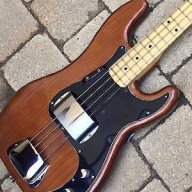
Your Road-worn P has a '50's-style neck, which has the vintage radius, 1.75" nut, but unfortunately also a thicker front-to-back profile compared to the '60's P bass neck, which was always known as the "wide and shallow" P neck. My suggestion would be to get a '63 AVRI P neck and see if that helps your pain. That way you're keeping the same neck radius, nut width, and finish, but changing only one variable--front-to-back thickness. The other good thing about this is that it will let you know for the future if a thick profile is something you need to stay away from.

Good luck!
 
Last edited:
  • Like
Reactions: Billyzoom
I know what the OP feels. My hands are also small. Well, even some chords on guitar can be hurts for my hand. But I always think that if somebody with smaller hands than me can play double bass well, I should be able to play this P-Bass well too. And I also think that (slow) practices will makes anything perfect, at least much better. so..
I myself give special practice for me in those first 5 frets of my P. Very slowly everyday. Now it felt just like as easy as any other frets on my bass.
 
As others have said, many factors come into play here, including technique, neck rear profile, and fretboard radius. It's possible that with technique adjustments and practice, playing on that neck would become pain free. But if playing is already pain free on other necks, why force the issue with this one, possibly causing further problems?

I've had a number of finger issues over the years, and technique plays a huge role in minimizing these. I recently had some sessions in Alexander Technique -- a sort of body balance approach -- applied to bass playing, which, to my immense surprise, seemed to cure a finger nerve problem I'd had for a couple of years and reduced the effort I expend while playing.

Nonetheless, I have found that 1.5" nut width necks help, as do flatter fretboard radii. I'm fine on Fender Jazz basses with the 9.5" fretboard radius, but the flatter 12" radii on my G&L necks are even better, and with Plek levelled frets they get very low action. And, on five strings, my Fender Jazz V is great, but my G&L M-2500 with its 12" radius and narrower string spacing is better. Anything that reduces effort, and thus strain, is a plus, and I don't hesitate to go that route.
 
As all the talk above indicates, there are a lot of variables here. But first off, pain isn't okay, or something to play through. Tired hands, some degree of aching from doing something new and difficult for extended periods, that's normal. But the kind of pain you're describing is not okay pain. All that "playing through it" will get you is carpal tunnel syndrome.

There are many potential variables, with neck width only one. Neck thickness, scale length, action (how high off the fretboard the strings are), how long of a reach to the lowest frets (which has to do with arm length compared with where the bass sits on your lap or hangs on a strap), the angle of the bass as you're playing it, how high or low you have the bass strapped, how sound your technique is (relative to your own body), how hard/fast you're playing, etc.

It can be a funny thing. My hands are on the small side for a bass player, so generally a narrower neck feels like a relief to me. But a couple years back I got a bass that has the biggest neck (for a 4-string) I ever played - A 1980 Yamaha BB800 - and I love it. The neck is fat, fatter than many Ps, but at the same time it feels great. But I can't play it quite the same way as I play my EBMM Sterling, my slimmest-necked bass. Generally, it's the same experience, but there are things that are just harder with the beefy neck, so I adjust.

I say, listen to the folks above suggesting different playing techniques. Unless you have long arms and big hands, one finger per fret on the first five frets is probably a bad idea. Using your pinkie and shifting rather than stretching are good ideas. The good kind of stretching - doing hand & finger stretches - could also help if done gently and patiently over time. There are lots of smaller men and women who play large-necked instruments, and the key is finding the ways to access the music you're trying to get out of the instrument in the way that's most comfortable.

Being able to one-finger-per-fret at the far end of the neck doesn't make you a good bassist. Playing the music you want to play does. Your path to that is yours - you own it. No one else does, no outside set of instructions does. There's a best way for you to fret notes, which has mostly to do with your body.

I agree with others that trying out a new neck is a valid idea. If you really love worn Ps and don't want to split parts, you might consider looking for what I have - I have a '75 P-bass with the A (Jazz width, 1.5" at the nut) neck option; it was made that way. Those seem to be less common but still turn up on the used market. I've seen a few over the years in the TB classifieds.
 
Being able to one-finger-per-fret at the far end of the neck doesn't make you a good bassist. .
Remind me of my 'bad' technique LOL,..I play 1 2 4(3rd & 4th fingers together actually) on first 5 frets,..and on 13th fret and higher LOL. It's (1-2-4) is double bass player tecnique, actually (CMIIW), if I remember it corectly, I learnt it from Ray Brown bass book.
I recommend to the OP to practice with the P-Bass slowly, and don't ...never..force it if you feel any pain. Stop and re-learn.
 
Remind me of my 'bad' technique LOL,..I play 1 2 4(3rd & 4th fingers together actually) on first 5 frets,..and on 13th fret and higher LOL. It's (1-2-4) is double bass player tecnique, actually (CMIIW), if I remember it corectly, I learnt it from Ray Brown bass book.
I recommend to the OP to practice with the P-Bass slowly, and don't ...never..force it if you feel any pain. Stop and re-learn.

Keep your second and third fingers together instead of third and fourth. Somehow the tendons of the middle and ring fingers influence one another more than other adjacent fingers. It's why doing the Vulcan salute is hard for people to do. You can naturally get a lot more spread between the index-middle and ring-pinky fingers than you will between middle-ring fingers.
 
Keep your second and third fingers together instead of third and fourth. Somehow the tendons of the middle and ring fingers influence one another more than other adjacent fingers. It's why doing the Vulcan salute is hard for people to do. You can naturally get a lot more spread between the index-middle and ring-pinky fingers than you will between middle-ring fingers.
Maybe you're right, if I have time I'd like to explore that and maybe 're-learn' my 1-2-4. But if I remember correctly, what Ray Brown teaches in his book is index - middle - ring&little (?) CMIIW.
 
I'm not a fan or wide or fat necks.

One of my favorite necks is the old Fender Performer "pencil neck" and I had been experimenting with re-profiling shortscale necks to be considerably more narrow for a few years.

Hofner necks were a nice fit for me and a while ago I came across a Vox Hawk IV shortscale in GC and found I really like extra narrow pencil neck on that. It was the easiest playing bass I had ever tried. I played it for quite a while and I liked it so much that I measured the neck then and there and I now profile the necks on my DIY basses to have similar dimensions as that Vox neck (the nut width on mine are a bit more narrow).
 
Last edited:
Why would anyone commit to playing a bass that's harder to play?

People that like P-Bass find it easier to play...why else would they play it?

This thread is wearing shoes that are too small because they look cool.
For me it's never to look cool.
It's the SOUND.
I tried many many short scale basses without success. Personally, I never like the sound of me playing those short scales I've tried. I'll be happy to find one that sounds good for me, and easily I'll switch from my P-Bass.
For now my P-Bass is my benchmark for sound.
 
What's the point of forcing yourself to play a neck you don't enjoy? They're bolt-ons. Bolt-on a neck you like better. If you end up selling it, having a good J-neck on there instead of a P-neck won't significantly decrease the value, it's not like it's a vintage collectible. Or just keep the P-neck in storage and swap it back when you sell it.
 
What's the point of forcing yourself to play a neck you don't enjoy? They're bolt-ons. Bolt-on a neck you like better. If you end up selling it, having a good J-neck on there instead of a P-neck won't significantly decrease the value, it's not like it's a vintage collectible. Or just keep the P-neck in storage and swap it back when you sell it.
Yeah, the OP may try that.
But me,..I have tried it before too, swapped a Jazz Neck into my P- Bass. Personally, they sound very different, and I didn't like the sound. So I put back the original neck into my P-Bass.