

Enjoy the benefits of a premium membership!
Upgrade Account
-
TalkBass has been independent since 1998. Add your voice.
Create a free account to reply to discussions, view embedded media, and browse with fewer display ads.
Join free Log in
Want zero display ads or expanded classifieds tools? Compare plans.
You are using an out of date browser. It may not display this or other websites correctly.
You should upgrade or use an alternative browser.
You should upgrade or use an alternative browser.
fEARful Part Ten (10)
- Thread starter greenboy
- Start date
- Status
- Not open for further replies.
More options
Who Replied?
Is anyone not liking the 15KLLF/18 Sound 6" x'd-over @800 hz with a 156 sans tweeter?
Mine's a RP/LDS x-over around 1100-1200hz I think. Sounds good tme. But on my next one I'm thinking of going with the 800hz x-over sans tweeter.
Mine's a RP/LDS x-over around 1100-1200hz I think. Sounds good tme. But on my next one I'm thinking of going with the 800hz x-over sans tweeter.
Is anyone not liking the 15KLLF/18 Sound 6" x'd-over @800 hz with a 156 sans tweeter?
Mine's a RP/LDS x-over around 1100-1200hz I think. Sounds good tme. But on my next one I'm thinking of going with the 800hz x-over sans tweeter.
Frickin' Christ on a bicycle I almost understand that... I need to get off the innnertubes.
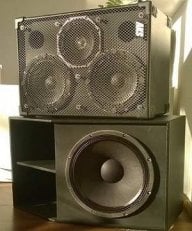
To me the real beauty of the 3015LF is that it has 9.6mm of xmax AND a sensitivity of 99dB. Most high sensitivity drivers have lower xmax or visa versa. One helluva speaker. That's why it can put out a lot of volume even with lower watts. It's just that it not only can thermally handle a lot more watts, it isn't as displacement limited in this cab design as most other woofers, so the more you throw at it (within reason of course) the louder it will go (which is insanely loud for a single 15).
And then the 18Sound mid is just a killer driver with its output in the mids and highs.
Together these speakers in this cab can get stupid loud even with as little as 300 watts and deafeningly loud with way more, all the while doing it with the most clarity and cleanest low end where most other cabs crap out.
The 3015LF does not have a higher(or lower) efficiency then most 15's. Btw. the effiency, in the bass range that is, for a woofer is mostly determined by it's cone size. The magnet strenght and the cone weight have just a slight influence on that (a heavier cone will mostly have a higher efficiency down low then a light weight cone, hence the light weight cone will have more efficieny on the upper range). What I state is very simplified though, there are way more parameters that determine it's efficiency.
I think there is one factor that is more important in this case and that is the thing you mentioned yourself, clarity. You can hear your bass sound better(seems to be louder) when the sound is clean and clear. The sound also cuts through better which makes you think it's louder.
The Qms(also Rms) of a driver determines it's mechanical Q, these show the mechanical losses (suspension, spider etc). The higher the Qms the lower the mechanical losses in a driver. The Rms is the mechanical resistance. You can only compare Rms values with drivers of the same cone size. A driver with high mechanical losses will sounds "dull" and not as detailed, especially on lower volumes. Also, the 3015LF non metal voice coil prevents eddy currents, which shows itself in higher Qms numbers.
Low harmonic distortion is also very important, when the driver adds lots of 3rd order harmonic content it will sound like sh... and your bass rig will sound like mud and will not have clarity on larger volumes.
Another big part is the overall design.
If the design is good, you don't need tons of power to cut through and be heard. The mid and the cabinet design(bracing) of the fEarful design contribute a lot to that. Also, drivers working in their optimal range will contribute to that too.
I'm after the same thing with the 2x10 I'm building. It will sound very clean and will have tons of clarity. Allthough it can only handle 400watts rms it will be loud enough to cut through and will even leave some 410's behind.
I got to borow Lomo's 15/6 for a week and wow, what a cab! I've got to say though, that 3015lf is such a monster that in order to get the low mid punch Im looking for, I would have to get the cab up to gig levels. I was thinking of doing a 2x12 version but realized that I'd probably get more of the same so I've decided that I will probably go with a 2512-II version tuned for a low mid bump.
Now for the mid driver. I have the 18sound driver, the faital pro driver and the eminence that seem to be the most popular mids for this type of cab. The 18sound is the loudest, the faital is the smoothest. I want a loud mid but find the 18sound a bit too honest or clacky when Im playing percussively. Is there another high sensitivity option?
Im liking these types of cabs but am looking to build something with more of a sound or character, rather than a flat, honest cab. If that makes sense. This is a crazy long thread!
Now for the mid driver. I have the 18sound driver, the faital pro driver and the eminence that seem to be the most popular mids for this type of cab. The 18sound is the loudest, the faital is the smoothest. I want a loud mid but find the 18sound a bit too honest or clacky when Im playing percussively. Is there another high sensitivity option?
Im liking these types of cabs but am looking to build something with more of a sound or character, rather than a flat, honest cab. If that makes sense. This is a crazy long thread!
I got to borow Lomo's 15/6 for a week and wow, what a cab! I've got to say though, that 3015lf is such a monster that in order to get the low mid punch Im looking for, I would have to get the cab up to gig levels. I was thinking of doing a 2x12 version but realized that I'd probably get more of the same so I've decided that I will probably go with a 2512-II version tuned for a low mid bump.
Now for the mid driver. I have the 18sound driver, the faital pro driver and the eminence that seem to be the most popular mids for this type of cab. The 18sound is the loudest, the faital is the smoothest. I want a loud mid but find the 18sound a bit too honest or clacky when Im playing percussively. Is there another high sensitivity option?
Im liking these types of cabs but am looking to build something with more of a sound or character, rather than a flat, honest cab. If that makes sense. This is a crazy long thread!
You could consider one of these: B&C 6 PEV13 is a 6.5" midrange speaker - B&C Speakers - B&C 6.5" midrange speaker for 3 or 4-way sytems. B&C 6 PEV13 midrange speakers available now.
B&C SPEAKERS
Invalid Link Removed
The 3rd one has a breakup node between 6 and 7 khz which will make it sound less "honest".

The 3015LF does not have a higher(or lower) efficiency then most 15's.
My point was about the sensitivity trade-off for extended xmax, where the 3015LF is high with regards to both. Most 15's don't have that kind of xmax either.
Obviously there are a lot of factors that come into play in cabinet design. But most 15's seem to like jumping voice coil gaps at the output the 3015 is capable of. That is no small concern.
But most 15's seem to like jumping voice coil gaps at the output the 3015 is capable of
True.
Allthough I have not heard them myself, I believe you guys since you've tested them thoroughly.
I did not have luck with the 10's from Eminence, way to much harmonic distortion when the voice coil starts leaving the voice coil gap.
The guy who imports the Oberton drivers here also has Eminence in his program (only these two manufacturers). I talked with him about my experience with Eminence and the quality I got with Oberton. He says you can not compare the two, Oberton is high quality PA stuff. But most of his customers still hesitate about using Oberton and buy Eminence instead because they have a big name. Here the Oberton 15NXB700-MXA Michaelis Speakers ~ Nederland - 15NXB700-MXA or the regular version Invalid Link Removed
Really a pitty that there is no importer in the US. But they told me you can buy them directly from the factory.
There are also others with great 15's , 18sound, Beyma....
Arjank, are you talking about the spike in response? What does that do, distort alittle?
The spike is a breakup node of the cone. This is the point at which the cone resonates within itself. So, at this point there is not only up/down movement created by the voicecoil but also "uncontrolled" movement(resonance) by the cone itself. In this frequency range the cone also does "ring" longer. You can see that in decay diagrams of a speaker. These diagrams show the "time" domain versus frequency and dB.
When the cone is made of not so rigid material(Paper, Polypropylene) the cone will "ring" shorter at the breakup node then a cone made of a very rigid material like metal. But, a very rigid cone will (mostly) behave better below this breakup node because it's stiffer and doesn't "suck up" energy like e.g. a softer cone made of paper. But, there are allways exceptions to the rule....
I would love to have a high spl mid made of ceramic material like those from Thiel&partner. These units behave very well within their passband and give a very good reproduction of the signal.
Thats some good information but, I don't totally understand it. How does that effect the sound? Im not looking for perfect, Im looking for alittle grit or growl in my sound. Kind of how an eden cab sounds but, better dispersion.
It's tough to find a good sounding mid with the sensativity to keep up with a pair of deltalite 2512-II woofers.
Thats some good information but, I don't totally understand it. How does that effect the sound? Im not looking for perfect, Im looking for alittle grit or growl in my sound. Kind of how an eden cab sounds but, better dispersion.
This peak around 6khz might sound a bit "gritty" , it just depends on how you define "gritty".
An Eden cab has a bit of a "loudness-button" sound, so that added sizzle form that B&C might be the ticket you're after.
It's tough to find a good sounding mid with the sensativity to keep up with a pair of deltalite 2512-II woofers.
Thats pretty tough indeed, those two 12" will have like 99dB in the low-mids. I think you should look for a good 8" driver and a well designed crossover. Best to bi-amp them at 300hz or so.
Invalid Link Removed
Im starting to think about a pair of 12/6 cabs using the 2512-II woofers and 6A-CBMR mids. Those mids might sound alittle grittier than the 18sound and then I could only use what I need for a gig or practise.
Im starting to think about a pair of 12/6 cabs using the 2512-II woofers and 6A-CBMR mids. Those mids might sound alittle grittier than the 18sound and then I could only use what I need for a gig or practise.
Whatever suits your purpose....
Seems like a great idea.

- Dec 18, 2000
- 13,201
- 340
- Disclosures
- greenboy designs: fEARful, bassic, dually, crazy88 etc
I got to borow Lomo's 15/6 for a week and wow, what a cab! I've got to say though, that 3015lf is such a monster that in order to get the low mid punch Im looking for, I would have to get the cab up to gig levels.
False premise based on what? Want a lower-mids oriented voice? Roll off some lower bass and some upper mids. Or boost specifc lower mids. That works at any general level. Frankly I think most people chase their own tails and think they want one thing without realizing it might already be within their grasp.
Now for the mid driver. I have the 18sound driver, the faital pro driver and the eminence that seem to be the most popular mids for this type of cab. The 18sound is the loudest, the faital is the smoothest.
Not true. Especially off axis. Independent measurements seem to confirm what the datasheets show. The word "smooth" is really a bad one for this though because to many it implies a lack of openly aggressive tendencies. The 6NM410 is actualy a mild improvement over the older 18sound, having a fuller body at crossover frequencies, and a slightly lesser spike at the primary breakup, so say Clair Bros.
I want a loud mid but find the 18sound a bit too honest or clacky when Im playing percussively. Is there another high sensitivity option?
You should learn to EQ and get your bass setup and strings and pickups and technique together. Clackiness can happen at some fairly high frequencies and over a broad span but if you scoop that out you are scooping for any notes harmonics as well so look first at bass setup and strings and pickups and technique if you are interested in extended response extended dispersion designs in the first place. Then use a little proper EQ as well.
Im liking these types of cabs but am looking to build something with more of a sound or character, rather than a flat, honest cab. If that makes sense. This is a crazy long thread!
Character really comes from the bass and player. There is tons of character in these designs if what you play has character, and if your bass has the agreeable character you seek. By conventional standards the designs are very sensitive to hand technique, bass setup and strings and pickups, and EQing. Knowing that, it follows that they are really flexible too.
One of the biggest detractors to really nail quality with these designs is getting the crossover wrong and using a variable L-pad on the mid driver. Variable L-pads are nearly 150% inaccurate through their sweep. Rather than opening up options they degrade WHAT COULD BE. Instead of providing an ideal setting both for the player and the room in general, they pretty much assure that any chosen setting will be less than ideal. Serious crossover designs are not going to be using them.
But hey, I'm just talking about fEARfuls. I'm not talking about something else. Tons of people are getting good results, and if they grok what I'm saying, spectacular results are within grasp. That's both for tone and for working more amenably in a variety of venues. this is just a fEARful thread, not a "design me what I think I want this week but will have changed my mind next week" thread.
I think.
One of the biggest detractors to really nail quality with these designs is getting the crossover wrong and using a variable L-pad on the mid driver. Variable L-pads are nearly 150% inaccurate through their sweep. Rather than opening up options they degrade WHAT COULD BE. Instead of providing an ideal setting both for the player and the room in general, they pretty much assure that any chosen setting will be less than ideal. Serious crossover designs are not going to be using them.
+1
Never ever use a variable L-pad. Even for the tweeter I think it's not appropriate.
Why use a variable L-pad if most amps have tons of eq under the hood?
The only suck precious energy.....

Starting a new 15/6/1 build for a TB friend. So new thread should be up soon with pics.
bassdog started cutting wood yesterday
Link Removed
bassdog started cutting wood yesterday
Link Removed
- Dec 18, 2000
- 13,201
- 340
- Disclosures
- greenboy designs: fEARful, bassic, dually, crazy88 etc
Originally I was going to do - unless someone else did - some fixed value padded full crossover designs for the waveguides too, at 2.5-3.5K Hz - no variable attenuator. But frankly most electric bassists would not benefit from that. Fortunately the electic bass does not require much accuracy up that high, because it has little content there. It's down lower were the wider dispersion is truly vital for room and player representation.
But it'd be great for sidefill, PA, and serious monitoring and the like.
But to do it right and feel my time was well spent I would have to afford measurement equipment.
But it'd be great for sidefill, PA, and serious monitoring and the like.
But to do it right and feel my time was well spent I would have to afford measurement equipment.
- Status
- Not open for further replies.


