• TalkBass has been independent since 1998. Add your voice.
    Create a free account to reply to discussions, view embedded media, and browse with fewer display ads.
    Join freeLog in
    Want zero display ads or expanded classifieds tools? Compare plans.

Fender Bassman 100T Chapter 3

I own the 810 and have previously owned the 610. The 610 is noticeably easier to move and lighter. I was initially surprised at how great the difference is. It is mainly that the greater height means that the 810 leans more heavily on you when dragging it around, I think. That said it is still by far the easiest 810 to schlep I have ever come across, but the 61o is still much easier. The lack of side handles on the 610 never bothered me, it is a tremendously light cab for its size. IMO of course.

so curious- how do you get it in and out of your car/suv?
 
The 810 is more agressive in the upper mids imo, maybe because of the added height, and obviously puts out more. Yes, the power difference/handling is noticeable. I wanted a cab for outdoor stages and it is more than adequate. That said, the 610 still projects plenty loud and does not look our of place in average size venues. In a smaller venue I would prefer the 610 over the 810, but I have other cabinet options for such occasions.
 
  • Like
Reactions: jumblemind
WAY OFF TOPIC
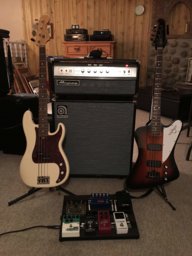
Something new has been added! I just got a '68 Type I Telecaster. I bought a bass exactly like this in 1969, my first "real" bass. That bass was stolen in 1980, and it's taken me this long to finally replace it. I love these basses. They get very little respect as they're post-CBS Fender, but they're a bit more than just a reissue of the '51 Precision. They pretty much are '51 Precisions. Anyway, it sounds beautiful with the Bassman rig. You'd almost think they were made for each other! Bad news is our guitarist had surgery yesterday and it'll be first of April before we gig again. GAH!

The new baby.
ffd137c4-b3e9-407e-840a-a5a402858987.jpg


Freight Train 1971 playing my original 1968 Tele bass, Slyvester, with its Sylvester decal. (I was a round mound of sound.)
7fa50e2b-e0e9-4aa6-8f5f-3441701a3c8c.jpg


Freight Train 2015. No comment.
a5495bcf-149a-4858-8090-58cc84806521.jpg


To go even further off topic, you see in the old pic from 1971 the big stack behind the drummer. That's two of the three 2x15 powered cabs in my Standell Artist 30 rig, also purchased in 1969. The head was a preamp, the cabs were 175 watt powered 2x15's that you daisy chained. I chose this 6x15 rig over an Acoustic 361 with two 360 cabs. Hearing them side by side there was no comparison for me, as I was going for a more aggressive roundwound sound that the Standell voiced beautifully. I still have one of the cabs, and may have the preamp somewhere in the personal museum as well.
 
Hi everyone,

I always wanted to experience a tube amp to understand what all the fuss is about, and I finally went ahead and bought a 100T. It arrived a few days ago and I love it. Great tones. I play it through one or two of my GK 212 NEO cabs. First gig with it is tonight. Can't wait!

This thread on TB played a role in my decision to buy the 100T and in reading through the posts I feel like I got to know a few of you! Thanks to everyone for your contributions, it's a useful resource and I've learned a lot from this thread.

One question remains though! It's a technical one. The "power tubes on the verge of breakup" tone is why I bought the 100T (rather than the SB300) so I could drive the amp hard and get that tone without destroying eardrums and venues. Related to that, I am wondering if there is a way to get that tone at even lower volumes by using the impedance switch. For example, if I set the switch to 4 ohms and run an 8 ohm cab, or 2 ohms and run a pair of 8 ohm cabs (total 4 ohm speaker cab impedance), would the amp work harder for the same volume and get the tone at a lower volume? Would this be safe?

In other words: I appreciate that we shouldn't run a lower impedance cabinet than amp output impedance (might burn out the amp) but is it safe to run a higher impedance cabinet than amp output impedance?

Hope you're all well.
 
Hi everyone,

I always wanted to experience a tube amp to understand what all the fuss is about, and I finally went ahead and bought a 100T. It arrived a few days ago and I love it. Great tones. I play it through one or two of my GK 212 NEO cabs. First gig with it is tonight. Can't wait!

This thread on TB played a role in my decision to buy the 100T and in reading through the posts I feel like I got to know a few of you! Thanks to everyone for your contributions, it's a useful resource and I've learned a lot from this thread.

One question remains though! It's a technical one. The "power tubes on the verge of breakup" tone is why I bought the 100T (rather than the SB300) so I could drive the amp hard and get that tone without destroying eardrums and venues. Related to that, I am wondering if there is a way to get that tone at even lower volumes by using the impedance switch. For example, if I set the switch to 4 ohms and run an 8 ohm cab, or 2 ohms and run a pair of 8 ohm cabs (total 4 ohm speaker cab impedance), would the amp work harder for the same volume and get the tone at a lower volume? Would this be safe?

In other words: I appreciate that we shouldn't run a lower impedance cabinet than amp output impedance (might burn out the amp) but is it safe to run a higher impedance cabinet than amp output impedance?

Hope you're all well.

I'm no tube amp expert but I've always been under the impression that proper impedance matching is critical. The only time I've ever heard of purposely mismatching the amp's impedance to the cab's is when one of your tubes blow, and the second of the pair shuts down so you're running on two tubes, in that case Fender recommends going one impedance setting lower on the amp. But it sounds like you're trying to relate impedance to output power the way solid state amps work, and there is no correlation there. The tube amp is a totally different beast. Why not just use the 25 watt setting instead? I use it at several of the venues we play and I love it.
 
Hi everyone,

I always wanted to experience a tube amp to understand what all the fuss is about, and I finally went ahead and bought a 100T. It arrived a few days ago and I love it. Great tones. I play it through one or two of my GK 212 NEO cabs. First gig with it is tonight. Can't wait!

This thread on TB played a role in my decision to buy the 100T and in reading through the posts I feel like I got to know a few of you! Thanks to everyone for your contributions, it's a useful resource and I've learned a lot from this thread.

One question remains though! It's a technical one. The "power tubes on the verge of breakup" tone is why I bought the 100T (rather than the SB300) so I could drive the amp hard and get that tone without destroying eardrums and venues. Related to that, I am wondering if there is a way to get that tone at even lower volumes by using the impedance switch. For example, if I set the switch to 4 ohms and run an 8 ohm cab, or 2 ohms and run a pair of 8 ohm cabs (total 4 ohm speaker cab impedance), would the amp work harder for the same volume and get the tone at a lower volume? Would this be safe?

In other words: I appreciate that we shouldn't run a lower impedance cabinet than amp output impedance (might burn out the amp) but is it safe to run a higher impedance cabinet than amp output impedance?

Hope you're all well.

For tube amps you should always match impedance of the amp to the impedance of the cab. Tube amps produce their rated power regardless of the selected impedance of the amp. IIRC it is possible (but highly inadvisable) to connect a cab with higher impedance than selected on the amp, but please let one of the tube amp gurus here confirm this, before actually trying.
The 100T should have a power selector switch on the back, where you can select 25W of output power. That should give you "power tubes on the verge of breakup" tone at more reasonable volume levels. If that is till too loud for you, you could get a power attenuator (one of these is already built into the amp, to reduce the output power from 100W to 25W, when selecting the switch) to place between amp and cab, which will "soak up" power, so you can run the tubes harder and get reduced volume. This is an example of a power attenuator: THD Electronics