• TalkBass has been independent since 1998. Add your voice.
    Create a free account to reply to discussions, view embedded media, and browse with fewer display ads.
    Join freeLog in
    Want zero display ads or expanded classifieds tools? Compare plans.

Fender Rumble Club

Thanks guys. Both are great empirical observations.

But I am interested in someone explaining why rolling an HPF is different than rolling off the low end EQ.
Hypothetically, if I have an external HPF that rolls off the bass at 6 db/octave starting at 100 Hz, how is this different than adjusting the internal amp EQ settings so they roll off the low end at 6 db/octave, starting at 100 Hz?

If they are the same filters and performed the same, there would be absolutely no difference. That's a big "if". Often on amps the low and high end EQ are shelving filters, that boosts and cuts the low and high end frequencies uniformly along the shelf. The roll off is typically different than that of a HPF and the -3dB knee is often fixed somewhere other than 100 Hz.

Since the mids are so important, designers pay more attention to implementing more control over those frequencies. That also costs more, they stick with something simpler for the low and high end.

[Invalid or Expired Link Removed]
 
  • Like
Reactions: rodl2005
I've got a 500 combo which sounds great but at last weekends gig I connected a Rumble 115 cab and put it on the other side of the drummer about 15' away (with the combo right behind me). The overall tone and dynamics changed, at least to my ear, dramatically. There was a real growling tone to it and some depth I hadn't heard before. I expected a difference but this was huge. Anyone else spread the speakers like this?
 
Last edited:
  • Like
Reactions: RedVee and G-Dog
I've got a 500 combo which sounds great but at last weekends gig I connected a Rumble 115 cab and put it on the other side of the drummer about 15' away (with the combo right behind me). The overall tone and dynamics changed, at least to my ear, dramatically. There was a real growling tone to it and some depth I hadn't heard before. I expected a difference but this was huge. Anyone else spread the speakers like this?
Many others, are better suited than I to discuss in detail, the inherent problems with separating cabs.
But some issues involve unpredictable phase cancellations that may sound different on stage than in the audience. And you get no coupling gain as seen with speakers that are placed together.
But if it works for you, that's great.
 
  • Like
Reactions: SpruceApple
If they are the same filters and performed the same, there would be absolutely no difference. That's a big "if". Often on amps the low and high end EQ are shelving filters, that boosts and cuts the low and high end frequencies uniformly along the shelf. The roll off is typically different than that of a HPF and the -3dB knee is often fixed somewhere other than 100 Hz.

Since the mids are so important, designers pay more attention to implementing more control over those frequencies. That also costs more, they stick with something simpler for the low and high end.

[Invalid or Expired Link Removed]
Thanks B.O.T.
What I take away from your comments are that an outboard HPF may give you more control or different degrees of control vs internal EQ, especially if you have data on how the outboard filter works vs what is going on inside the amp?
 
Thanks B.O.T.
What I take away from your comments are that an outboard HPF may give you more control or different degrees of control vs internal EQ, especially if you have data on how the outboard filter works vs what is going on inside the amp?

Yes. Not all filters are designed alike. I would say, if you have one, try the HPF and see if it makes a difference. It never hurts to experiment. I probably wouldn't buy one solely for this purpose expecting a huge difference in the low end EQ. HPF's are usually employed to avoid specific low end issues such as thumping and rumble associated with standup basses for example. The frequency is variable so that you can dial out issues. Many amps have a fixed HPF designed into the power amp. This helps protect speakers by limiting over excursion caused by low frequency thumps.

There is a lot that comes into play, complicating things. For instance, there is an insertion loss associated with an EQ stage. There is often a gain makeup stage at the end of the EQ to make up for this loss. With a HPF on the front end, there isn't always this makup stage so you need a little more gain to compensate. It could affect the noise level. Also, the right design and components make all the difference.
 
Thanks B.O.T.
What I take away from your comments are that an outboard HPF may give you more control or different degrees of control vs internal EQ, especially if you have data on how the outboard filter works vs what is going on inside the amp?

Yes, definitely. It's my understanding that onboard eq is two sided, in that it cuts / adds on both sides of the set frequency. The HPF is one sided cut only, and its slope is much steeper, 12dB per octave or more.

The bottom line is that a variable HPF is an easy to use powerful tool for the gigging bassist, regardless of whether the amp has a fixed HPF built in already.
 
Yes, definitely. It's my understanding that onboard eq is two sided, in that it cuts / adds on both sides of the set frequency. The HPF is one sided cut only, and its slope is much steeper, 12dB per octave or more.

The bottom line is that a variable HPF is an easy to use powerful tool for the gigging bassist, regardless of whether the amp has a fixed HPF built in already.
Good info. That's what I was looking for. Thanks much. Other future comments still appreciated.
 
Yes. Not all filters are designed alike. I would say, if you have one, try the HPF and see if it makes a difference. It never hurts to experiment. I probably wouldn't buy one solely for this purpose expecting a huge difference in the low end EQ. HPF's are usually employed to avoid specific low end issues such as thumping and rumble associated with standup basses for example. The frequency is variable so that you can dial out issues. Many amps have a fixed HPF designed into the power amp. This helps protect speakers by limiting over excursion caused by low frequency thumps.

There is a lot that comes into play, complicating things. For instance, there is an insertion loss associated with an EQ stage. There is often a gain makeup stage at the end of the EQ to make up for this loss. With a HPF on the front end, there isn't always this makup stage so you need a little more gain to compensate. It could affect the noise level. Also, the right design and components make all the difference.
Good tech info and explanation B.O.T. Just what I needed. Thanks much.
 
  • Like
Reactions: beans-on-toast
While I got you guys here, I currently run a 2 x Rumble 115 V3 setup. I love the form factor, weight, look and value. My only...concern (i guess we'll call it that) is that I am not in love with the Warm/Wooly/Vintage sound of thew speakers themselves, and wondering if a woofer replacement would help get me where I want to go. I know I know I know...Fender designed this cab and this woofer for each other, it might not be worth it....I could just sell these and upgrade to something else....well not really. I can get a good discount on eminence woofers and with the price to quality ratio on these being so high, I don't think I'm going to find a better "deal."

So has anybody swapped woofers? I've heard the 3015 (non LF) get thrown around a lot.

Thoughts?
 
Hello fellow Rumblers! I'm considering ditching the instrument cable and trying out a wireless guitar system. Any recommendations on a solid, gig-worthy system--under $300?

I bought a Shure GLX-D16 a couple of months ago and it has performed flawlessly at rehearsals and gigs. It has a built in tuner that is an excellent tuner. I never liked the clip-on's so this is a welcome change. The transmitter is all metal and seems quite durable so far. The receiver is also metal and just a durable. I keep it on top of my amp. The battery is a true 15 hour battery and ~2 hours for a full re-charge.
It's $500 (no tax if purchased from Sweetwater) so a bit out of your range but buy once and you don't have to monkey around with battery doors that come off, replacing batteries, etc.. You will not regret buying this unit.
Once you go wireless you'll never go back!
 
Nah. Eminence Deltalite II 2515 is your Love Puppy! Fender uses a custom tweaked version in their Bassman Pro 115 Neo cabinet. Invalid Link Removed

Doesn't seem to be reach quite as low as the 3015. I player a 5'er a half step down, see any issues there? I understand with notes that low, we're largely hearing the harmonics rather than the fundamental. I know Fender doesn't publish specs on their products, but are we thinking thinking that this would be a more efficient woofer?

While we're at it, do you happen to know what the crossover frequency is on these?
 
I recently picked up the Line 6 G10. Quite cheap and has worked flawlessly at multiple rehearsals and a couple gigs. Feel free to ask any questions you may have.
I also use a Line 6 G10. It is a great no hassle wireless. The only downside (maybe) is the receiver has to have wall power.
I've had no problems with mine at all. It is truly plug and play. One feature I like is the auto off on the transmitter. After some period of time with no input signal (forgot the time), it turns itself off to save power. Hit one note and it comes back on. You can also swap it from one instrument to another without any noise or static.
The receiver is powered through a USB jack like on you phone that goes to a charger you plug in. I have heard that it may be fragile and a couple have been reported broken. I am very careful with it so that hopefully will not happen.
 
I also use a Line 6 G10. It is a great no hassle wireless. The only downside (maybe) is the receiver has to have wall power.
I've had no problems with mine at all. It is truly plug and play. One feature I like is the auto off on the transmitter. After some period of time with no input signal (forgot the time), it turns itself off to save power. Hit one note and it comes back on. You can also swap it from one instrument to another without any noise or static.
The receiver is powered through a USB jack like on you phone that goes to a charger you plug in. I have heard that it may be fragile and a couple have been reported broken. I am very careful with it so that hopefully will not happen.

Someone just listed one for $140 in the classifieds.
 
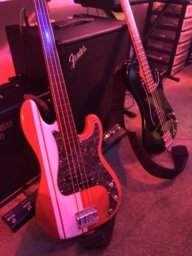
Hey everyone, I finally got the 2x10 ext cab. $299 demo model from Sweetwater.
20170619_162429.jpg