• TalkBass has been independent since 1998. Add your voice.
    Create a free account to reply to discussions, view embedded media, and browse with fewer display ads.
    Join freeLog in
    Want zero display ads or expanded classifieds tools? Compare plans.

Double Bass Finally got the correct setup position and measurements..

so I finally got the perfect setup where the bridge is supposed to be placed on my bass.. I was shown the exact measurements to where the bridge should be placed. And it actually was slightly lower than where I had it for years.

The question is:

With the new correct (by measurement) spot of the bridge, the strings are now slightly towards the bass (E-string side) of the bass fingerboard..

In other words, the strings are not centered on the fingerboard.. And you know when that happens, the strings are slightly higher off the fingerboard of whichever side it's leaning towards right..

So if this makes sense, my question is:

-would it be my only option to shift the bridge slightly over towards the treble F-hole side to make the strings centered on the fingerboard and keep the heights even of the strings..

Or Eventually will I need to have a new bridge carved with that kind of adjustment made in the making ?

As it stands now, the bass side strings are higher off the fingerboard than the treble side strings because of the lean towards the bass side.

I'm basically thinking to shift the bridge over slightly to get the strings centered on the fingerboard for more of an even height between all of the strings.

I feel it when playing and the only remedy I can think of is to shift the bridge over slightly towards the treble side to center the strings on the fingerboard.. But then I lose the correct centered position of the bridge. I would keep the same plane though between the F-hole notches..

See picture of what I want to do.

Other factors I should mention are that I have a removable neck bass which may also be why the centered position may not always be exact.

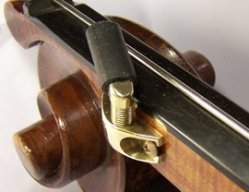
image.jpg
 
I don't think I quite understand it all. You say this is "the perfect setup where the bridge is supposed to be placed", and that it is lower than you used to have it, but why is this so perfect? In the up-down direction, I believe the maker gave notches in the f-holes to indicate where he thought the bridge should come. I cannot see the inner notches, but looking at the outer one I can see, it might even have to come down slightly further. But then again, maybe the maker of the Eminence does not adhere to the convention to centre the bridge around the inner notches. I've seen pictures suggesting that (but maybe the bridge was placed wrong in those pics too).

Anyway, you ask left-right. A small bit (a few mm) of movement is always possible, but the basic position is that the bass-side leg (leg, not foot) is centred over the bass bar. If you put it too much sideways of the bass bar, I fear you risk deforming the top, and the transfer of vibrations is impeded. The bass bar carries the bass side of the bridge.

And I also like the strings to be centralised over the fingerboard. Not only because it looks cleaner, but primarily because that is their intended path, and only along that path the strings 'see' the intended scoop. Think of the cross section through the fingerboard along a line at an angle, either in a constant curvature or in a cone-type fingerboard. You get a bump in the middle. Again, small deviations are no problem, but centralised it the optimum. (Well, at least that's how I make them.)

If you cannot centralise your strings over the FB with a small movement right, which still keeps the leg largely above the BB, the string notches are at the wrong place in the bridge crown. And looking at your pic, I cannot see the FB, but also wrt the body the lot should move right a bit, in order for the strings to centralise. Have a look at this & see what's relevant for you.
 
What I have is the strings and curve seem to be a little off from the fingerboard when I have the bridge in the exact center of the bass using the measurements from the inner notches and a right angle..

These measurements were from a good luthier who showed me how to measure where the bridge goes..

Now I guess I should ask the maker of Eminence basses where he thinks the bridge should go though too.

But the luthier I recently went to took out 3 different rulers and showed me where the feet go and the angle and etc..
 
At the risk of stating the obvious, make sure your adjusters are at the same height. It's surprising how much those little things can effect the alignment of the strings relative to the board.


How to measure and see if the adjusters are at the same height? I didn't see how to measure the adjuster heights..

I do think the height of the adjusters affects the bass immensely..
 
When the adjusters are bottomed out, is also the time to place the bridge correctly. But ofcourse (to me anyway), the correct, middeled position of the strings over the fingerboard trumps whether the bridge feet are one millimeter off to one or the other side of the "correct", measured position. There might be small production or building tolerances involved.
 
  • Like
Reactions: Ortsom
Right now I just have the bridge over to the treble side, it helped a little..

But it's not the optimal solution for the future.. I'm probably just going to do what I've been wanting to do for a year now and get a god dang carbon fiber bridge made or copy of a correct bridge for my bass.


- On the note of filing down the lower strings with the bridge in the exact middle of the bass- isn't there a certain length of string that should be in and out of the bridge?

Or I mean how shallow or deep the string sits in the bridge ..

I don't want my bridge looking like this!


image.jpg
 
Don't look for the optimal solution, it is not worth worrying about.
Use your ears where it sounds best and if it is not possible to correct your current bridge get a new one that will fit (not necessarily an Eminence bridge if the feet distance is not optimal).

You need to learn to live happily with a good setup and optimize where it could easily be done and leave the rest as it is. I cannot think of any other person here on Talkbass worrying about his/her instruments as much as you do.

BTW, a carbon fiber bridge is not a good idea I think, even carbon fiber basses use wooden bridges because carbon fiber bridges didn't work well with them.
 
True.

I'm pretty sure 90% of my worry about the setup is because of the bad bridge..

I never tried a new bridge actually cut and setup from the beginning for my playing..

For years I've been trying to fix bridges that were definitely not crafted to the style and feel I want to play..

And just so its out there, I've played basses that do feel good. I just wanted the one I have now (due to traveling) to feel good..

My two 3/4 basses at home feel good.. (One has a good crappy buzz though on the D-note on the G- string..)

That one is a carbon fiber bass but yes the bridge is wood on that one. I had a luthier carve it and it feels good. Just too much buzz..

I have to try my last and final attempt of (wasting) money on the travel bass by having a custom bridge made by one of my 1000 luthiers I go to around the world..

Then I can finally put my last post up here on talkbass saying, utopia has been found.. There is a God and after all those wasted years, it was the bad bridge that caused my troubles..