• TalkBass has been independent since 1998. Add your voice.
    Create a free account to reply to discussions, view embedded media, and browse with fewer display ads.
    Join freeLog in
    Want zero display ads or expanded classifieds tools? Compare plans.

Fingering 1 -2 - 4 or Finger Per Fret?

Wow, this really opened a can of worms.

From what I've read I've decided to settle on OFPF when practicing technique and adapt to 1-2-4 as necessary for economy of movement and less strain when playing repertoire.

Many thanks to everyone who replied.

Paul.
 
Octave playing really should be done with the 1-2-4. But you are totally misunderstanding the point of this conversation. The point is not to use a strict OFPF or 5-fret reach for every single little thing you do, but to be able to do it when you need it. Those who learn it and work it are much better off for harder parts that require stretches like that than those who aren't. Otherwise, nobody would teach it.


Easy.

I realized by watching talented bassists both famous and local that using 1-4 for playing songs with alot of octave parts made more sense and was easier. I found this to be true for slapping octaves as well as playing octaves fingerstyle.

I bolded that for a reason. The joke is that the way you articulate or strike the string (with the fingers, thumb, slap, pick, funk fingers) doesn't affect the fretting hand. :)
 
I don't know where people are getting the idea that a finger per fret is uncomfortable. I've got the smallest hands of any man I've ever met, and I have no problem getting around with 1 finger per fret, and I can also do a 5-fret stretch when necessary. I'll do Simandl if it's not a demanding song, but 1 finger per fret is fine if you do it the right way. If you hang your thumb over the neck, it's going to hurt, but if you curve your fingers and keep yout thumb behind the neck, it's cake.
IMO, I think you've nailed it right on the head there. The natural tendency (and from what I've seen in many videos, etc.) is for players to keep their fingers nearly straight and to drop the wrist below the hand to facilitate the reach. This is where you get the bad wrist angle leading to injury. This seems to be the reasoning behind alot of guys promoting the 1-2-4 method stating that you can't safely use OFPF without a hard wrist angle.

After watching one of the videos that a guy here posted showing how "ackward" the OFPF style is in 1st position, I went home and tried it.

Lo and behold, when I BENT MY FINGERS I could reach all 4 frets on the E string using OFPF style and my wrist was NOT at some ackward 90 degree angle!

I'm an average sized man with average sized hands (and, unfortunately average sized everything else) and I can do it easily and painlessly.

I do sometimes use 1-2-4 depending on what I'm playing.

The length of individual fingers don't really matter because the width of the neck (on a 4 string bass) is designed to be small enough to accomodate the average human hand. Unless you are a dwarf or have some other medical issue with your hands, IMHO, you should be able to reach.

IME, you can bend your fingers and raise the palm of your hand while still keeping the thumb in the center of the back of the neck and you'll eliminate hard wrist angles and still be able to play OFPF with strength.

I'm not saying that we should play with one hard, fast rule. Training should always be more strict and more rigorous than the work you're training for. Players should use what is comfortable and avoids injuries; however, I think new students should learn OFPF to develop dexterity and strength. I know the Ed Friedland Hal Leonard books teach 1-2-4 and I don't claim to know more than Friedland does, but I think learning OFPF is useful in the long run.


Alvaro just posted this video of him playing in a position very similar to the one I put my hand in in my video. I wouldn't say "nobody". You can see his wrist is bent pretty severely. All I know is I would never do that to my own body, nor would I teach that to my students...
I watched that video too.
Dude, I'm not knocking your ability as a player or a teacher; however, even what I saw in this guy's video is EASILY fixed with some better technique! I'm not knocking his playing ability either, but I think his posture in this video is atrocious and it makes his technique look very bad, IMO!

IMHO, it comes down to work "smarter not harder".

In the video in question, all the player had to do was to bring the neck/headstock closer to his own left shoulder and that wrist angle would drop. His overall playing position is bad, IMHO (no offense, bro). Instrument on his right leg while his legs are crossed, leaning to the left, headstock too far away from his body and too low. If a guy wants to play it that way, cool, to each his own...but I certainly wouldn't want to emulate that playing.

Now, I know everyone doesn't like to do this but when I sit to play, I hold the bass like a classical guitar: Left knee elevated (on a proper footstool of the right height for me), bass resting on left leg (with the bridge end mostly between my legs), headstock up by my head, neck just out from my left shoulder and pretty close to my body...

I can play like that for HOURS!! Without any discomfort either in my arms or in my body when I stand up afterward. There's a reason that classical guitarists do it that way when they sit.

Suit yourself, but dude...c'mon...that video was just an example of bad playing posture--period!

I hope you wouldn't teach your own students to practice sitting like that or holding the instrument like that!
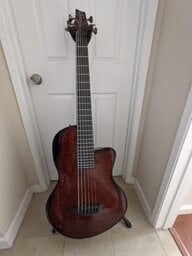
 
The first bass line I learned was Smoke one the water which walks up the first three frets on the E string. At the time my hands were too small to cover that with on finger per fret so I adopted a method of playing the first and second frets with index finger, third fret with middle finger and fourth fret with ring and pinky fingers working together, only going to one finger per fret at the fifth position. When I grew I adopted the one finger per fret but it was difficult to break an old habit, muscle memory being what it is.
 
Last edited: