• TalkBass has been independent since 1998. Add your voice.
    Create a free account to reply to discussions, view embedded media, and browse with fewer display ads.
    Join freeLog in
    Want zero display ads or expanded classifieds tools? Compare plans.

Fingering 1 -2 - 4 or Finger Per Fret?

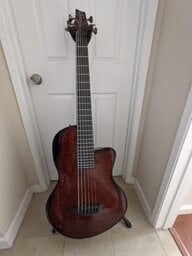
I gots one dem basses with the peg on the bottom that rests on the floor. No more shoulder pain. :D
A Barker? Yeah, they look pretty good, and I guess in your circles they would go over. In mine, I would be laughed off the stage no matter how good it is. I could get away with it for a song or two just to break it up a little, but for me, image is everything, and I like it ;)
 
I should say, though, that that's not the fault of OFPF. What you describe would not be considered a correct way of applying OFPF. It's never meant that if you had your index finger on the 1st fret, any notes on the 3rd fret on any string had to be played with the 3. That would be a considerable misunderstanding. Watch a good classical guitarist sometime. Or even a bad one. :-)

wouldn't that be.... two fingers per fret?
 
Jimmy, you need to clone your wrist/shoulder and sell it. I envy your genetics...I have to use a more upright technique now, and while I can't do what I used to do, I'll get by with less pain now...
...If it feels awkward on your hand, all you have to do is raise your neck a little and the angle gets easier.
Seems to me y'all are saying the same thing, no?
 
explain..?

Sorry, that was a little cryptic, wasn't it?

My point is that, as I said, OFPF is not a rigid, dogmatic system saying that if you're in 1st position, any and all notes on the 1st fret must by played with the 1, any and all notes on the 3rd fret with the 3, and so on. This stands to reason if you think about it. For example, suppose you wanted to play an F on the low E and an Ab on the G. It would be silly to try to play this with a full barre, and no sensible fingering system would expect you to. You would likely play the low F with the 1 and the Ab with the 2 (though I guess I could imagine a case when you'd do the opposite). This does not conflict with OFPF, because OFPF is not as rigid as you assume.

Basically, OFPF means (1) that you hold your left hand in a way that you are prepared and able to assign one finger to a fret and (2) that you use the finger-per-fret approach as your fundamental fingering approach. (IOW, it's a basis, not an unchanging grid.) This fundamental fingering approach is then modified as necessary to suit the demands of the music that you're actually playing. If it's impossible to use the same finger for all notes on the same fret--as in that example I gave above--then you just don't do it, and there's nothing about this that contradicts the spirit or even the letter of the OFPF approach.

OFPF is really more about building the capability to use all four fingers as effectively and independently as possible than it is about enforcing any absolute regularity of the sort you were assuming.

Beyond this, the best illustration I can suggest is just to go watch a good classical guitarist. They know the idea of OFPF as a basic principle (watch how they position their left hand when they first bring it up to the neck), but it's clear that to play the music they play, they can't restrict themselves the way you were restricting yourself when you were doing OFPF.

Is that any clearer?
 
Sorry, that was a little cryptic, wasn't it?

My point is that, as I said, OFPF is not a rigid, dogmatic system saying that if you're in 1st position, any and all notes on the 1st fret must by played with the 1, any and all notes on the 3rd fret with the 3, and so on. This stands to reason if you think about it. For example, suppose you wanted to play an F on the low E and an Ab on the G. It would be silly to try to play this with a full barre, and no sensible fingering system would expect you to. You would likely play the low F with the 1 and the Ab with the 2 (though I guess I could imagine a case when you'd do the opposite). This does not conflict with OFPF, because OFPF is not as rigid as you assume.

Basically, OFPF means (1) that you hold your left hand in a way that you are prepared and able to assign one finger to a fret and (2) that you use the finger-per-fret approach as your fundamental fingering approach. (IOW, it's a basis, not an unchanging grid.) This fundamental fingering approach is then modified as necessary to suit the demands of the music that you're actually playing. If it's impossible to use the same finger for all notes on the same fret--as in that example I gave above--then you just don't do it, and there's nothing about this that contradicts the spirit or even the letter of the OFPF approach.

OFPF is really more about building the capability to use all four fingers as effectively and independently as possible than it is about enforcing any absolute regularity of the sort you were assuming.

Beyond this, the best illustration I can suggest is just to go watch a good classical guitarist. They know the idea of OFPF as a basic principle (watch how they position their left hand when they first bring it up to the neck), but it's clear that to play the music they play, they can't restrict themselves the way you were restricting yourself when you were doing OFPF.

Is that any clearer?

So you are saying... use OFPF unless there is an easier way to do it?

That is exactly what I am recommending. Maybe I am wrong, but I didn't think people here were referring to 1-2-4 as some strict Simandl double-bass fingering where you are having two fingers taped together to function as one.. its just as simple as that if you don't need to stretch, don't!
 
So you are saying... use OFPF unless there is an easier way to do it?

That is exactly what I am recommending. Maybe I am wrong, but I didn't think people here were referring to 1-2-4 as some strict Simandl double-bass fingering where you are having two fingers taped together to function as one.. its just as simple as that if you don't need to stretch, don't!

Well, the catch might come with "easier way to do it." Your earlier post suggests that you were finding OFPF difficult in some cases because you had misunderstood what it was supposed to be about. As I stated, it never meant that when you had two notes on the same fret of adjacent strings they had to be played with the same finger. IOW, that particular problem you had is not an argument against OFPF, because it stems from a misunderstanding of OFPF.

And yeah, I think people were referring to Simandl in some reasonably strict sense, at least to the extent of not using the ring finger. In this context, the point of OFPF is more "don't NOT use the ring finger" than it is "you must use one and only one finger for all notes on a given fret" [spoken in James Bond villain voice]. As I understand it, the 1-2-4 approach means, just don't use the 3, even if it's easier. I guess the presumption is that using the 3 could never be better by definition. If so, I disagree. (I'm aware that many proponents of 1-2-4 use 1-2-3-4 in higher positions. I'm not talking about that, I'm talking about the area where they typically use 1-2-4.)

When you use 1-2-3-4, you can also use 1-2-4 if you choose to. I'm not convinced that the opposite works as well. If you refrain from using a particular finger, it's just not going to work as well as the ones that get more practice time. It's difficult to use a finger--or anything--well if you don't practice with it. (Which is why many old-school rock guitarists couldn't use their pinkies that effectively--they grew up just using 1-2-3. But I digress.)
 
A Barker? Yeah, they look pretty good, and I guess in your circles they would go over. In mine, I would be laughed off the stage no matter how good it is. I could get away with it for a song or two just to break it up a little, but for me, image is everything, and I like it ;)

Actually, an upright. :D But the Barker looks like a really cool concept.

Loy Berryman uses a peg to support her accordion, so I suppose you could do the same thing with an electric:

[Invalid or Expired Link Removed]
 
Actually, an upright. :D But the Barker looks like a really cool concept.

Loy Berryman uses a peg to support her accordion, so I suppose you could do the same thing with an electric:

[Invalid or Expired Link Removed]
I guess I could wheel myself to the stage in a Powerchair too, but I'm not gonna ;) Besides, accordions are way heavier than basses. Who could blame her?
 
Funny you should mention that; I saw a band a couple months ago where the bassist got up on stage with a walker, sat down the entire gig, and totally nailed it too.

Mr. Cool in spades, that guy was.
I'm sure he did look like a badass, but funny thing about walkers...if you don't really need one, you end up looking like a douchebag if you use one ;)
 
Well, the catch might come with "easier way to do it." Your earlier post suggests that you were finding OFPF difficult in some cases because you had misunderstood what it was supposed to be about. As I stated, it never meant that when you had two notes on the same fret of adjacent strings they had to be played with the same finger. IOW, that particular problem you had is not an argument against OFPF, because it stems from a misunderstanding of OFPF.

One-Finger-Per-Fret seems pretty explicit. Is there some sort of definitive reference for this stuff?

I think the core of what most people here are arguing is whether you should fret a 3 fret span near the nut with your index and pinky for safety reasons, or whether this is just being lazy and not properly training and stretching your hand. I believe the former.
 
This is really at the crux of it.

With respect to you both, I disagree. I don't think that's really the crux of it at all.

Perhaps I'm coming at it from a different angle (not wrist angle, mental angle ;)). To me it's about this: Some folks are arguing that you should avoiding using one of your LH fingers (25% of your total supply) almost everywhere in the "money" area of the neck, whereas others are saying that it's worthwhile to practice being able to use all of your fingers equally well, or as equally as is feasible, all over the neck. The latter seems like a much more sensible idea to me.

One idea that seems to be getting lost here--and that is at the basis of tF's misunderstanding--is that learning OFPF is much more about inculcating the ability to do something than it is about mandating that a given fret interval always be fingered a certain way. IOW, OFPFers are not saying that if you want to go from, say, F to G, on the low E, you must always finger it 1-3. They're saying that you practice doing it that way so you have the ability to do it should you ever need or want to. They're saying that you're better off if fingering it 1-4 is not the only way you are able to do it. There are plenty of times when an OFPF player might elect to use 1-4 for that sequence, depending on what came before and what will come after. I do that kind of thing all the time, and so do others. I also do it as 1-3 when that's called for. I know I've said this before, but watch a good classical guitarist. That's OFPF (actually sometimes more than one fret per finger) in practical application.

The thing is, if you practice OFPF, there's nothing stopping you from dropping into 1-2-4 whenever you feel like you want or need to. But I don't think it works the other way as well. If you avoid using the 3 by only practicing 1-2-4, I think you won't find it as easy to go to 1-2-3-4 should that ever seem advisable. If your 3 is underdeveloped, it won't be able to keep up as well. You don't know something that you haven't learned, and you can't effectively use a skill you haven't practiced to develop. It's easier to refrain from doing something you already know how to do than it is to suddenly start doing something you never learned how to do. Knowing 1-2-3-4 allows you to use fewer fingers if you like, because you've practiced all of them, but practicing only 1-2-4 is likely to restrict your ability to use 3, at least to some extent.

The argument from safety strikes me as dubious. I see no reason to believe that 1-2-4 is any safer on the BG than 1-2-3-4 (again, understanding that OFPF is not to be applied in the kind of rigid gridlike manner suggested in an earlier post). I see no difference in wrist angle at all. However appropriate sticking to 1-2-4 fingering may be for the DB, I see no reason why that should automatically make it preferable for the BG. The ergonomic issues are not the same.
 
I played for five years using OFPF/1-2-3-4 and then I realized by watching talented bassists both famous and local that using 1-4 for playing songs with alot of octave parts made more sense and was easier. I found this to be true for slapping octaves as well as playing octaves fingerstyle.

Watching bassists playing octaves with 1-3 looks awkward, uncomfortable and silly with the 4th finger dangling uselessly.

I decided that if 1-4(over 3 frets) was working so well for octaves, why not use it over three frets on the same string. I was learning James Jamerson parts from the SITSOM and he played 90% of his stuff in the first position using open strings and the first four frets. This also changed the way I play as I used to rely on 5th fret rather than playing open strings.

I find that it is easier to keep my other 3 fingers closer to the strings when they are not in use (none dangling away from the strings) when using 1-2-4 for economy of motion and it is also easier for left hand muting of open strings when you are not stretching in first position for 1-2-3-4.

I started using 1-2-4 for the first 5 frets initially but found it more comfortable up to the 12th fret, especially for octaves and parts that only span 3 frets.

I still use 1-2-3-4 for any run or passage that spans 4 frets even down in first position by the nut.