That said, let me pose a rhetorical question. We have 4 fingers (5, actually), on our right hand. Why don't we use all 4? The vast majority of people are using just 50 percent of their total supply. Think of how much better everybody would be playing if they used all four.
I dunno, maybe they would be.

I use 3 of the 4 myself, the way classical guitarists do. (Or rather, 4 of the 5, counting the thumb.) The main reason classical guitarists don't use the RH pinky much is that it's typically a lot shorter and hard to make work, But I don't see what that has to do with LH technique--especially since those same classical guitarists most definitely use all four of their LH fingers.
No, that's not OFPF in action, thats a more nuanced approach that takes aspects of OFPF and 124 and synthesizes it into a more complex system. If you want to call it OFPF, fine, but I'd like you to direct me to a definitive source (book, dvd, whatever) that explains to me that system in detail - when to shift positions, when to pivot, when to use 1-4 fingering for the "box" and when not to, etc.
Well, yeah, I do call that OFPF. A system that's not nuanced enough to take reality into account isn't worth arguing on behalf of. As for backup, I would point you at any classical guitar book. There really isn't that big a difference. But why should I be the only one expected to provide proof? Can you point me to a definitive reference that says that OFPF on the bass guitar is generally agreed to be as rigid a thing as you and tranceFusion have made it out to be? I've never seen such a reference, and I doubt that a good one exists. But I'm willing to be proven wrong. If no such reference exists, then my interpretation of OFPF is no more unreasonable or atypical than anyone else's. Also, I think you're asking for an unreasonable level of detail for a fingering system. All of those questions you ask have multiple answers, not one, and I don't think they can be answered so schematically. You shift positions when doing so gets you a result you want or need; you don't when it doesn't. You use 1-4 fingering for the box when you want or need to; you don't when you don't.
You see, the argument thusfar has been on the most simplistic of terms, because the fingering systems for bass guitar are (at this point in time anyway) described in the most simplistic of terms. People assume OFPF and 124 to be literal descriptions of all possible scenarios. On other instruments, like classical guitar and double bass, they're overarching systems with specific patterns developed in positional playing that govern how to shift, what fingers to use, etc. When you try to approach bass in exactly the same fashion as guitar or upright, however, there is lost in translation. That's why I keep referencing the fifth fret as a point to shift mindsets from upright bass to guitar - because that's approximately where the guitar fingerboard starts, and also approximately where people start using all four fingers on upright. I have my own idiosyncracies, but I'm not so bold as to develop it into a "system".
But wait, I thought my take on it was "nuanced"?

How can it be simplistic too?
My whole point was precisely that in this particular post, a couple of folks--by no means everyone--were understanding OFPF in far too simplistic a way. But I'm not sure I'd conclude from this that the bulk of the bass-playing world understands OFPF this way, and that this understanding is therefore what is generally meant whenever the term OFPF is used. Again, I'd like to see a reference that says that. I really doubt that most good teachers who use the OFPF system ever meant it to be deployed as rigidly as, for example, tF described it in an earlier post. (tF, buddy, I truly don't mean to sound like I'm picking on you, it's just that you provided a particularly concrete example, which is always useful in these rather fuzzy discussions.)
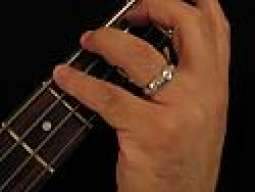
I invite you again to watch my video where I compared wrist angles. If you disagree that the 90 degree angle in the hand is bad news, that's an argument for another thread (and a physician). If you can show me how to do it safely without pivoting, I'd love to see that, but I'm pretty thoroughly convinced it can't be done.
With all respect--and I do respect you greatly as a poster--I don't have any need to look at your video when I can look at my very own left hand, as I have been doing on a daily basis for rather a long time now. There's nothing your video could show me that would outweigh what I see in my own left hand, and what I see is that whatever else changes, wrist angle doesn't. I'm not assuming that everyone plays exactly like me, but if an average guy like me, who has average hands and no special joint elasticity, can do it, then I have to assume that a lot of other people could do it as well as or better than I. So, unless I see strong evidence to the contrary, I assume that I'm not atypical.
Now, one concessions. JimmyM mentioned he wears his bass relatively low, so I can see how, if the neck were angled up enough, OFPF could be implemented safely. That, however, requires you to somehow be lifting the neck up - whether with your forearm of your opposite hand against the body or with your fretting hand's thumb/palm, unless you have a bass that somehow stays up at that angle naturally. That really isn't ideal if you want to be jumping up and down the neck or doing anything fancy, but I guess if it works for you, fine.
I do angle my neck up. Forgive me if I'm misunderstanding, but why do you think that would hinder "jumping up and down the neck or doing anything fancy"? I don't really think that's got much to do with it. Watch John Patitucci, or again, almost any classical guitarist, who typically angle their necks. Then watch a flamenco guitarist, who typically doesn't. I just don't think that's something you can pronounce on so definitively. Of course, a DB has far more of a vertical angle than a BG, and it's certainly possible to fly all over the neck and do fancy stuff on a DB....