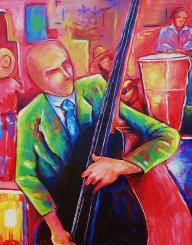
"Now about the bass, I want to buy new..."
Why? In your place, I'd get the least expensive thing I could find that wasn't junk because you simply cannot know what you'll like and dislike six months or a year from now.
-S-
The least expensive bass may not be a "healthy" bass, and may require extensive setup to be playable. When I decided to get a double bass, I did purposely purchase a CCDBSO (that is, Cheap Chinese Double Bass Shaped Object, CCB for short) because I wanted to do exactly that: learn how it is set up. It came with baling wire at least 10 cm off the fingerboard, which thankfully was a slab of ebony, rough hewn. It was not a Palatino, but it was only about a half-step up from there, with a paint job to simulate fake wood grain even worse than the Fender Foto Flame! Here is what I had to do to get it playable:
1) shave, recontour and refinish (with tung oil - I just like how it feels) the neck at the nut down to 1 3/4 inch width, (it was over two inches - now, we all want thick necks for stability, but this was just too much) retaining as much as possible;
2) bandsawing a proper contour to the bridge (I had to take off almost 1/4 inch) and recontour the flat sides to the proper bevel on my belt sander;
3) trimming and resetting the soundpost
4) new ebony tailpiece and cable to replace the anodized aluminum one, and learning how to set the afterlength to even out resonance and avoid the wolves.
5) contouring the fingerboard - fortunately, it had a fairly good slight scoop already. I clamped each string to the board under reduced tension and shined a light behind it to highlight the "gap" and know where and exactly how much to sand down in any particular flat spot. It took hours, and I think there is still a fine coating of ebony dust all over the work area, all these years later;
6) hacksawed off the excess peg length that extended so far up into the body that, well, watch Drurb's video;
7) strings, strings, strings, until I finally realized, as we all eventually do, that everything goes with a Dead Spiro E;
8) Fishman Full Circle and an fDeck Series 2 preamp, after trying some lesser and inferior piezo pickups;
9) because my pinky is so short and curved in, and my index finger is slightly short and slightly curved in, installed a false nut to shorten the mensure so I can span the F to f in 1/2 position.
10) purchase of a proper bow, in case my right hand stops cramping and I actually can arco some day (I spent hours with a friend who teaches double bass, tried both French and German, and nothing is working right now. I don't have time to play in community orchestra, anyway, with my other gigs, so it rests peacefully if and until then)
I've probably done more over time; that's all I can think of right now. The cheap gig bag is starting to unravel at the bottom of the zipper; I'll need a new gig bag eventually. I may still upgrade the tuners, but the thought of spending another couple hundred bucks and a other couple of hours on it is not appealing to me, even though one tuner post desperately needs to be re-drilled and re-chamfered because it is in the wrong place to mount the string properly. The bass still has a resonant peak on the open D string; I just keep a brown washcloth shoved in the off-side soundhole to damp the resonance and as a feedback controller when amplified.
OK, so far, initial purchase was, with the stand (hey, Drurb!) $750. I already had the larger woodworking tools, but add in purchasing the smaller ones, like the model plane and blades to shave the neck, factor in the time, and upgrades, and injuries (yes, there is one cross-grained spot in the neck that the blade caught, slipped, and took off a chunk of thumb skin - not good for a guy who takes rat poison daily) and I easily have @$2K in it, just to be playable. And that does not count getting a new bass amp that can be used for both DB & EB, which I needed anyway because my old one was over twenty years old and the capacitors on the board are starting to get hissy. Then there is the Simandl book and at least some time with a proper teacher to learn good habits and break old EB habits, and the rest of your life learning something new every day.
That's why you don't just go out and get the cheapest bass to start on.
The whole point of this digression: To get a proper bass, unless you want to dive into it piecemeal to learn how it works and how to set it up as you go along, (which I did because I am at least 200 miles from the nearest double bass luthier shop), plan on at least a $2K budget, new or used.