• TalkBass has been independent since 1998. Add your voice.
    Create a free account to reply to discussions, view embedded media, and browse with fewer display ads.
    Join freeLog in
    Want zero display ads or expanded classifieds tools? Compare plans.

First Build - And May My Mistakes Be Minimal

Howdy folks!

First off, I appreciate the fantastic builds and advice offered up in this forum. Build newbies like me are quite fortunate to have such a resource as this.

Although I am still in the design phase, I thought I'd go ahead and get this build thread started at the very least to help me keep track of what I need to do.

With that said, here is what I have so far:

Overall Design:

I am a huge fan of Aria basses. So elegant and quite fun to play. Not a bad place to start, eh? Nope, not a bad place at all. Although there will be differences, namely bridge, pickups and other hardware, the general shape will be a close proximity. So, I will go ahead and state that this bass guitar will be for myself, and at no point will it be sold.

Specs:

Neck: Neck Through, 24 frets (fretted)
Scale: 34"
Woods: Laminate of Maple, Peruvian Walnut and Purpleheart (wood pattern pending)
Fingerboard: Pre-slotted Ziricote

Body: Hickory. My hickory boards are 1" thick, so I am going to laminate each wing to 2" and plane down to 1 7/8.

Nut: 40mm Brass MIJ, slotted
Tuners: Hipshot Ultralite - Gold
Bridge: Hipshot TransTone (gold)
Pickup(s): MB-1E replacement humbucking pickup from handcrafted pickups & guitars - Home
Wiring: Pre-amp is replacement for 1980s Aria SB-1000, deisgned by Prostheta

As you can see, I still have some decisions to make.

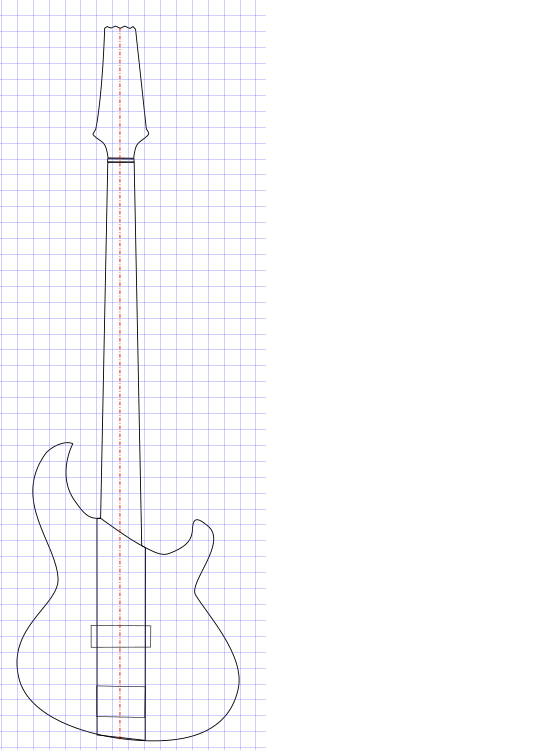
Here is the rough trace of the shape--I need to go back and refine it and make sure it's all symmetrical and on-line before final printing. As you can see right away, I need to fix my Bezier curves on the headstock!:
bass.png


And here, we have my wood selection:

Left to right: 2 hickory boards, maple and Peruvian Walnut lashed to the purpleheart for ease of carrying out of the store.

10306244_10205255445081234_5990251823505187655_n.jpg


So I still have some things to clear out of my garage and schlep down to the basement, but I was able to cut and joint-prep some lumber for a nice strong work bench. Once that is done (mid-week, depending on work), I'll be able to actually start building templates from 1/2" MDF shelves that I had sitting around. I'm quite excited to get this going!

-Rich
 
Last edited:
Looks like a cool project, I always liked the Aria body shape and Alembic-esque image. The 80's Arias were well made , versatile basses. Is this a six string? If not, the headstock looks a little long ti my eyes. Sub'd.

The headstock is indeed long for a 4-string. As you can see below, it'll indeed fit 6. That is one of the fun little oddball touches Aria loves to do. I love the design!

Example:
sb1000b_2b_sbl.jpg


If I were to do a faithful representation, I'd need to purchase a replica pickup by Kent Armstrong or Rautia Guitars. Alembic is an option as well. I think it'll boil down to cost there. I also need to scan the Aria Club threads on TB as well. The bridge is another tricky one. I may consider those Hipshot single-string bridge units as well, if I want to go for a nut -> bridge string parallel.
 
Last edited:
These basses always reminded me of an Alembic Spoiler, a comparable bass, but twice the price. Seeing the headstock in color, I dig it. Definitely oversize, but its a statement. If it feels neck heavy, you could always cut it back a little before drilling for tuners. You might consider Hjpshot Ultralites. It looks like you pulled the lower bout down a little, looks a little unbalanced, but what do i know. Any reason not to follow the original body shape more closely? My build is a straight up Ric 4001 copy, so I guess I have it easy from a design standpoint. I had a hell of a time getting all the curves to flow well on my Steinberger build, didn't succeed 100%. What drawing program is that? I use Autocad 2015. Looking forward to following this one, us Noobs have to stick together.
 
  • Like
Reactions: PDX Rich
These basses always reminded me of an Alembic Spoiler, a comparable bass, but twice the price. Seeing the headstock in color, I dig it. Definitely oversize, but its a statement. If it feels neck heavy, you could always cut it back a little before drilling for tuners. You might consider Hjpshot Ultralites. It looks like you pulled the lower bout down a little, looks a little unbalanced, but what do i know. Any reason not to follow the original body shape more closely? My build is a straight up Ric 4001 copy, so I guess I have it easy from a design standpoint. I had a hell of a time getting all the curves to flow well on my Steinberger build, didn't succeed 100%. What drawing program is that? I use Autocad 2015. Looking forward to following this one, us Noobs have to stick together.

Inkscape since it is free. :) It seems ok, but obviously I have some tinkering to do to get my shape right. I think I'll lay my SB-1000 on a high contrast surface and get a good hi-rez photo that I can then import and trace. Again, that is just the rough as I wanted to have something to show. I have a little time to practice with it a bit and finalize the drawing.

I guess I'll just print it out on 8.5 x 11 and tape it all together. Or even better, see if Kinkos has reasonable large-format printing.

Alternatively, as I mess around with vector tools in Inkscape, I may just scrap the design entirely and make it unique. I kind of like how I have the lower horn a bit different. By accident, of course.
 
I figured you would. While we were discussing your purpleheart/hickory build, it stuck in my head. When I saw those cool hickory boards yesterday, I couldn't resist.

Work bench 1/2 done. Ran short on time tonight. Gives me more time to mess with Inkscape however. :)
 
I figured you would. While we were discussing your purpleheart/hickory build, it stuck in my head. When I saw those cool hickory boards yesterday, I couldn't resist.

Work bench 1/2 done. Ran short on time tonight. Gives me more time to mess with Inkscape however. :)
Inkscape can be addicting. ;) I spend a LOT of time in it planning things out, and though it may not be as exact as a CAD application it's plenty for what I use it for. One warning about the hickory - it's some seriously hard stuff that tears out just looking at it sharply. It will dull your cutting tools, and you want them SHARP when working with it. That being said it's super gorgeous wood. I have read that it is comparable to mahogany tone wise if you're of the opinion that body wood affects tone.
 
Hmmmm. I plan to do several relief cuts with the bandsaw before shaping to 1/8" of template lines before hitting it with a compact router w/whiteside flush trim bit (bearing on template). Think that will help? And new blades/bits. Not sure I can do much else hah!

I am also hoping for massive good luck, of course. :)
 
Hmmmm. I plan to do several relief cuts with the bandsaw before shaping to 1/8" of template lines before hitting it with a compact router w/whiteside flush trim bit (bearing on template). Think that will help? And new blades/bits. Not sure I can do much else hah!

I am also hoping for massive good luck, of course. :)
I am really hoping you don't have the challenges I did with hickory and the bandsaw, and look forward to seeing your progress on this!
 
I was able to find a slotted brass nut on Amazon for $5 + $3 shipping. Made in Japan - 40mm. The current SB-1000 models are 40.5mm. So, I will go 40mm. If brass is good enough for my favorite bass, it'll be good enough for this one. Is it odd to go this route? Well, if it doesn't work, it was a small cost. If it works, bonus! I just can't see myself complaining about that width, and I planned on carving a volute anyway...

So, as long as I am going this route, I may as well go gold on my hardware, since I need to start narrowing down my selections....and good call on the Hipshot Ultralites, Gilmourisgod.
 
Since the neck width at the nut will be rather narrow (40mm), should I go for a larger fingerboard radius such as 16"? Seems I will be trimming quite a bit!
I will be purchasing a pre-slotted, pre-radiused one from ILM. They have ziricote, so I am having trouble not wanting to grab one.
 
What kind of trouble did you have with the hickory? Most hickory seem to have a janka around 1800, which is hard, but not extreme. Bubinga, for example, is around 2400.
Tear-out during planing and routing was the biggest issue. I had to take it VERY slow and VERY carefully. Of course this may just expose my ignorance and inexperience. ;)
 
Hmmmm. I plan to do several relief cuts with the bandsaw before shaping to 1/8" of template lines before hitting it with a compact router w/whiteside flush trim bit (bearing on template). Think that will help? And new blades/bits. Not sure I can do much else hah!

I am also hoping for massive good luck, of course. :)

You'll probably find that you can get closer than ⅛" pretty easily. And if you're worried about tearout (and apparently you should be), sand the body down to 95% of the finished shape in the areas where there is significant endgrain (that the router bit wants to grab and rip off). Then the router bit will just do the most minute shave of the surface in those spots. If you find that you overshoot and sand further than the line, no real harm done.
Or, as I have done once or twice, just sand it to the finished shape on the ROSS, and forget about using the router and the template.

How will you arrange the "two-tone" hickory pattern on your body? I find that I like to photograph my boards, and mock up different grain configurations in the computer.
If you are concerned with weight, when you are sandwiching two boards for the body you have the opportunity to chamber the wood in between the layers. That can be as simple as drilling a bunch of large shallow holes on the inside halves, which is what I'm about to do next on my build.
 
Since the neck width at the nut will be rather narrow (40mm), should I go for a larger fingerboard radius such as 16"? Seems I will be trimming quite a bit!
I will be purchasing a pre-slotted, pre-radiused one from ILM. They have ziricote, so I am having trouble not wanting to grab one.

With the narrow-ish nut, I assume that you won't be doing the bizarre SB1000 parallel string wide-nut-narrow-bridge thing? You could still no a narrow bridge - Hipshot makes ones down to 16.66mm string spacing, the original Arias were apparently 16mm. That said, one of my regrets on my latest build (the short scale Talman-style one) is that I spaced the strings too narrowly.
I don't think the width of the neck should dictate your fingerboard radius, just pick one you like on your other basses. I personally prefer a really small radius. You might just want to use whatever radius your slotted brass nut uses, so they will match without much adjustment.
 
Tear-out during planing and routing was the biggest issue. I had to take it VERY slow and VERY carefully. Of course this may just expose my ignorance and inexperience. ;)

Yeah, I'm new at this too, so what do I know? Maybe tear-out has nothing to do with janka hardness. But the one significant tear-out disaster I've had was flush routing the end of a fingerboard of macassar ebony (janka 3200), which is very brittle. Ever since then I've sanded my fingerboard ends to shape instead of routing.
 
You'll probably find that you can get closer than ⅛" pretty easily. And if you're worried about tearout (and apparently you should be), sand the body down to 95% of the finished shape in the areas where there is significant endgrain (that the router bit wants to grab and rip off). Then the router bit will just do the most minute shave of the surface in those spots. If you find that you overshoot and sand further than the line, no real harm done.
Or, as I have done once or twice, just sand it to the finished shape on the ROSS, and forget about using the router and the template.

How will you arrange the "two-tone" hickory pattern on your body? I find that I like to photograph my boards, and mock up different grain configurations in the computer.
If you are concerned with weight, when you are sandwiching two boards for the body you have the opportunity to chamber the wood in between the layers. That can be as simple as drilling a bunch of large shallow holes on the inside halves, which is what I'm about to do next on my build.

Good point on using the ROSS. I may just grab a smaller hickory scrap board from Woodcrafters, if they have them, and see how the router handles it.

Body grain pattern organization! This will be a real treat. I need to photograph the backsides. Fantastic idea using the computer to arrange them.