• TalkBass has been independent since 1998. Add your voice.
    Create a free account to reply to discussions, view embedded media, and browse with fewer display ads.
    Join freeLog in
    Want zero display ads or expanded classifieds tools? Compare plans.

First Build - "Lucifer"

So it is totally a throw-away?

Can those blue shop towels be used?
View attachment 4510129
Yep, use once and toss. It starts to harden pretty quickly. In fact, it also starts to harden pretty quickly in the bottle too - the old trick is to punch a single hole in the foil cover on the top of the bottle under the cap, and then store the bottles upside down after they are opened. This can also help it last longer. :thumbsup:
 
Not as bad as french polish then.
That's exhausting. I can't even watch a vid of someone else doing it.
I worked for a while doing museum restoration of furniture and once french polished an entire 10 seater replica 17th century dining table for an exhibit. It took approximately a million years and clarified for me that I'm not an acoustic guitar builder. :D
 
Okay, I took the advice of our resident squirrel and bumped up the application frequency a bit. We are now on coat #4. I'm gonna leave it alone until tomorrow and we will try to do 2 coats per day, one before I leave for work and one after I get home. I'll continue this frequency until my patience and self control run out or I just get way too bored and frustrated. Pray for me. :meh:

Oh, or until I just run out of application rags. I guess that's a thing too.
 
Tim, what if you used a piece of any ol' cotton shirt, balled up in a coffee filter, similar to a french polish applicator.
I was curious and looking for how people store their applicators,.... All I got was a million pages of how to apply it and stopped looking. But I did see that some people recommended the coffee filters.
Any old T shirt would work and the coffee filter would prevent lint. Plus, it won't hurt to throw it away and make a new one.

I need to invent a reusable tru oil applicator. Someone write that down and remind in a few months.
 
  • Like
Reactions: TerribleTim68
In the interest of helping to make this happen quickly... one thing I've found that helps lower my curing time here in 90+% humidity-land is hanging my instrument directly over an oil-filled radiator heater. There are some convection currents that rise above it, but it doesn't kick up any dust. It seems to help get a hard finish faster, but I'll sheepishly admit I've done no testing or scientific method to evaluate it. (I'm going to have to now, friggin' OCD) The cabinet shop I worked in had a "drying room" that looked like an autobody paint booth. It was probably 45C in there I think? Around 110 Fahrenheit for any Liberians. Maybe not that hot, but quite hot anyway.

Also, once it glosses over, keep going with slightly thicker coats. Tru-oil really gets glassy after around 15 coats. I really have taken it up to 30 or so to get a higher gloss finish. They are very thin compared to sprayed urethane, so it takes more to ensure good even coverage and depth to finish that looks so pro. :thumbsup: Part of the thickness of coats and the time is because it shrinks back quite a bit when drying.

I'm also sparing with the steel wool, only after around 5 coats and gently at that. It can leave it's own scratches embedded in the layers of the finish. Once it starts getting glossy, I like to take a brown paper bag and crumple it up a bit and then use that to burnish the surface. Not really burnishing, because you don't want to create too much friction or heat, but smoothing over the whole thing gets rid of bumps and nibs.
 
Okay, coat #5 went in this morning. -
20211219_094106_HDR.jpg


20211219_094121.jpg


20211219_094138_HDR.jpg


It's really starting to gloss up to a point where photos are hard because of the light glare, so we're getting somewhere. I think the crazy amount of era in filling was a good choice, even though at the time I was questioning every coat. Looking back, I'm glad I did it.

The wife approves of the finish choice, so my biggest critic has been appeased. The coats shall continue! 2 floggings per day!
 
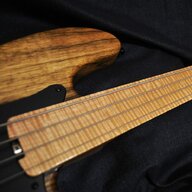
Oh, I'd love to show you guys the front, but my method is to do the front, then flip it over and prop it up with a block of wood in the pickup cavity and then do the back. That way the freshly coated front isn't touching anything. I keep forgetting to snap a pic before the flip because I'm wearing gloves and trying to move with purpose. But, the zebrano looks epic! Perfectly golden and shiny!
 
I use these for wiped on finishes:

https://www.amazon.com/gp/product/B07BLJN8GW/

I'm with Beej in that literal "old tee shirts" have sometimes caused me problems. These rags are less prone to leaving nibs of cotton behind or causing contamination. I cut them up into small pieces - a one pound bag probably lasts me at least 10 instruments. Part of me hates buying something to throw away after 30 seconds of use, but it's worth it for this.
 
As an Amazon Associate, TalkBass may receive commissions from qualifying purchases made via links on this site.
Regarding fibers and oil applications. Birchwood Casey likely recommends using coffee filters, because they contain mostly long fibers to help them retain shape and sizing so they don't fall to pieces when wet. Cotton fibers like a t-shirt are brushed to fray the edges of the fibers to make them soft. Since you're just applying the Tru-Oil with the material and not buffing it, you don't really need anything soft. Back a long time ago on TDPRI, (the tele forum)I think it was Doug Kauer that suggested doing some buffing every few coats. Don't quote me on that. The first time I used it was on one of Doug's necks, back when he pretty much just made necks.

I think the idea of coffee filter or shop towels is probably a good one. I had pure cotton untreated rags when I've done oil applications in the past. Cotton is a good idea as it is a stronger cellulose than paper, but how it is treated is key to not leaving lint. If you've ever noticed that your bathroom has more lint than anywhere else in your house it is because, the majority of bathroom dust is skin scale and tiny cotton fibers because towels need to be soft.
 
My challenge when wiping finishes is getting a good balance of "spreading" vs carrying the finish. I want an applicator that will hold enough finish that you aren't dipping into the jar every 3 seconds, but also one that spreads it nicely enough that you don't have to work hard to keep it even and streak free. That's where the cotton does well for me. What I do is wrap a square of cotton around a disposable foam brush, then use that to wipe the finish on. I don't use it like a brush, I basically ignore the handle and hold it like a pad. When I'm done with a coat, I throw out the cotton and squeeze out the brush in a paper towel. Then I wrap the foam brush in plastic and squeeze the air out. I re-use the same foam brush for an entire instrument and just put a new cotton square on it each time. I use this process for tru oil and wipe-on poly.
 
Last edited:
Well, I discovered that I still had 3 of the "rags" that Birchwood-Casey packages in the kit that I bought. It came with a walnut stain, the Tru-Oil, a "Stock Sheen & Conditioner", a few steel wool things and some rags of some sort. -
23801_83__39456.1626934795.jpg

I got it at Bass Pro Shops. FYI, they don't sell basses there nor do they have famous bass players such as Flea, Claypool or Victor Wooten there either. :roflmao:
Anyways, I cut up the rags from the kit into smaller, more bite sized pieces, mostly to make them last longer. I also noticed that by placing it in the ziplock bag and squeezing out as much air as I possibly can, it seems to be holding up quite well without hardening, so I can keep using it. I've been using the same piece now for the last 4 coats, so I can eventually toss it when I reach a point where I'm concerned about the stiffness of it and then grab the next piece. I figure the rags that came in the kit are probably the right stuff, so we'll stretch them as long as we can. also, any usage of steel wool has been the steel wool that came in that kit because again, probably the right stuff. I'm sticking to the stuff they packaged together, for now anyways.

I still don't really know what the sheen & conditioner is exactly, or how they intended it to be used. :eyebrow:

Also, coat #7 went on before I left for work. I'll hit coat #8 when I get home. No pics of #7, you'll have to wait. I think I've also decided to hold on pics of the front until I'm satisfied, because who doesn't love a big reveal? :smug:
And again, listing what coat I'm on mostly so I remember where I am in the process. ;) :laugh:
There's progress, it's just not monumentally noticeable. But I feel good about it.
 
Since Tim's thread is now mainly a discussion on Tru-Oil, I won't feel guilty about the continued diversion...

I know Tru-Oil takes a long time and many (many!) coats; a lot of you commenting on this thread seem to take even longer than I do! I usually get 12-15 coats in a week to a week-and-a-half and, depending on weather, I only seem to need 24 - 36 hours for the final coat to cure.

Are you folks going for a higher sheen or am I not applying enough oil? On my current project, I used all but a few drops from the small bottle...
 
  • Like
Reactions: TerribleTim68

Latest posts