• TalkBass has been independent since 1998. Add your voice.
    Create a free account to reply to discussions, view embedded media, and browse with fewer display ads.
    Join freeLog in
    Want zero display ads or expanded classifieds tools? Compare plans.

First Build - "Lucifer"

So, to recap, because why not. I moved my build inside, so it's a constant 68 degrees in the room. It seems to be drying quite well in a 12 hour timeframe, I've been applying 2 coats a day, pretty much dead on that 12 hour mark.

As for what I'm going for, I honestly don't really know yet. I'm just gonna keep applying coats until it looks crazy shiny and I get totally sick of doing this never-ending step. I know I'm applying very little per coat, so yeah, they are super thin coats. I probably could apply it a bit thicker, but meh, why push it? It seems to be going well, no reason to change what I'm doing at this point and end up borking it all up. I know I want a high shine, I'm not really a fan of matte or even satin finishes, I like super high gloss. So yeah, I'm gonna keep going till I'm satisfied that I can put a buffing pad to it without burning through and then I'm gonna buff it up as glossy as I can.

I haven't really decided on exactly how I'm gonna buff it just yet, I have some options. Typically, I just use a buffing pad chucked up in my cordless drill, and use automotive compound such as Mequiar's or Turtle Wax. something real similar to this, but I prefer the mushroom shaped ones (I have this hole kit) -

s-l400.jpg

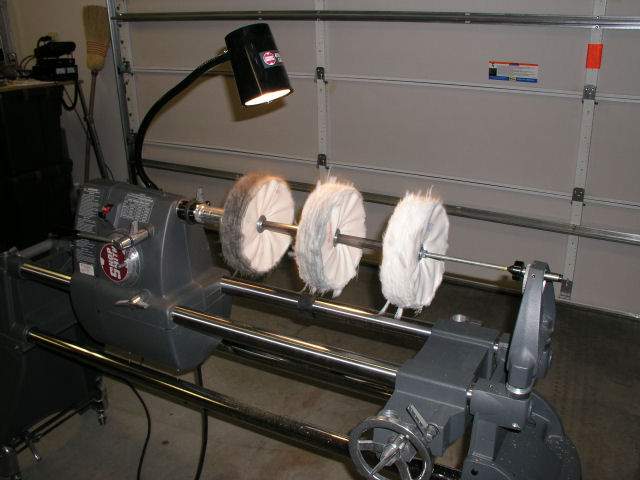
That has worked very well in the past on my swirl paint projects, and I'm fairly comfortable with it. The other option is, I have buffing wheels I could put on the ShopSmith and actually do a real buffing on it. My concern there is, I've never done it that way, and I'm curious how you go about presenting it to the wheel without smacking the neck or body into something while trying to present the other part. Know what I mean? It would look very similar to this setup, except my wheels are all individuals -
2007-12-30-4347a.jpg

So I would buff one compound, change wheels, and buff the next compound. I tried using it on a different project, just to see how it works, and what I learned right away is, I can press hard enough that the wheel part stops spinning with the shaft. I don't know how tight you need to tighten it up or if I was just pushing too hard or what. Again, it's something I'm not terribly familiar with. I dunno. I want to use a real buffing setup over a cordless drill. But I also want to know what the heck I'm doing too. :eyebrow:
 
Last edited:
Oh, a couple other things I noticed. I went searching for the official Birchwood-Casey Tru-Oil instructions, which led me to their website where they have a "how to". In reading through it, they said that you need to wait 7 days after your last application of Tru-Oil before moving on to either the "Sheen & Conditioner" or their other preference is applying a wax finish and buffing the wax. Either way, they say 7 days. That seems much shorter than the recommended "month" I've seen stated here. Are you guys just waiting a month because of weather conditions? Or is this something you've learned that 7 days isn't enough?

Not sure I'm gonna put a wax finish over it. I get it, I do it on my turnings. It feels crazy smooth when you buff a wax over it, I just don't think I want my bass all waxy.
 
  • Like
Reactions: RodRy
What did you use to grain fill and how much did it take to smooth out the Wenge?
I used Zinsser Seal-Coat. -
912A6Dc4F6L._AC_SS450_.jpg

I get it at my local Rockler affiliate store where I get all my turning supplies. It's perfectly clear for starters, so that's a win. I think I applied about 6 coats by the time I had enough. I honestly forget exactly how many coats, but I'm pretty sure it was 6-ish. It goes on pretty thick too, so there's that. I put 2 coats on and then sanded it back, then another 2 coats, sanded it back, then another 2 coats and sanded that back.

As for your question about filling the wenge, that's a totally different conversation. :roflmao:
I think it did a good job of filling overall, the current situation feels extremely smooth to my hands when I run a finger down the back of the neck.

But, that being said, I do still see a few places where I did not sand it well enough before the sealer went on and you can still see some grain pock marks (or whatever you wanna call them). There's also a few places in the zebrano top where I noticed some grain tear out from building it that didn't get fully sanded smooth, and a couple spots where I could have sanded better overall. But, I'm past that point and I'll forever know they are there, but will probably be the only person who notices them. They will live as motivation for the next build to be even better. I've taken the stance that I don't plan on pointing them out to people, because part of learning to be a better woodworker is not stealing the joy from others as they admire your work. Quit pointing out the flaws, just let them enjoy it. I am always my own worst critic and will always know where I messed up. That doesn't mean I should point it out to everyone else. It's a completely different mental approach that I'm still struggling with. But I've decided to add this new mantra to my current one of "No Zero Days". The hope is that my quality of life reflects the efforts put forth. Thus far it's been good, but yeah, it's a struggle to stop pointing out your mistakes.

But at the end of the day, it felt crazy smooth this morning with only 6 coats of finish on it, so it must have filled the grain rather well. The finish also started building pretty dang quick, another indication that it must have filled the grain rather well. I think I've stumbled through a couple steps that probably helped me more than I realized, all while not fully understanding or appreciating them at the time. In my honest opinion, I've gotten crazy stupid lucky on this entire build thus far.
 
The shellac is definitely speeding up how those first few coats are building.

If you still have spots with grain texture showing that you don't want in the glossy finished product, you can wet sand with the tru oil and high grit wet/dry sandpaper for the next several coats and the sanding slurry should help fill the pores.
Yeah, I saw that on the Birchwood-Casey website "how to", they talk about that there. :thumbsup:
Honestly, I'm just not sure how much I'm concerned about it, it's barely noticeable. I may be just overreacting to my own inadequacies. :laugh:
 
The shellac is definitely speeding up how those first few coats are building.

If you still have spots with grain texture showing that you don't want in the glossy finished product, you can wet sand with the tru oil and high grit wet/dry sandpaper for the next several coats and the sanding slurry should help fill the pores.
I may actually do that to the top. I have concerns that with it propped up like I'm doing while it dries during each coat, the top is facing "down", so the whole self-leveling of the Tru-Oil probably isn't happening. So I may spend some time just applying extra coats to the top and doing the wet-sand slurry method there. I just gotta figure out how to blend it in if I do that.
 
  • Like
Reactions: RodRy
It should be fairly easy to do it to the top only. I've done that on a couple acoustic instruments (where the tru oil soaked into softwood tops and left pock marks) and it worked fine.

I kind of like the grain pores showing through, personally. But I think it's an all or nothing thing, or at least per surface or per type of wood on the instrument it's all or nothing. Grain pores always look bad when they're only present in one patch or one spot. If they're everywhere or nowhere it looks good, but if there's some here and there it looks unintentional.
 
Yeah, I can tell they are tear out from the planer, and I just missed it when sanding. I was getting dangerously close to "too thin" with this body and was starting to have great concerns about the electronics fitting in it with it this thin. You know, first build mistakes and all. I made them, trust me, you just gotta know where to look. ;)
Luckily, it is contained right in this area, and if you don't catch it in the right lighting angle, you don't really notice it -
Screenshot 2021-12-20 103203.jpg


You can feel it tho, which makes me want to do something. We'll see how I feel 20 more coats of Tru-Oil from now or whatever. :roflmao:
 
  • Like
Reactions: RodRy and dwizum
I have a bass with what started out as a similar defect right in that same area. It was super annoying at first. After about a year of hard playing, the defect has been completely obscured by tiny fingernail dents and other playing wear, since that's such a high contact spot (for me at least). So I wouldn't get too hung up on it!
 
It's a work in progress that so far involves lots of biting my lip and the occasional wife hitting me over the head as she says "STOP POINTING OUT THE FLAWS!" :roflmao:

Tim, I have the same problem. I think it is just sort of a general woodworker's syndrome. Basically you have an overwhelming compulsion to point out every flaw on a finished piece of work. I'm trying to break myself of it, and I've made good progress, but I'll always be afflicted. :D
 
  • Like
Reactions: RodRy and deff
We're all human and what I've noticed is, even though there's 8 billion of us and they say everyone is unique, there's really only a small number of personality/aptitude types.
It seems the folks who are drawn to wood working share quite a few personality traits and cut from the same cloth. Self criticism and hyper focus on details seems common.
Thankfully I have ADD, so I only focus on them for a minute.
 
  • Like
Reactions: Mickey666 and RodRy
What's crazy is how small that bottle is and you have 8 coats on a whole bass and probably 8 to go.
Those must be reeeeeally thin coats.
How much is left in the bottle?
Plenty. Yeah, it’s pretty thin. Their own website says “apply it by using your fingers to rub it on”. Of course, I’m not because quite honestly, it’s kinda sticky and your fingers tend to stick together if you leave it on your skin. It’s also a pain to wash off, so I glove up. But yeah, it’s really thin coats. You really don’t want to leave any sort of “puddle”, it will dry wonky and cloud up.