• TalkBass has been independent since 1998. Add your voice.
    Create a free account to reply to discussions, view embedded media, and browse with fewer display ads.
    Join freeLog in
    Want zero display ads or expanded classifieds tools? Compare plans.

First Build: SC5 Headless

Neck blank being glued. The pieces of ash are just under 2" by 2". I think I should be able to get two 3/4" blanks out of it.

IMG_0448.gif


And since I plan on letting the neck blanks sit for a while to make sure they don't decide to bend or twist, I figured I might as well glue them all up. Looks like I'm going to need some more fingerboards ...

IMG_0449.gif
 
Neck blank.

IMG_0450.gif


I'm looking into trus rod options. Ideally, I want something that I can route a single width channel for that extends past the end of the fretboard to allow for adjustment (on the body end, see pic below). Is the double action with a welded nut rod (Item Number TRBSD)from LMII the best choice?

2011-03-30122210.jpg


NOTE: Just to be clear, the bass pictured above is not something that I built. I only used it to show the trus rod access because I would like to do something similar.
 
It looks like I'm only going to get one neck per blank. I remembered buying the ash as 2x2's, but I forgot that they actually measure closer to 1-11/16. After cleaning up the surfaces, I'm just over 1/1/2" thick. I was hoping for two necks that were 0.75" thick, but obviously that isn't going to happen. Does anyone use necks that are closer to 0.625" before the fretboard is attached? I plan on adding a 0.250" thick piece of the fingerboard material to the back of the neck where it meets the body to provide a little contrast in the area that transitions from the neck to the body.
 
I went ahead and ran the neck blanks through my jointer. The top and back surfaces are all nice and flat, but not necessarily parallel. I also cut one of the neck blanks in half to give me two. I'll be visiting the guy who does my planing some time in the next two weeks so I'll have to wait until then to know exactly how thick they are going to be when finished. I'm also going to be getting a few more pieces planed so I can get ready to start a few more blanks to keep me busy this coming winter. :hyper:
 
It looks like I'm only going to get one neck per blank. I remembered buying the ash as 2x2's, but I forgot that they actually measure closer to 1-11/16. After cleaning up the surfaces, I'm just over 1/1/2" thick. I was hoping for two necks that were 0.75" thick, but obviously that isn't going to happen. Does anyone use necks that are closer to 0.625" before the fretboard is attached? I plan on adding a 0.250" thick piece of the fingerboard material to the back of the neck where it meets the body to provide a little contrast in the area that transitions from the neck to the body.

.625" is totally usable with a .25" fingerboard on it. Add those together and you're at .875" or 7/8". That's plenty thick. In fact, you will probably end up taking a bit off to make it more comfortable. At least I would.

You're off to a good start. Keep it up man.
 
.625" is totally usable with a .25" fingerboard on it. Add those together and you're at .875" or 7/8". That's plenty thick. In fact, you will probably end up taking a bit off to make it more comfortable. At least I would.

You're off to a good start. Keep it up man.

That's good news. I feel a little better about having gone ahead and cut one now. I took another couple of measurements and I think 5/8" is the worst case. I should be able to get closer 11/16" after planing.
 
Trip to the planer scheduled for mid week. I love seeing the appearance of the wood change when you see the rough side of the lumber going into the planer and the smooth side coming out.

While I'm there I'll also be getting some tops (not for this build) planed. They will be my first attempt at bookmatching. Depending on how they turn out, I may post a few "teaser" pics of other body blanks that I plan on making. Should be fun!
 
It's been a while since I've updated this thread, but I have been making lots of saw dust. Even though I didn't want to, I've gone ahead and started on a few other basses. I figured since I have the wood on hand and the tools out/set up, I might as well go ahead and build a few extras. I'll probably take them up to the point where I have to fit the neck and then just concentrate on one.

Anyway, everything has been planed. I'd still like to find someone with a good drum sander, but I can probably use most pieces as they are if I have to.

Neck blanks and fingerboards patiently waiting for truss rods and fret slots ... I was able to pick up three Ziricote fingerboards and one ebony fingerboard so that I can finish the six neck blanks I have started. I have another blank that I can split into two, but I'm leaving that one sit for now.
IMG_0455.gif


Tops and backs waiting to be glued. I should be finished joining them by Wednesday if all goes well.
IMG_0453.gif


Tops that I have already joined.
IMG_0454.gif


Ash (will get a Walnut back)
IMG_0459.gif


Cherry (I think it's getting a Walnut back too)
IMG_0458.gif


Here's a shot of a Walnut top being glued. I use the same arrangement of clamps for gluing my body blanks as well.
IMG_0451.gif


Closer so you can see the top.
IMG_0452.gif


Another Ash body that has just been rough cut.
IMG_0460.gif


Maple Body (rough cut)
IMG_0461.gif


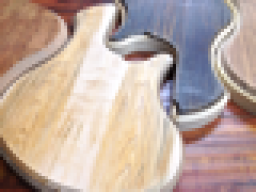
And with permission from one of TB's up and coming new talents, a pair of mini bodies (maple). When I saw Adams first Habanero build I thought this shape looked really cool. When I saw his second (his entry in the fretless 5-string competition) it really grew on me. I've had a few pieces of Chechen around for years that I didn't know what to do with because they are just too narrow to make a top on a regular sized bass. However, it turns out that they are just wide enough to fit a Habanero. Adam has graciously given me permission to use his body design for a set of twins (one fretted, one fretless).

IMG_0462.gif


IMG_0463.gif
 
Are you going to make you Habaneros headless? You might find that they balance better sans headstock. If you make them w/ traditional headstock, get the lightest tuners you can.