• TalkBass has been independent since 1998. Add your voice.
    Create a free account to reply to discussions, view embedded media, and browse with fewer display ads.
    Join freeLog in
    Want zero display ads or expanded classifieds tools? Compare plans.

First time ever for me... A string broke while I was playing... (Pyramid Gold)

Nice, but where is the Framus?
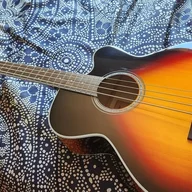
IMG_20211113_0049025.jpg
 
Over the past few decades, I've had many guitar strings break on me while playing, but never a bass string... And then earlier in the evening it happened, during a gig...

We were playing a backyard/birthday show, I was playing my main bass (Harmony H22), we had maybe a 2-hour set list prepared (split into two sets with a brief break in between)... Got through the first four songs, and then we were about to start the next song when I felt my E string completely stretch and detune because it developed a break at the bridge... I would have never expected a .110 gauge flatwound to just break from wear and tear (and definitely not on a wooden bridge), but it happened... Anyway, I also had my Danelectro longhorn with me, for use on three songs where I need a different sound (it is strung with LaBella white nylon tapewounds), so I just switched to that bass and played the rest of the gig with it. Even though both basses are short-scale, they have a much different physical feel from one another for a bunch of reasons, so it was a little tricky, and I did mess up on a couple songs because of it, but in the end, everything worked out OK and everyone had a good time.

But now I need just a single replacement Pyramid Gold .110 long-scale E string (the Harmony needs long-scale strings because of the distance between the bridge and tailpiece)... I don't really want to shell out approx $70 for a whole new set, but I guess I don't have a choice. I suppose I can just keep the other three strings as spares in case of future breakage, because I learned earlier this evening that it is a real possibility and not some semi-mythical thing that only happens to other people.

I get it, string breakage is something that we all really should be prepared for, but this was literally the first time I ever had a bass string break like that. For the time being, until I get a new E string, I'll be using my Framus Star-Bass as my main bass...


@GC34 might be interested to hear of reports of a string breakage

Must of been a really old string. Maybe a burr on the bridge.
 
Last edited:
So.... I tried living with a LaBella Deep Talkin' flat .110 as n E string with the rest of the strings being Pyramid Gold and it just didn't work out. The LaBella had a much greater amount of mid overtones, sustain, bark, perceived loudness, etc. I tried working around the issue by playing that string differently than the rest (muting it harder, plucking it more softly, etc.) but it was way too troublesome to keep doing, way more effort than it was worth. So I just bought a new set of Pyramid Gold extra heavy long-scale strings; I found out that they are much more widely available now in the US in various gauges etc. I used to have to order them from overseas, but Chicago Music Exchange stocks them now (it's been year since I had to purchase any, so I had no idea it would be much easier and quicker than my past experiences having to import them). ANYWAY, they arrived within a few days, and I just had my first practice with it today, and it was so much of an improvement that it filled me with joy! It sounds like four of the same type of strings again (because that's exactly what it is!). So yeah, the lesson learned is that Pyramid Gold does not mix well with other brands/types of flatwounds. Probably because the Pyramids have round cores and are chrome nickel, and the LaBellas have hex cores and are stainless steel.
 
  • Like
Reactions: Dynacord
Only the E string (and, where applicable, the low B, I would assume) in Pyramid Gold flatwound sets is round-core, the rest of the set is hex.
https://www.talkbass.com/posts/25614958/ Well, in your case, the 090 A *might* have a round core as well. If you can, get a magnified look at the exposed core around each ball end.
Hmm, interesting! Reading further in the thread it does seem like the .090 should have a round core too. Also, from further reading, Pyramid will custom make a full round core set if you request it, and the price is comparable to the regular set.

I wonder if this mixed-core thing is a change that happened in recent years, or if it has always been the case. My higher strings are several years old (and I don't even know when the strings were manufactured; they could have been sitting around in stock at the retailer for several years before I purchased them), and they don't sound or feel different. Also, I've purchased Pyramid Gold regular electric guitar stings in the past, and they were advertised as having round cores (and the retailer included special instructions for installing them because of this, e.g, crimp before trimming the excess), so it seems really odd that they would use hex cores for some of their bass strings....

One weird thing I noticed with this new string set is that the strings seem less polished than the old A, D, and G that are still on the bass. The old strings are super smooth, and the new ones not so much. They aren't super rough or anything, just not as luxuriously polished.
 
  • Like
Reactions: Root 5
Hmm, interesting! Reading further in the thread it does seem like the .090 should have a round core too. Also, from further reading, Pyramid will custom make a full round core set if you request it, and the price is comparable to the regular set.

I wonder if this mixed-core thing is a change that happened in recent years, or if it has always been the case. My higher strings are several years old (and I don't even know when the strings were manufactured; they could have been sitting around in stock at the retailer for several years before I purchased them), and they don't sound or feel different. Also, I've purchased Pyramid Gold regular electric guitar stings in the past, and they were advertised as having round cores (and the retailer included special instructions for installing them because of this, e.g, crimp before trimming the excess), so it seems really odd that they would use hex cores for some of their bass strings....
As I said, there is one non-destructive way to find out ;)