• TalkBass has been independent since 1998. Add your voice.
    Create a free account to reply to discussions, view embedded media, and browse with fewer display ads.
    Join freeLog in
    Want zero display ads or expanded classifieds tools? Compare plans.

Double Bass First upright day!

... learn to use your open strings. How do you find that low F if your tuner won't do it for you? Well, you've got that open A one string higher. That A is a major third against the F. Play your A and keep hacking (well, actually micro-adjusting) at your E string until you've got a nice consonant third happening. There's your F. Your D is a major 6th against that F; your G is a major 9th. Learn to think this way! It's a skill you will use your whole DB career, just as thousands of others before you have done....


Keys to the kingdom right there. Makes no difference what type of music. You can only play what you can hear.
 
I certainly find it hard to imagine my teacher running pizz-only lessons. He's far more wholistic than that. Both hands have to work together with the body in a correct posture to get good sound and not injure yourself, and the further I go the more I realise how totally right he is.

As an educator it can be much easier for the student to focus on one hand at a time. And this is also a good time to work on pizzicato technique which is different than electric.
 
As an educator it can be much easier for the student to focus on one hand at a time. And this is also a good time to work on pizzicato technique which is different than electric.

Not arguing with you, that's what I do in practice, but in lessons my teacher doesn't let me.

My teacher is in his seventies and pretty much retired. In his heyday he was a serious classical musician, and has worked with people like Benjamin Britten, Vaughan Williams and Neville Mariner. He's certainly an experienced teacher, but in his heyday I doubt he'd have wasted his time on a hack like me.
 
Well hurt my self today playing the upright!


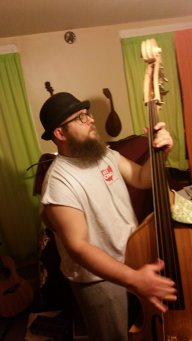
Here i was just jamming and really just trying to figure out what the hell i was doing. And then it happened while trying to play house of the rising sun! I was getting a few notes right and then BAM beard got cought under the E string!

I just steped back in shock! And tears ;)
 
Your poor beard! :eek:

If it's any interest to you, I pulled the tape position markers off my bass as soon as I left the store. I saw it as an opportunity to force good intonation on myself but who am I to talk? I'm still an amateur with bad technique. :hyper:
 
Well went to Cincnnati bass cellar today. And i want to start off by saying they are some amazing people! I have to say i didnt know what to expect from a place that makes and sells basses upward of 50,000 dollars. But they where real down to earth guys! We talked and joked and they even showed me around the shop and gallery! They are first class in my book!!

So now there opionen of my Framus.

They belive it to be a 5/8 not a 1/2.

Body is solid.

I need to keep a eye on the neck joint.

And the neck and finger board are alittle twisted.

Finger board is scooped and alittle loose from neck.

So there suggestion is to remove the board strengthen the neck and reinstall the board and plain it. They said it is playable now but will be a ALOT better when they get done with it. But it will never be perfect.

So now its just wieghing if it's worth putting another $350 in it. Plus strings and a bag.
 
Can't really say too much without seeing it, but:

a) I would trust them
b) If it's a 5/8ths it's more relevant than if it's a 1/2
c) If you're going to have a bass and go through the "lot" of trouble with learning to play it, it needs to sound good and respond positively when you do something right.

I'm on record saying that I don't think it's the bass for you, but since you have it, make it as good as it can reasonably be.
 
Can't really say too much without seeing it, but:

a) I would trust them
b) If it's a 5/8ths it's more relevant than if it's a 1/2
c) If you're going to have a bass and go through the "lot" of trouble with learning to play it, it needs to sound good and respond positively when you do something right.

I'm on record saying that I don't think it's the bass for you, but since you have it, make it as good as it can reasonably be.

+1

It's a lot more rewarding to ride a bicycle that doesn't have flat tires and a rusty chain. :)
 
Body is solid.

I need to keep a eye on the neck joint.

And the neck and finger board are alittle twisted.

Finger board is scooped and alittle loose from neck.

So there suggestion is to remove the board strengthen the neck and reinstall the board and plain it. They said it is playable now but will be a ALOT better when they get done with it. But it will never be perfect.

So now its just wieghing if it's worth putting another $350 in it. Plus strings and a bag.

You know, noone who hangs around here is going to say "Don't spend the money!" We're all going to think it's worth doing :)

My reasoning.

The neck joint is a pretty important structural component of an upright. You want to get that fixed.

Since that will probably affect the position of the neck, you need it put right.

Strings - you could leave till later, but that's one of the ways you can really affect the sound of the bass. Unlike electric, you can't change amps, add fx, etc. It's the instrument, the strings and your technique.

Never perfect.....well if they are benchmarking against $50,000 basses, there's a lot of room for useful and playable instruments without that much perfection.
 
Can't really say too much without seeing it, but:

a) I would trust them
b) If it's a 5/8ths it's more relevant than if it's a 1/2
c) If you're going to have a bass and go through the "lot" of trouble with learning to play it, it needs to sound good and respond positively when you do something right.

I'm on record saying that I don't think it's the bass for you, but since you have it, make it as good as it can reasonably be.

That last part almost sounded like my dad;)LOL

OK all silly aside thank all of you for your help and being striaght with me. In the end one of the things that ade me go against evey ones advice was the THIN neck. And now that might have come back and bite me in the ass.
 
You know, noone who hangs around here is going to say "Don't spend the money!" We're all going to think it's worth doing :)

My reasoning.

The neck joint is a pretty important structural component of an upright. You want to get that fixed.

Since that will probably affect the position of the neck, you need it put right.

Strings - you could leave till later, but that's one of the ways you can really affect the sound of the bass. Unlike electric, you can't change amps, add fx, etc. It's the instrument, the strings and your technique.

Never perfect.....well if they are benchmarking against $50,000 basses, there's a lot of room for useful and playable instruments without that much perfection.

There only thing about the neck joint is that it was repaired at one time. Since they did not do the work and there is no info on who did. They can not speak to the quility of the repair.

So they said it is a easy and good thing to keep a eye on.

Also they said forwhat i want to do folk/bluegrass this is a great bass for that. Drag it everywhere and dont worry about about it! He said play it till it delaminats and then find another one LOL;)
 
What strings are you getting?

Dont know yet! They said wait till i repair it before woring about strings. Just do it all at one time neck, plain board, strings and set up.

He said they have tons of used strings that i could try out on it to find what i like. Seems like strings for upright are VERY subjective. Much more so than bass guitar.

But in my noob opionen i am looking for something easy n the hands. Good for folk/country most likely a synthectic gut type string. Nylon?

But one other thing i have noticed is that alot of upright players used different strings on the same bass at the same time?????