

Enjoy the benefits of a premium membership!
Upgrade Account
-
TalkBass has been independent since 1998. Add your voice.
Create a free account to reply to discussions, view embedded media, and browse with fewer display ads.
Join free Log in
Want zero display ads or expanded classifieds tools? Compare plans.
You are using an out of date browser. It may not display this or other websites correctly.
You should upgrade or use an alternative browser.
You should upgrade or use an alternative browser.
Five string P basses that the B doesn't sound blah?
- Thread starter MultiScaleMale
- Start date
More options
Who Replied?

Dingwall Super P5 is the answer:
Even that sounds flubby on the B string. I think it's the magic that works on a P bass to fit strongly in the mix is counterproductive to lower notes.

The Bs on my Wilkins PJ5s are great. FWIW, I rarely play above the 5th fret and never play above the 7th on any 5'er, even when I owned 35's. YMMV

What gauge do you use? Ironically, you might wanna use light or super light gauges and play softer. Boom, that low B will ring.
On a 4 string, I'm able to tune a .095 string to C# and the note is crystal clear!
On a 4 string, I'm able to tune a .095 string to C# and the note is crystal clear!

Nobody has ever said “drop D on my P bass sounds blah”. So there’s nothing about the pickup position or design that’s going to make a bad sounding B string, at least down to D. I’ve found choice of strings to be super important for B strings. Graphite or denser woods seem to help. 35” scale is different-not-better.

I don't play 5er's any more but when I did the Lakland 55-02 had the best sounding B string. Maybe it was the longer scale?

I will agree to disagree with you on that.Even that sounds flubby on the B string. I think it's the magic that works on a P bass to fit strongly in the mix is counterproductive to lower notes.

Having owned and played a Super P5 myself, I can tell you that the B-string worked really well with the rest of the register, mainly due to the multiscale. Very even tone on all strings and registers. It was the best B-string I'd ever heard until I got my 37" Dingwall. No issues with it standing out or not resonating like the other strings. It handled drop A beautifully.
Nobody has ever said “drop D on my P bass sounds blah”. So there’s nothing about the pickup position or design that’s going to make a bad sounding B string, at least down to D. I’ve found choice of strings to be super important for B strings. Graphite or denser woods seem to help. 35” scale is different-not-better.
You're wrong, 35" helps to get more harmonics in fact
Just look at pianos... no wonder why a "full lenght" piano is that long and yes it does make a difference. My point was that, the lighter you string is, the more harmonics you will get. A .105 string tuned to E often sound "blah" to me, with tone wide open, compared to the other strings. I went to .100 gauge and were more satisfied. But then, .095 was even better, piano like. That's why I recommend the OP to get a lighter gauge


a reverse p configuration should help to even out the string response. but b strings will always be a bit tricky...
This. There's no one special thing (even scale length) that "solves" all B strinf potential issues. But a couple tweaks will usually get you there. For me, it was a slightly lighter gauge and an HPF.

I've been using the Fender American Pbass V in my avatar for going on 5 years now. The B string sounds like a truck (in a good way), but there is definitely a lack of harmonics. I often play between the pickup and the bridge, which is likely to be a part of the equation that makes it work for me. I will say that I like the B on 35" basses better, but I can usually compensate for that by using a .135 B string. Aside from that, the basses with active preamps seem to be the thing that makes the difference to my ear. Something about having that extra headroom of a preamp....

You need a active eq 5 string for best sound. I have a ESP/LTD B205 Korean made with factory emg's. 5th string is low and clean. One of the best I have heard straight out of the guitar.

There's a video on YT where Hugh McDonald (Bon Jovi) explains that he had the opposite experience from what the OP describes. Maybe it can offer some insight...
Found the video, linked it to right when he mentions it.

Doug Parent
Supporting Member

I rarely use the blended tone on my Sadowsky PJ5. Full P 90% of the time. B-String is phenomenal, but IME, this configuration is super-sensitive to pickup height.
I'd have to find it again, but I'm pretty sure I use Roger Sadowsky's recommended setup:
(With machinist's ruler, holding string down against last fret and measuring from top of pickup to bottom of string):
6/64th's under B-string. 8/64th's under A/D string, and 7/64th's under the G-String.
Even the slightest variation from that and it gets warbly and unclear.
I'd have to find it again, but I'm pretty sure I use Roger Sadowsky's recommended setup:
(With machinist's ruler, holding string down against last fret and measuring from top of pickup to bottom of string):
6/64th's under B-string. 8/64th's under A/D string, and 7/64th's under the G-String.
Even the slightest variation from that and it gets warbly and unclear.

Listening to videos and personal experience with a lot of five string P basses, I'm convinced that the pickup placement is worst case for the B string. It always seems like the B string has a high pass filter some where around E or Eb and instead of playing a low B, you might as well play a 7th fret B on the E string. On the same basses with the neck pickup soloed, if you add the bridge pickup it makes the B string much fuller.
Edit for clarity: Notes below E on the B string sound dull. Eb, D, Db, C, open B. Almost more overtones, far less fundamental.
Disagree? Fight me!! (Kidding)
Some basses are just poorly setup with a low B. Drop the saddle and experiment and you’ll be surprised by the change. Also, going for lighter gauge strings allows for decreased tension and of course you can lower your action even more. My personal favourite 5 string set are Fodera 40 to 120 nickels.
The 120 B is amazingly different than a 125 or 130. I won’t go back!

adding a stealth string retainer has really helped tighten up the B on a few of my basses.
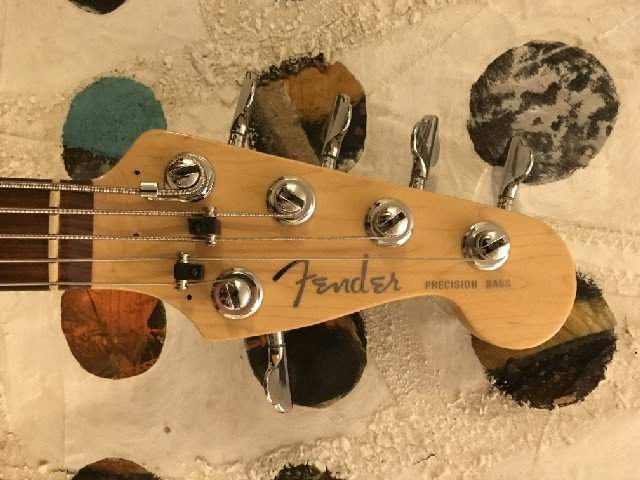
Another interesting thing in general which I think the OP is going after is the overall string balance of all 5 strings.
Pickup height and action adjustments will help the B and other strings quite a bit. Any bass off the shelf at a music store or even recently shipped from you from a fellow talkbass member is rarely ever perfect for everyone to play.
Sometimes there isn’t much you can do to improve the string balance or it can something simple like the bridge or neck bolts (if it is a bolt on) not being tightened.
Pickup height and action adjustments will help the B and other strings quite a bit. Any bass off the shelf at a music store or even recently shipped from you from a fellow talkbass member is rarely ever perfect for everyone to play.
Sometimes there isn’t much you can do to improve the string balance or it can something simple like the bridge or neck bolts (if it is a bolt on) not being tightened.
Great topic!
I've had a Fender American Standard P5. It had a good B string, but not great. Ed Friedland reviewed the bass and his assessment was the same as mine. It doesn't sound bad, but it just a little muddy and undefined. The average listener won't notice it.
I think the real issue is that some folks have never heard a really good B string. I've played mostly 5 strings for nearly a decade. I've owned Fender, Lakland, Reverend, Ibanez, Peavy, custom basses, etc. All of them sounded "good". But it wasn't until I played my first Dingwall that I said, "WOW! That's amazing!". The 37" B string combined with two pickups makes the B string have the same timbre as the rest of the strings.
At the end of the day, the best advice I can give you is play a 5 string P bass, and if you like the B on that particular bass, buy it. Different strings, nuts, bridges, string retainers, pickups, etc....all combine to influence how a string sounds. Even if you buy the same model bass, you may find it sounds different.
I've had a Fender American Standard P5. It had a good B string, but not great. Ed Friedland reviewed the bass and his assessment was the same as mine. It doesn't sound bad, but it just a little muddy and undefined. The average listener won't notice it.
I think the real issue is that some folks have never heard a really good B string. I've played mostly 5 strings for nearly a decade. I've owned Fender, Lakland, Reverend, Ibanez, Peavy, custom basses, etc. All of them sounded "good". But it wasn't until I played my first Dingwall that I said, "WOW! That's amazing!". The 37" B string combined with two pickups makes the B string have the same timbre as the rest of the strings.
At the end of the day, the best advice I can give you is play a 5 string P bass, and if you like the B on that particular bass, buy it. Different strings, nuts, bridges, string retainers, pickups, etc....all combine to influence how a string sounds. Even if you buy the same model bass, you may find it sounds different.
Great topic!
I've had a Fender American Standard P5. It had a good B string, but not great. Ed Friedland reviewed the bass and his assessment was the same as mine. It doesn't sound bad, but it just a little muddy and undefined. The average listener won't notice it.
I think the real issue is that some folks have never heard a really good B string. I've played mostly 5 strings for nearly a decade. I've owned Fender, Lakland, Reverend, Ibanez, Peavy, custom basses, etc. All of them sounded "good". But it wasn't until I played my first Dingwall that I said, "WOW! That's amazing!". The 37" B string combined with two pickups makes the B string have the same timbre as the rest of the strings.
At the end of the day, the best advice I can give you is play a 5 string P bass, and if you like the B on that particular bass, buy it. Different strings, nuts, bridges, string retainers, pickups, etc....all combine to influence how a string sounds. Even if you buy the same model bass, you may find it sounds different.
Great response man!
I echo all of it!
Latest posts
-
 NAD - Thrift Store Score – Genz Benz Shuttle 3.0 w/ 10" Docking Cab
- Latest: Kilroy Was Here
-

-

-

