• TalkBass has been independent since 1998. Add your voice.
    Create a free account to reply to discussions, view embedded media, and browse with fewer display ads.
    Join freeLog in
    Want zero display ads or expanded classifieds tools? Compare plans.

Fix for Kramer/Bean bowed aluminum necks - Paul Unkert!

I came to master luthier, Kramer/BC Rich builder Paul Unkert a couple weeks ago to see about straightening out the severely bowed neck on my beloved Kramer 350b bass. We all know, Paul’s the guy that can do this. But the only means for him to do so requires the dragging out and setup of an *extremely* heavy industrial vice like machine which is tucked away in his shop. It would take *several* able bodied (perhaps hulk like) individuals to do this, but not before he’d have to pretty much clear out his entire shop to make room. In short, a major logistical undertaking.

As we discussed it, Paul indicated that one job is not enough to warrant such an undertaking, but if there were enough aluminum neck guitar/bass owners in need of this fix, *and* we could get them all rounded up to make it worth while, he’d take a weekend, clear the shop, get the machine setup and do them all in one fell swoop so to speak.

SO, I know it’s a long shot and a logistical challenge in itself, but I’m beginning my quest to seek out other Kramer/Bean aluminum neck owners who need their necks straightened and see if we can’t organize a mass aluminum neck straightening weekend with Paul. Those of you around the country would of course have to ship yours to his shop in Tom’s River, NJ. Paul’s website was overtaken by hackers so his only online presence right now is a Facebook group started by friends and clients. I’m the one spearheading this quixotic endeavor with Paul’s approval (“if you can get enough to participate, I’ll do it.” So anyone out there (or if you know anyone) who wants to get their aluminum neck instrument back into service as much as I do and is interested in pursuing this you can PM me here. The quest begins!
 

Attachments

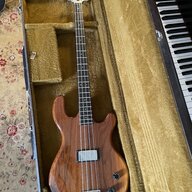
  • IMG_4419.jpeg
    IMG_4419.jpeg
    4.6 MB · Views: 148
I don't know. I acquired it like this. I had a '76 that was lost in a fire many years ago (only the neck remained amongst the ashes!). I loved that bass and decided a while back I wanted to find another. I found this one reasonably cheap because of the condition of the neck.
 
I am a Travis Bean TB2000 owner/player. I own a few basses and of those, the Bean is the only one where the neck does not change a bit with the seasons where I live. Bean necks are not ideal according to their design .... they have no relief and no radius .... flat as an aircraft carrier. So 1st position plays a little buzzy when you dig in and up above the 12th fret the action is a little higher than ideal. But after about 20 years of owning mine the neck has never moved, warped or twisted at all. I don't know how it could unless it was in a fire or run over by a truck. I suppose the rosewood fingerboard could warp, swell or twist, but I don't know what could cause that. under normal use.

On the Kramer aluminum necks there are wood inlays, right? Does the warping of that wood exert enough force/influence to warp or twist the aluminum?
I am asking this with respect .... not trying to argue with or challenge the existence of a warped aluminum neck. I just don't understand what could cause that, and have never heard nor read about this on this forum or anywhere else, until this post. I am interested to learn more and will follow this thread.

 
Last edited:
  • Like
Reactions: Jeff Scott
You're not going to believe this but...

I had a Kramer DMZ-Stagemaster Imperial bass with a neck that had bowed. I took it to a luthier (in Omaha, Nebraska) who used to work at the Kramer factory in New Jersey. He had a look at my neck from a few angles, did a measurement or two and then set the bass neck across two chairs. The next thing I know he climbed up and stood/bounced on the middle of the neck!!!! I couldn't believe my eyes!!

I remember him telling me that was the way they'd straighten the necks that arrived out of specs at the Neptune factory. I wouldn't have had the guts to bend my neck by bouncing on it, but I have to admit, my bass played perfectly from that day onwards.


Speaking of that bass... if anyone happens to come across a teal green DMZ Stagemaster Imperial bass with a factory installed Kahler tremelo tailpiece, I would LOVE to have that bass back.
 
You're not going to believe this but...

I had a Kramer DMZ-Stagemaster Imperial bass with a neck that had bowed. I took it to a luthier (in Omaha, Nebraska) who used to work at the Kramer factory in New Jersey. He had a look at my neck from a few angles, did a measurement or two and then set the bass neck across two chairs. The next thing I know he climbed up and stood/bounced on the middle of the neck!!!! I couldn't believe my eyes!!
I am surprised that he didn't ask you to go sit in the waiting room while he performed the surgery. :eyebrow:
 
Pressure & time.
Aluminum is alike a lot of materials, where it has a linear region - if you apply stresses below a certain threshold, and then take the stress off, it goes back to precisely where it was - the stress of strings on an aluminum bar of that cross section are pretty minor - that should not bow a neck ever. I had 2 Kramers with strings tensioned on them for over 30 years, and never did either of the necks budge one iota.

The fact that it takes a huge industrial press to straighten it should tell you that the force to get past the linear region is substantial. I have straightened wood necks with heat and force - the force applied through a regular C clamp (and nowhere near the force capacity of even that C clamp). Even though you can straighten a wood neck with that kind of force, most never warp under the force of string tension.
 
Just throwing this out there...

Are you sure that wasn't a polite way of saying he didn't want to do it?
"OK dear, if you really want me to take this trash out - you know I'll have to put down my beer, put some pants, socks and shoes on and get up off the sofa. No, that's totally fine if that's what you really want."
 
Those basses are so cool looking, but a buddy had one with the "Y" headstock, and had a hell of a time trying to keep a consistent setup, just the heat from your hand seemed to change it slightly, so he had constant tuning issues. Did he get a Lemon, or was that a problem inherent to the design? At any rate, worth fixing if you can get it done without exceeding the value of the bass.
 
Those basses are so cool looking, but a buddy had one with the "Y" headstock, and had a hell of a time trying to keep a consistent setup, just the heat from your hand seemed to change it slightly, so he had constant tuning issues. Did he get a Lemon, or was that a problem inherent to the design?
My experience says that's how those aluminum-necked basses "work".

Kramer 350B-800_0766.jpg
 
  • Like
Reactions: Boot Soul
Those basses are so cool looking, but a buddy had one with the "Y" headstock, and had a hell of a time trying to keep a consistent setup, just the heat from your hand seemed to change it slightly, so he had constant tuning issues. Did he get a Lemon, or was that a problem inherent to the design? At any rate, worth fixing if you can get it done without exceeding the value of the bass.

Yes, you're right. If the temperatures are somewhat chilly the neck will change slightly once your hand warms up the aluminum. On the other hand, the aluminum neck doesn't suffer from changes in humidity as a wooden neck does. The same goes for the fretboard. Where rosewood or ebony can shrink and crack or cause fret sprout, the ebanol fretboards on Kramers remains steady.

The biggest issue I found with aluminum neck Kramers is the weight. On average, they're relatively heavy basses and can sometimes suffer from neck dive. I didn't mind this when I was a young buck stud, but now that I'm a wretched old geezer I prefer to play four-set gigs with a light bass..
 
  • Like
Reactions: Gilmourisgod
You're not going to believe this but...

I had a Kramer DMZ-Stagemaster Imperial bass with a neck that had bowed. I took it to a luthier (in Omaha, Nebraska) who used to work at the Kramer factory in New Jersey. He had a look at my neck from a few angles, did a measurement or two and then set the bass neck across two chairs. The next thing I know he climbed up and stood/bounced on the middle of the neck!!!! I couldn't believe my eyes!!

I remember him telling me that was the way they'd straighten the necks that arrived out of specs at the Neptune factory. I wouldn't have had the guts to bend my neck by bouncing on it, but I have to admit, my bass played perfectly from that day onwards.


Speaking of that bass... if anyone happens to come across a teal green DMZ Stagemaster Imperial bass with a factory installed Kahler tremelo tailpiece, I would LOVE to have that bass back.
Yeah, Paul talked about doing that too. Back in the Kramer factory. But, he said it is neither as dependable or accurate as using the machine.
 
BTW, just as an update: I’ve already had four respondents who have expressed a keen interest in doing this and asked me to please keep them in the loop. So I think it’s a good start. The question everybody keeps asking is what the fee is going to be. I’ve been explaining that I wanted to see what kind of response I got first before I went back to Paul and we really started working on details. - fees, logistics, etc. . But next time I talk to him, I’ll ask him about the fees and post it here.
 
This can be done in a simple fabrication shop with a arbor press. Most heat treatment shops have a experienced employees that straighten out much tougher materials easily
I did just this for a long time in a machine shop. I don’t work in that shop anymore, but I just straightened out a piece of steel yesterday that got damaged in shipping with clamps and a steel table. I feel like an aluminum bass neck shouldn’t require too much more in the way of equipment. At work, I did most of my work on CRS with a six ton hydraulic press. A 1”x2” aluminum billet shouldn’t need nearly that much force (depending on the alloy, of course). My biggest concern would be damaging the fretboard or wood inserts on the backside. The hard part of stress relieving steel is managing overbends and counter- bends. Aluminum doesn’t present these problems. I’m glad you have found enough owners to make a run doable. Good luck!
 
UPDATE:
OK so here we go. I talked to Paul this morning. His launch number to do this is 6 or more participants. once we have enough, we'll set a target date and he'll rearrange the shop and get his gigantipithicus arbor press (MotorCityMinion;)) setup over a weekend. The fee will be $100 per neck to include straightening the neck, dressing frets, set up, etc.. He recommends everyone buy new strings and bring (or send if shipping) with the bass/guitar. I think 100 bucks is incredibly generous (I'd pay considerably more to get this done and have mine back in regular usage)! Obviously it'll be more for those who have to ship but if you're as enthusiastic about this as I am... .

I already have 4 respondents that are interested in moving forward with this including myself, so we only need 2 more, so I'm really hoping there are a few more of you out there who want to take advantage of this. Please spread the word!

Its funny, when I first decided to initiate this, I thought, yeah this'll probably go nowhere, but there's been enough of a response on all platforms that even Paul was surprised and started talking about the possibilities of doing a YT video about the whole thing lol. We'll see. Fingers crossed and thanks everyone for the responses. Keep you posted!
 
  • Like
Reactions: WRM and Bob_Ross

Latest posts